

The Supreme Court has quashed a dowry death case against a man whose wife died by suicide in Toronto, Canada. The Court held that calling her “stupid” and “useless” may reflect the husband’s temperament but does not amount to cruelty or criminal intimidation.
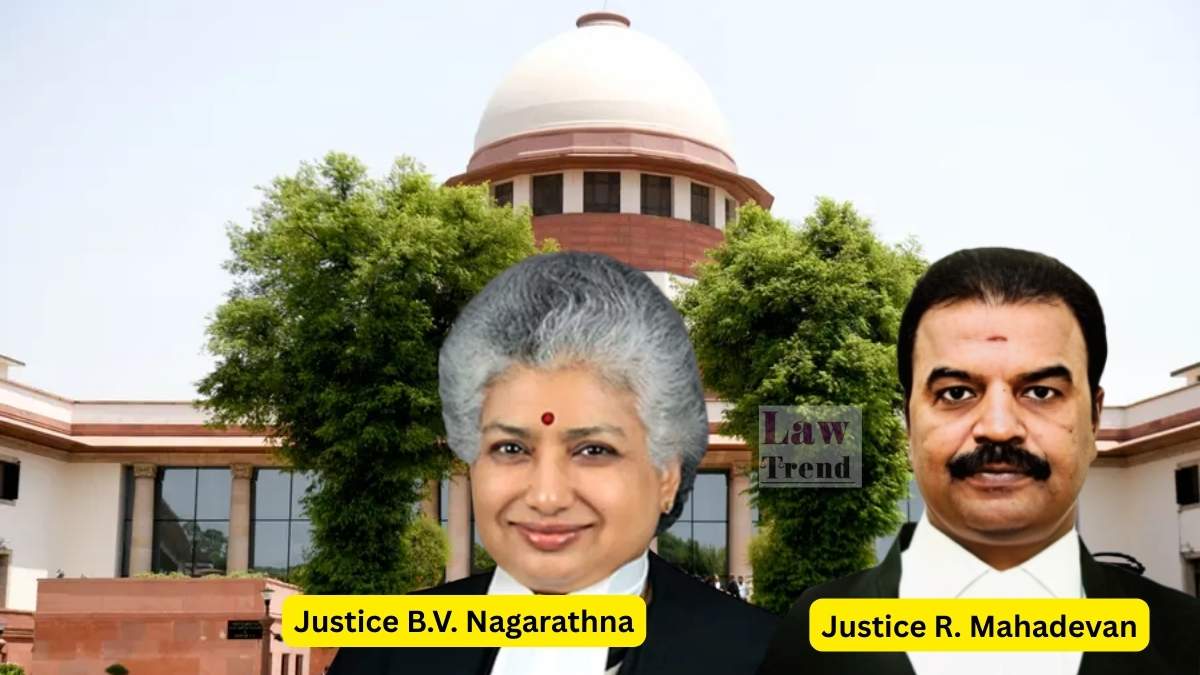
A Bench of Justice B.V. Nagarathna and Justice Manmohan set aside a Bombay High Court order that had refused to quash the FIR against the husband, Piyush Narlawar. The Court found no nexus between the allegations and the woman’s death.
Background
The appellant married the deceased on January 3, 2021, and the couple moved to Toronto in February 2022. On June 11, 2023, she died after jumping from the 22nd floor of their apartment. A handwritten suicide note recovered from the flat said she felt she had failed in life because she had been unable to find a job for over a year.
Her father lodged an FIR at Satara Police Station, Aurangabad, on June 30, 2023, under Sections 304B, 323, 498A and 504 read with Section 34 IPC and Sections 3 and 4 of the Dowry Prohibition Act. He alleged dowry demands of 15 tolas of gold before the marriage, gold ornaments on the first Diwali, ₹1,00,000 from the deceased’s brother, and verbal abuse.
The coroner’s report and the Toronto Police closure report found no signs of struggle or foul play. The police also found that the handwriting in the note matched the deceased’s and that CCTV footage showed the husband arriving about half an hour after the incident.
The Bombay High Court, Aurangabad Bench, quashed the FIR against the husband’s parents and sister but refused relief to him. A chargesheet was later filed, and non-bailable warrants were issued against him on February 4, 2025. On August 11, 2025, the Supreme Court directed that no coercive steps be taken against him.
Arguments
Counsel for the appellant argued that the allegations were vague and that the suicide note, the coroner’s report and the Toronto Police report showed no foul play. Counsel also submitted that the appellant had made the deceased his nominee and had transferred money to her and her family.
Counsel for the State argued that the deceased was subjected to repeated mental and physical violence over dowry and that custodial interrogation was needed. The State also submitted that it was improbable that the deceased would ask for her organs to be donated after a fall from the 22nd floor. Counsel for the complainant contended that the Canadian reports were invalid because Canadian law has no provision equivalent to Section 304B IPC.
Court’s Findings
The Court noted that no dowry allegation was raised from the date of marriage until the death, and that the FIR was lodged only afterwards. It also pointed to the suicide note and observed, “Had there been even an iota of mental or physical agony caused by the unlawful demands of dowry by the appellant and his family, the same would, in the natural course, have found mention in the suicide note.”
The Bench held that the 15 tolas of gold were given to both the appellant and the deceased as a wedding gift and could not be construed as dowry. It said the Diwali gifts were plausibly exchanged as part of custom and tradition. It also found that the ₹1,00,000 transfer took place around the time the appellant booked the deceased’s flight to India, among multiple transactions between the two accounts.
On the allegations of verbal abuse, the Court said, “At best, it reflects on the temperament of the husband, but it cannot be given a criminal colour so grave as to become the reason for the suicide of his wife.” It added that “The term ‘cruelty’ cannot be established without specific instances of commission or omission.”
The Court described the proceedings as “an unfortunate instance of a father, grieving the bereavement of his daughter, searching for some semblance of reason as to why the deceased took such a drastic step to commit suicide.” Relying on State of Haryana v. Bhajan Lal, it held that categories (1), (2), (3), (5) and (7) of paragraph 102 of that judgment squarely applied.
Outcome
The Supreme Court set aside the High Court’s order and quashed FIR No. 212/2023 and all consequent proceedings against the appellant.
Case Title: Piyush S/o Deepak Narlawar v. State of Maharashtra & Others
Case No.: Criminal Appeal arising out of SLP (Crl.) No. 12158 of 2025
Bench: Justice B.V. Nagarathna and Justice Manmohan
Date: 02.11.2026


