

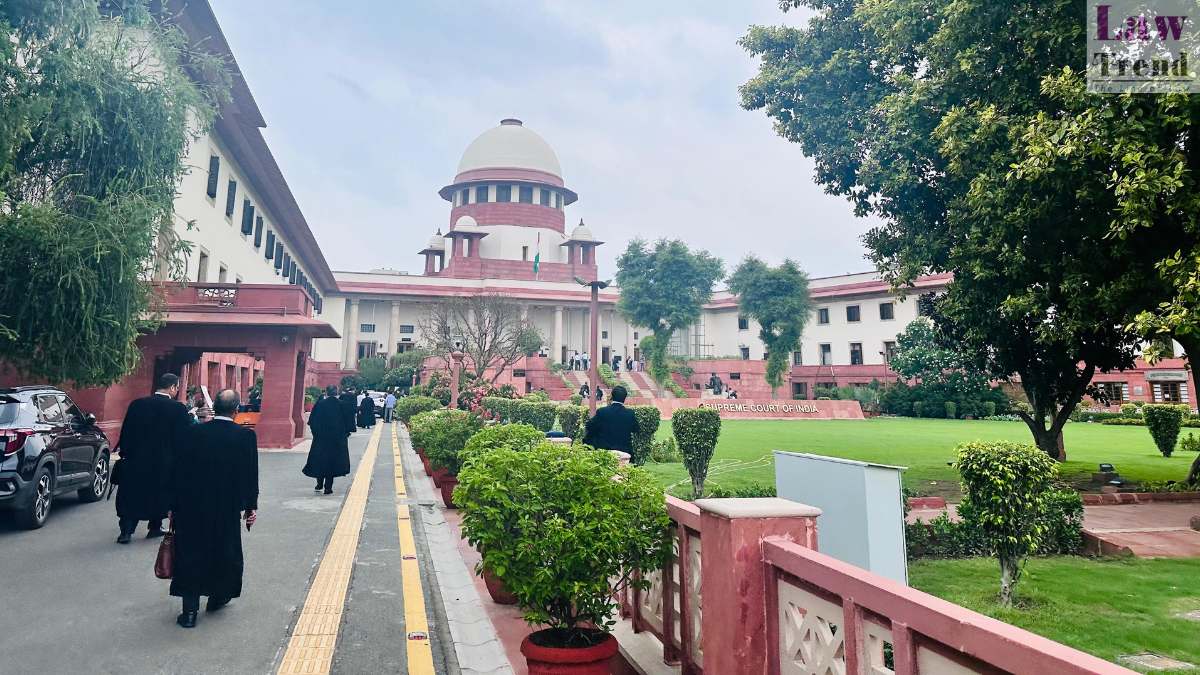
The Supreme Court has held that an acknowledgment of debt in a party’s balance sheets can extend the limitation period under Section 18 of the Limitation Act, 1963, even if the entry does not name the creditor. What matters is that the entry, read with the surrounding circumstances, shows a subsisting liability.
A Bench of Justice Vikram Nath, Justice Augustine George Masih and Justice Sandeep Mehta set aside an order of the Delhi High Court that had rejected a contractor’s money suit as barred by limitation. The Court revived the suit before the Trial Court.
Background
The original plaintiff, Wazir Hussain, filed a suit under Order XXXVII of the Code of Civil Procedure, 1908 (CPC) in 2014. He sought recovery of money due under a civil works contract dated 10 February 2000 with the defendant society, for construction of a multi-storey building in Mayur Vihar, Delhi.
Relying on running bills raised between 2000 and 2003, he claimed ₹11,16,000 along with interest of ₹11,04,840 calculated at 9% per annum. The society had also issued cheques in his favour, which were dishonoured.
The society applied under Order VII Rule 11 CPC to reject the plaint, arguing that the suit was time-barred. The Trial Court dismissed the application on 6 January 2020. It found that the outstanding amounts were reflected in the society’s balance sheets from 2004 to 2013, which amounted to acknowledgment of debt.
The Delhi High Court allowed the society’s revision petition on 4 November 2024 and rejected the plaint. It held that the bank statements did not establish any acknowledgment beyond 2005. It also held that the 31 March 2013 balance sheet did not indicate that the amount shown under sundry creditors was payable to the plaintiff. The plaintiff’s legal heir then appealed to the Supreme Court.
Arguments
The plaintiff’s side relied on the society’s balance sheet and bank reconciliation statements for 2004-05. The bank reconciliation statements recorded three cheques issued in favour of “Wazir Hussain Contractor”. It argued that the amount claimed formed part of the sum carried forward in later balance sheets under the head “Balances pertaining to 2004-05”. This, it said, amounted to an acknowledgment of liability from 2005 onwards.
The society contended that a time-barred debt cannot be revived indefinitely, particularly when no application for condonation of delay had been filed.
Supreme Court on Balance Sheets and Section 18 Limitation Act
The Court framed the limited question as whether, given the balance sheet entries up to 2013, the suit could have been rejected at the threshold as time-barred.
It referred to Asset Reconstruction Company (India) Ltd. v. Bishal Jaiswal, where a three-judge Bench held that balance sheet entries may constitute an acknowledgment under Section 18. That decision added a caveat: such entries must be read in the context of the balance sheet as a whole. The Court also referred to Axis Bank Ltd. v. Naren Sheth, which reiterated the same principle.
The Court held:
“Section 18 of the Limitation Act does not require that an acknowledgment be made to the name of the creditor specifically or be drawn up using a fixed format, so long as it acknowledges a subsisting liability.”
It found that, on the facts, the surrounding circumstances supported the plaintiff’s claim that a liability existed and was carried forward in the society’s own balance sheets up to 2013, “renewing the limitation period every year.”
No Mini-Trial at Order VII Rule 11 Stage
The Bench clarified that the entries do not conclusively establish that the entire amount claimed is owed. How the cheques, the amounts carried forward and the sum claimed relate to each other must be tested in evidence at trial. It observed:
“At the stage of considering an application under Order VII Rule 11 CPC, the Court ought not to have gone into the depths of evidence and conclusively determined the non-existence of liability.”
The Court rejected the society’s argument on condonation. It held that since the entries constituted an acknowledgment under Section 18, a fresh limitation period would run automatically from each subsequent date of acknowledgment. No application for condonation of delay was therefore required.
Outcome
Holding that the High Court erred in rejecting the plaint, the Supreme Court set aside the order dated 4 November 2024 and allowed the appeal. The suit was revived on the file of the Trial Court, with all questions on the merits of the claim left open.
Case Title: Yusuf v. Vigyapan Loke Delhi Advertising CGHS Ltd.
Case No.: Civil Appeal arising out of SLP(C) No. 30778 of 2024
Bench: Justice Vikram Nath, Justice Augustine George Masih and Justice Sandeep Mehta
Date: 6 November 2026


