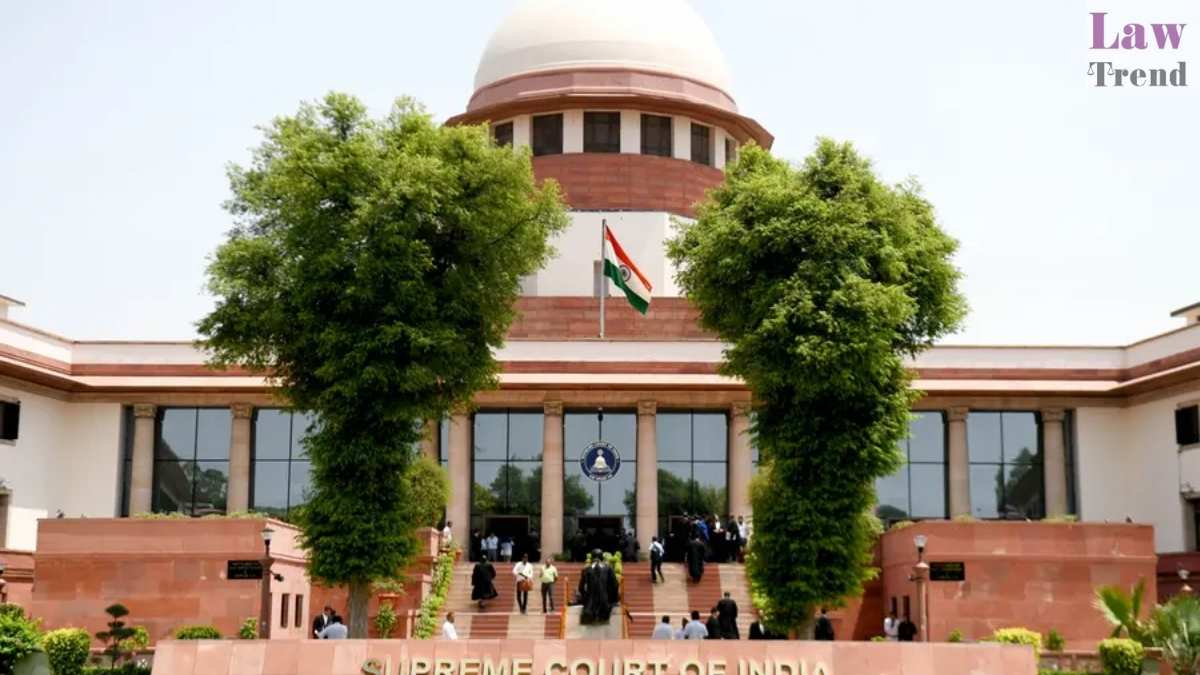
The Supreme Court of India, in a bench comprising Justice R. Mahadevan and Justice Manmohan, held that statutory additions under the Land Acquisition Act, 1894—including additional amounts under Section 23(1-A), solatium under Section 23(2), and statutory interest under Section 28—are integral and inseparable components of the total compensation awarded for compulsory acquisition. Consequently, the Court ruled that an appeal filed under Section 54 of the 1894 Act challenging or seeking the exclusion of these statutory benefits is an appeal relating to compensation, which attracts ad valorem court fee under Section 8 of the Court Fees Act, 1870, rather than a fixed court fee.
Background of the Case
The matter originated from land acquisition proceedings initiated by the State Government of Uttar Pradesh (now in Uttarakhand) through a notification dated March 7, 1992, issued under Section 4 of the Land Acquisition Act, 1894. The acquisition pertained to land situated at Banjarawala Mafi, Dehradun, for the rehabilitation of Tehri Dam oustees. Possession of the land was taken on January 29, 1996, and the Special Land Acquisition Officer passed an award on December 3, 1997.
Dissatisfied with the award, the respondent landowners sought a reference under Section 18 of the Act, contending that compensation had been awarded for only 29.43 acres out of 31.18 acres acquired, and claiming statutory benefits. On November 24, 2008, the District Judge, Dehradun (Reference Court) rejected the claim for enhancement regarding the remaining 1.75 acres but held that the landowners were entitled to statutory benefits under the Act. These included an additional amount at the rate of 12% per annum on the agreed compensation from the date of notification till the date of award or taking possession (whichever was earlier), solatium at 30%, and statutory interest at 9% per annum for the first year and 15% per annum thereafter from the date of taking possession till payment.
Challenging only the grant of these statutory benefits (valued at Rs. 2,34,03,602.05), Tehri Hydro Development Corporation Ltd. preferred First Appeal No. 33 of 2009 before the High Court of Uttarakhand at Nainital under Section 54 of the Act. The appellant paid a fixed court fee of Rs. 10/-, on the premise that the appeal did not challenge the determination or market value of compensation. While the Stamp Reporter initially reported the court fee as sufficient, the High Court subsequently reconsidered the matter and, by judgment dated October 25, 2017, directed the appellant to pay ad valorem court fee on the decreetal amount of Rs. 2,34,03,602.05 within two weeks. Aggrieved by this direction, the appellant approached the Supreme Court.
Arguments of the Parties
The learned counsel for the appellant submitted that the grant of solatium and other statutory benefits does not constitute a fresh determination or enhancement of compensation by the Reference Court. It was argued that “determination of compensation” involves an adjudicatory exercise evaluating market value under Section 23(1), whereas benefits under Sections 23(1-A), 23(2), 28, and 34 are statutory incidents of acquisition that flow automatically once market value is fixed. The appellant contended that Section 8 of the Court Fees Act applies only when an appeal challenges an enhancement or re-determination of market value. Since the market value had been settled by mutual agreement and was uncontested, the appeal was restricted purely to the legal entitlement to statutory benefits. In support, the appellant relied on State of Gujarat v. Gujarat Revenue Tribunal, Union of India v. Shri Ram Mehar, Sunder v. Union of India, the Full Bench judgment of the Andhra Pradesh High Court in Kesireddi Appala Swamy v. Special Tahsildar, and the Madras High Court judgment in Moulvi Abun Naser Khuthubuddin Syed Shah Mohammed Rakher Khadiri v. Special Tahsildar, while distinguishing Indore Development Authority v. Tarak Singh.
Conversely, learned senior counsel for the respondents contended that the award of the Reference Court is deemed to be a decree under Section 26(2) of the Code of Civil Procedure, 1908. An appeal under Section 54 seeking to avoid or reduce that decree necessarily attracts Section 8 of the Court Fees Act. Relying on the Constitution Bench judgment in Sunder v. Union of India and Indore Development Authority v. Tarak Singh, the respondents argued that statutory additions cannot be compartmentalized or severed from the award, as all components under Section 23 collectively constitute the total compensation. The respondents also pointed to State of Haryana v. Kailashwati and the Uttarakhand High Court’s ruling in Power Grid Corporation of India Ltd v. Gurbachan Singh (against which an SLP was dismissed by the Supreme Court) to assert that ad valorem court fee was mandatory.
Court’s Analysis and Legal Reasoning
The Supreme Court examined the interplay between Section 8 of the Court Fees Act, 1870, and Sections 23, 26, 28, 34, and 54 of the Land Acquisition Act, 1894. The Court emphasized that Section 8 of the Court Fees Act is a special provision mandating that court fee on a memorandum of appeal against an order relating to compensation shall be computed based on the difference between the amount awarded and the amount claimed. The provision does not distinguish between different components of compensation.
Analyzing previous jurisprudence, the Court referenced Narain Das Jain v. Agra Nagar Mahapalika, observing that solatium is an intrinsic component of compensation:
“Solatium, as the word goes, is ‘money comfort’, quantified by the statute, and given as a conciliatory measure for the compulsory acquisition of the land of the citizen, by a welfare State such as ours.”
The Court further noted from Narain Das Jain that solatium “springs up spontaneously as a part of the statutory growth on the determination and emergence of market value of the land acquired.”
The Bench highlighted the Constitution Bench ruling in Sunder v. Union of India, which established that the expression “compensation” encompasses the market value under Section 23(1), the additional amount under Section 23(1-A), solatium under Section 23(2), and statutory interest under Sections 28 and 34. Quoting Sunder, the Court reaffirmed:
“What the legislature intended was to make the aggregate amount under Section 23 of the Act to reach the hands of the person as and when the award is passed, at any rate as soon as he is deprived of the possession of his land. Any delay in making payment of the said sum should enable the party to have interest on the said sum until he receives the payment. Splitting up the compensation into different components for the purpose of payment of interest under Section 34 was not in the contemplation of the legislature when that section was framed or enacted.”
The Bench also noted the affirmation of this indivisible character of compensation in Gurpreet Singh v. Union of India, Shree Vijay Cotton & Oil Mills Ltd v. State of Gujarat, and Periyar & Pareekanni Rubbers Ltd v. State of Kerala.
Addressing the core procedural issue, the Supreme Court held that since an award under Section 26(2) of the 1894 Act is deemed to be a decree, an appeal under Section 54 challenging any component of that decree is an appeal against the decree determining compensation itself. Relying on Indore Development Authority v. Tarak Singh, the Bench observed that when an acquiring authority seeks to avoid or reduce the decretal amount:
“when the appellant seeks to avoid the decree, which is made by the reference Court, it must be construed that the appellant is seeking to avoid the amount of higher compensation determined by the reference Court, as claimed by the land owners. Therefore, the appellant is required to pay the Court fee on the memorandum of appeal to the extent on which the appellant seeks to avoid the higher compensation awarded by the reference Court under the Central Act.”
The Court clarified that earlier decisions of High Courts in Kesireddi Appala Swamy and Moulvi Abun Naser, which treated statutory benefits as independent of compensation, were rendered prior to Indore Development Authority, Sunder, and Gurpreet Singh, and can no longer be treated as good law.
On fiscal interpretation, the Supreme Court stated that court fee statutes must be strictly construed and there is no estoppel against a statute. Erroneous initial acceptance of a deficient court fee by the Registry does not create a vested right. Citing Vinod Infra Developers Ltd. v. Mahaveer Lunia and Manjula v. D.A. Srinivas, the Court observed that litigants must be given a reasonable opportunity to make good any court fee deficit. The Bench also remarked that unlike States like Maharashtra and Haryana—which passed specific legislative amendments exempting statutory benefits or prescribing fixed fees—the State of Uttarakhand has no such amendment, meaning the unamended text of Section 8 of the Court Fees Act applies in full.
Decision of the Court
Concluding the analysis, the Supreme Court laid down the explicit legal finding:
“the additional amount under Section 23(1-A), solatium under Section 23(2) and statutory interest under Section 28 constitute integral and inseparable components of the compensation awarded under the Land Acquisition Act, 1894.”
Holding that an appeal under Section 54 seeking to eliminate or reduce any of these statutory components attracts ad valorem court fee under Section 8 of the Court Fees Act, the Supreme Court found no error in the High Court’s judgment and dismissed the Civil Appeal.
Since the appellant had already deposited the deficit court fee before the High Court pursuant to the Supreme Court’s interim order dated February 12, 2018, the Supreme Court directed that the deposited amount in fixed deposit be transferred to the account of the High Court, and instructed the High Court to proceed with the hearing of the First Appeal on merits in accordance with law.
Case Details:
Case Title: Tehri Hydro Development Corporation Ltd. v. S.P. Singh & Ors.
Case No.: Civil Appeal No. 3454 of 2019
Bench: Justice R. Mahadevan and Justice Manmohan
Date: July 31, 2026