

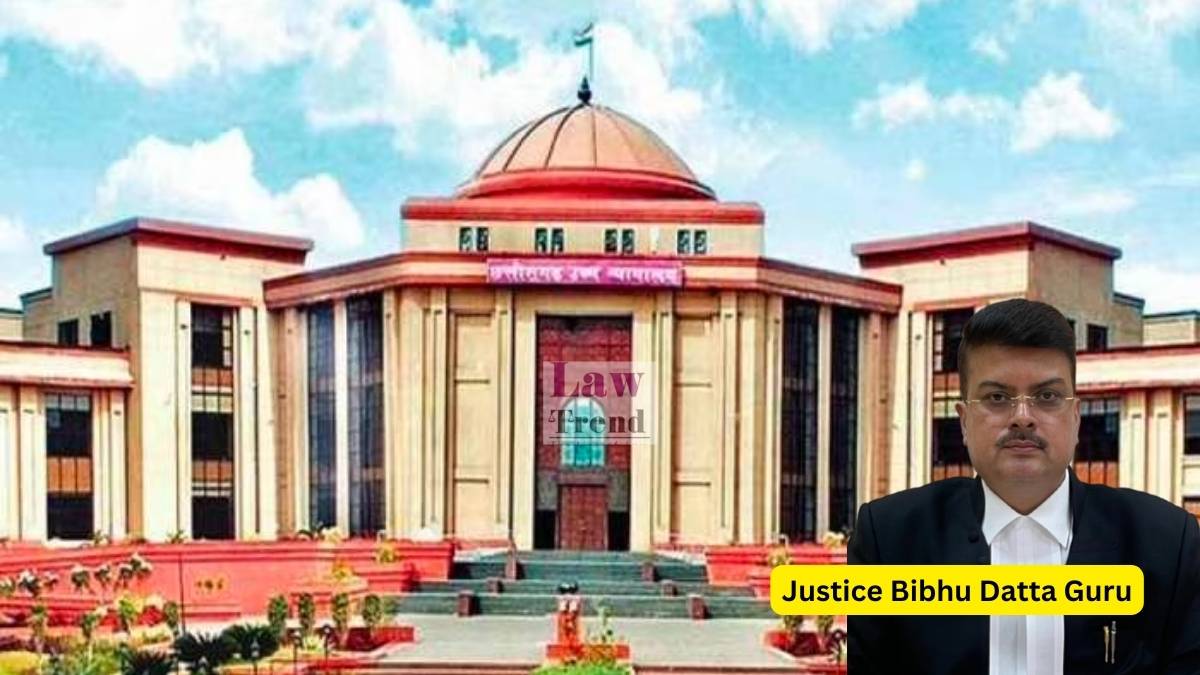
The High Court of Chhattisgarh, in a ruling delivered by Justice Bibhu Datta Guru, held that seniority by itself does not confer an indefeasible right upon an employee to hold the current charge of a higher post. The Court rendered this judgment while dismissing a writ petition filed by a Block Education Officer who challenged an order entrusting the current charge of In-Charge District Education Officer (DEO), Gariyaband, to a junior officer.

Background of the Case
The petitioner, Kishun Lal Matawale, who has been serving in the Education Department since 1995 and is currently posted as Block Education Officer, Chhura, challenged the order dated June 10, 2026, issued by the Secretary, School Education Department. Under the impugned order, current charge of the post of District Education Officer, Gariyaband, was assigned to respondent No. 5, Rajesh Chandrakar.
The petitioner asserted that under the Chhattisgarh School Education Services (Educational and Administrative Cadre) Recruitment and Promotion Rules, 2026, he fulfilled the requisite qualifying service and held extensive experience as a Principal and Block Education Officer, making him senior and eligible for the position. He submitted that despite filing a representation on July 20, 2026, no corrective action was taken by the competent authorities.
Arguments Before the Court
Senior Advocate Ms. Hamida Siddiqui, appearing for the petitioner, contended that entrusting the current charge to respondent No. 5—who was promoted to the post of Principal only in April 2025—violated executive instructions and impermissibly overlooked the petitioner’s seniority without any legal justification.
Opposing the petition, Additional Advocate General Mr. Gary Mukhopadhyay, representing the State, submitted that the petitioner substantively holds the post of Principal and is merely discharging duties as In-Charge BEO, which does not confer any legal right to claim the higher charge of DEO based on seniority.
The State counsel placed reliance on a official communication dated June 6, 2025, from the Collector, Gariyaband, which recorded that the petitioner had acted in disregard of government rules and exhibited gross negligence in performing official duties. The Collector noted that such conduct violated the Chhattisgarh Civil Services (Conduct) Rules, 1965, regarding integrity and devotion to duty, and had recommended initiation of strict disciplinary proceedings, including suspension and a departmental enquiry. Senior Advocate Mr. Mateen Siddiqui, appearing for respondent No. 5, aligned with the State’s contentions and prayed for dismissal of the writ petition.
Court’s Analysis
Upon evaluating the records, the High Court observed that the petitioner failed to point out any statutory provision or binding rule establishing that seniority automatically entitles an officer to receive charge of a higher post. The Court noted that entrustment of current charge is an administrative stopgap arrangement.
Addressing the weight of seniority, the Court observed:
“Seniority by itself does not confer an indefeasible right upon an employee to hold the charge of a higher post. Mere seniority, in absence of any statutory provision creating such a right, cannot be the sole determining factor for entrustment of current charge.”
Regarding the adverse communication issued by the Collector, Gariyaband, the Bench noted that while it was not a final finding of misconduct, it formed a relevant administrative circumstance for the competent authority to assess an officer’s suitability for a higher administrative responsibility.
Elaborating on the criteria for administrative entrustment, the Court held:
“Seniority alone is not sufficient to claim the charge of a higher post. Entrustment of current charge involves consideration of the overall suitability, experience, administrative requirements and other relevant circumstances by the competent authority. Seniority cannot be treated as an automatic substitute for suitability, nor can it be said that a senior employee has an absolute right to supersede every other eligible employee for being entrusted with the current charge of a higher post.”
The Court further clarified the limits of judicial review in such matters:
“In absence of any statutory violation, arbitrariness or mala fide being established, this Court, in exercise of its writ jurisdiction, would not substitute its own assessment for that of the competent authority.”
Decision
Holding that there was no illegality, arbitrariness, or perversity in the order dated June 10, 2026, the High Court concluded that no ground was established for intervention under Article 226 of the Constitution of India and dismissed the writ petition.
Case Title: Kishun Lal Matawale v. State Of Chhattisgarh and Others
Case No.: WPS No. 5810 of 2026
Bench: Justice Bibhu Datta Guru
Date: 11.08.2026


