

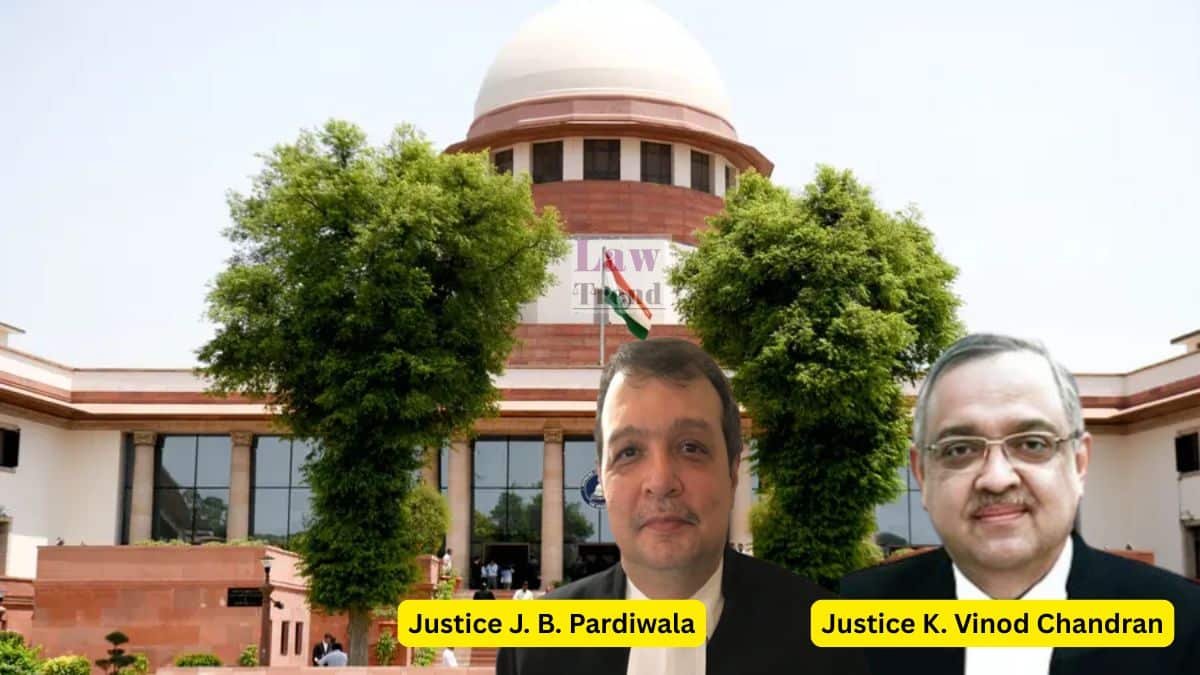
The Supreme Court has held that the bar under Section 96(3) of the Code of Civil Procedure, 1908 (CPC), on appeals against consent decrees, read with Order XXIII Rules 3 and 3A, applies only to the parties to the compromise. A person who was a stranger to the suit can seek leave to appeal if the decree prejudicially affects his rights. A Bench of Justice J.B. Pardiwala and Justice K. Vinod Chandran dismissed appeals against Gujarat High Court orders that granted leave to appeal to non-parties, condoned an 11-year delay and restrained the appellant from dealing with the disputed land.
Background
In 1975, Purshottambhai Punjabhai sold the land to Vikram Punjabhai Palkhiwala through a registered sale deed. Respondent Nos. 1 to 9, members of the family HUF, claim the land through him.
In 1996, the heirs of the original seller executed an agreement to sell the same land in favour of Geetagram Cooperative Housing Society. The society filed a suit for specific performance in 2012. The suit ended in a consent decree on April 29, 2013. In 2022, a Court Commissioner executed a sale deed under that decree in favour of the appellant, Girishbhai Natwarlal Patel, with the society as confirming party.
Respondent Nos. 1 to 9 say they found the appellant’s name in the revenue records in 2023. In February 2024, they challenged the consent decree before the High Court, alleging fraud and collusion. The High Court granted them an ex parte ad interim injunction against the appellant on April 2, 2024. On August 14, 2024, it confirmed the injunction, condoned the 11-year delay and granted leave to appeal.
Arguments
Senior Counsel Anshin H. Desai, appearing for the appellant, argued that no appeal lies against a consent decree under Section 96 of the CPC. He submitted that a non-party to the compromise cannot get a cause of action to challenge it, relying on Triloki Nath Singh, Pushpa Devi Bhagat and R. Janakiammal. He also contended that the injunction rested on a draft amendment, that the delay was condoned mechanically, and that the HUF, not its members, was the aggrieved party.
Senior Counsel Mihir J. Thakore and Megha Jani, appearing for Respondent Nos. 1 to 9, argued that the suit was collusive. They pointed out that the heirs of the seller had executed a power of attorney in favour of the appellant before the suit was filed, and that he had filed a vakalatnama on their behalf. They added that documents obtained under RTI showed he was the society’s Chairman in 2002-2003. They relied on H. Anjanappa v. A. Prabhakar.
Court’s Findings
The Court held that the statutory bar exists to prevent parties who consented to a decree from resiling from it. It observed: “The statutory bar, however, cannot be mechanically invoked to defeat the right of a person who was not a party to the compromise and who asserts an independent legal interest prejudicially affected by the decree.”
Distinguishing Triloki Nath Singh, the Court noted that the appellant in that case traced his title through a party to the suit. Respondent Nos. 1 to 9, in contrast, were complete strangers who did not claim through any party. The Bench held: “A stranger to a compromise decree cannot be said to be barred under Section 96(3) read Order XXIII Rule 3 & Rule 3A of the CPC, 1908, since the scope and import of these provisions are limited to the parties to the compromise and act as an estoppel only with respect to them.”
The Court added a caution: “At the same time, non-party status does not confer an unrestricted right of appeal.” Such a person must show prima facie prejudice and obtain leave of the appellate court. The Court noted that the same principles apply as for an ordinary decree, and that “The fact that the decree in question is a consent decree neither dispenses with this requirement nor, in itself, constitutes a bar to the grant of leave.”
Applying the principles summarised in H. Anjanappa, the Court found that the respondents had asserted a legally cognisable interest that may be prejudicially affected by the decree.
On delay, the Court held that “it would be erroneous to proceed on the assumption that they had knowledge of the decree from the date of its passing”. It found that the record disclosed an explanation and steps taken by the respondents once they acquired information.
On the injunction, the Court noted that the appellant was later heard before the order was continued. It held that the continuation of the injunction “was thus not an automatic perpetuation of the ex parte order”.
Outcome
The Supreme Court dismissed the appeals. It clarified that its conclusions do not express any final opinion on title or on the allegations of fraud and collusion. It requested the Gujarat High Court to hear and dispose of the main appeal within three months.
Case Title: Girishbhai Natwarlal Patel v. Gautam Punjabhai Palkhiwala (Dead) by LRs & Ors.
Case No.: Civil Appeal Nos. 14017-14018 of 2026
Bench: Justice J.B. Pardiwala and Justice K. Vinod Chandran
Date: October 30, 2026


