

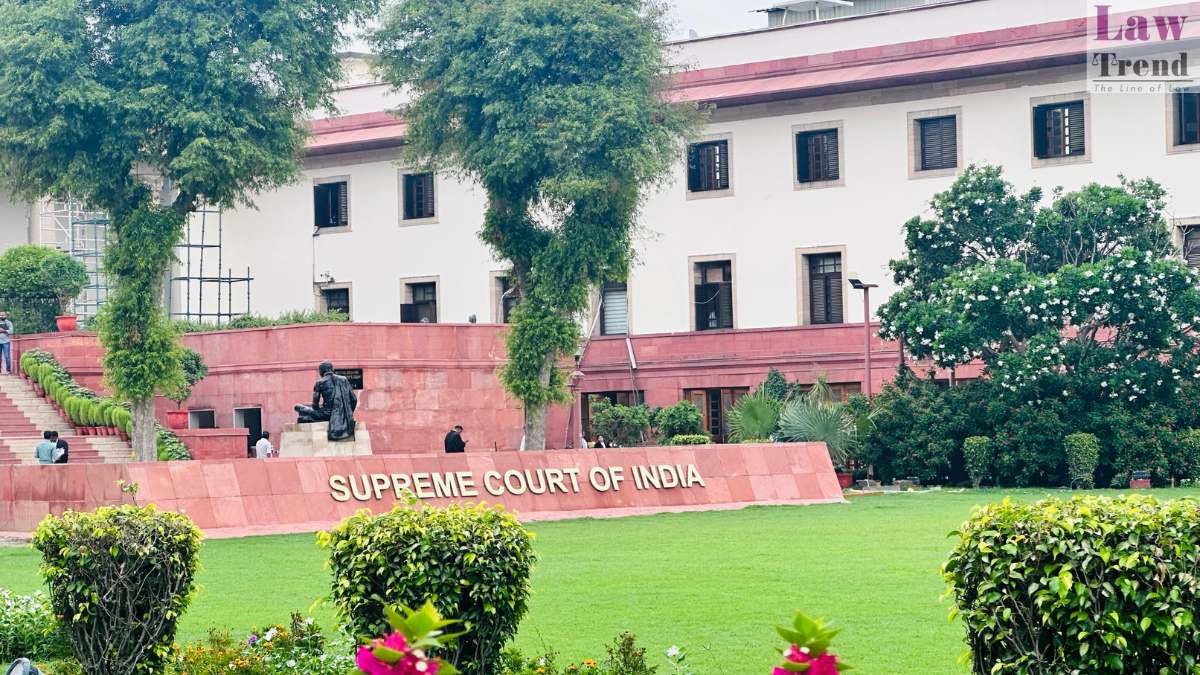
The Supreme Court on Monday expressed serious doubts over the maintainability of a writ petition filed by the Telangana government challenging Andhra Pradesh’s preparatory work on the proposed Polavaram–Banakacherla/Nallamalasagar Link Project (PBLP/PNLP), suggesting that the matter is more appropriately addressed through an original suit under Article 131 of the Constitution.
A bench led by Chief Justice of India Surya Kant, along with Justice Joymalya Bagchi, said that the core of the dispute involves an inter-state water issue — namely, the potential impact of Andhra Pradesh’s project on Telangana’s share of the Godavari river water — and that Article 131 offers a more suitable constitutional mechanism to resolve such disagreements between states.
“Ultimately, at the end of the day, it is a water dispute… and you apprehend that their project might affect your share of the Godavari water,” the bench told senior advocate Abhishek Manu Singhvi, appearing for Telangana.
The Telangana government had filed the writ petition under Article 32 of the Constitution, seeking directions to restrain Andhra Pradesh and its agencies from preparing a detailed project report, issuing tenders, or proceeding with the execution of the link project. The state contends that Andhra’s plans to divert surplus water from the Godavari to the Krishna basin — up to 200 TMC, as against the earlier sanctioned 80 TMC — threatens its lawful water share.
Singhvi argued that the Union government had already greenlit a high-powered committee to examine the project, and therefore the Supreme Court’s immediate intervention was warranted. “I have no other remedy to stop the committee from going into the issue,” he submitted, asserting that the ongoing activities were in violation of the Inter-State Water Disputes Act and the awards of the Godavari Water Disputes Tribunal (GWDT).
The bench, however, said that where the Constitution provides for a specific dispute resolution forum for inter-state conflicts, such as Article 131, writ petitions under Article 32 must be approached cautiously.
“Our issue is maintainability. If the constitutional scheme envisages a different remedy, should we not resort to that?” the CJI asked.
Appearing for Andhra Pradesh, senior advocate Mukul Rohatgi defended the state’s actions. He argued that preparing a project report aimed at addressing regional water scarcity does not require prior restraint.
“A report that we want for our state… how can there be an estoppel against that?” Rohatgi said, asserting that the proposed project was designed to serve public welfare by improving irrigation and addressing drought in Rayalaseema.
He also pointed out that the project was still in its preliminary stage and had not moved into execution.
Telangana has alleged in its petition that Andhra Pradesh is proceeding without mandatory approvals from the Central Water Commission and the Ministry of Jal Shakti, thereby bypassing the statutory safeguards put in place for inter-state water projects. The state also invoked the Andhra Pradesh Reorganisation Act, 2014, arguing that the current actions violate the principles of cooperative federalism and equitable resource sharing post-bifurcation.
Political tensions have also surfaced, with BRS leader T Harish Rao accusing the Andhra Pradesh government of securing Central approvals through political influence. Telangana irrigation minister N Uttam Kumar Reddy rejected the allegations, stating that the Revanth Reddy-led government was actively protecting the state’s interests.
After prolonged deliberations, the bench reiterated that an original suit under Article 131 would provide a more “comprehensive” legal avenue for Telangana to press its claims. Singhvi sought time to obtain instructions from the state government, particularly on two issues: whether the court could intervene to halt the high-powered committee’s proceedings, and whether Telangana would consider filing a suit under Article 131.
The court agreed to adjourn the matter for a week.
The Polavaram–Banakacherla Link Project is a proposed inter-basin transfer project that aims to move surplus water from the Godavari river at the Polavaram reservoir to drought-prone regions in Andhra’s Rayalaseema area. Telangana fears that the scale of the project — with up to 200 TMC of water proposed for diversion — exceeds past tribunal-sanctioned limits and may adversely impact its share of river waters.




