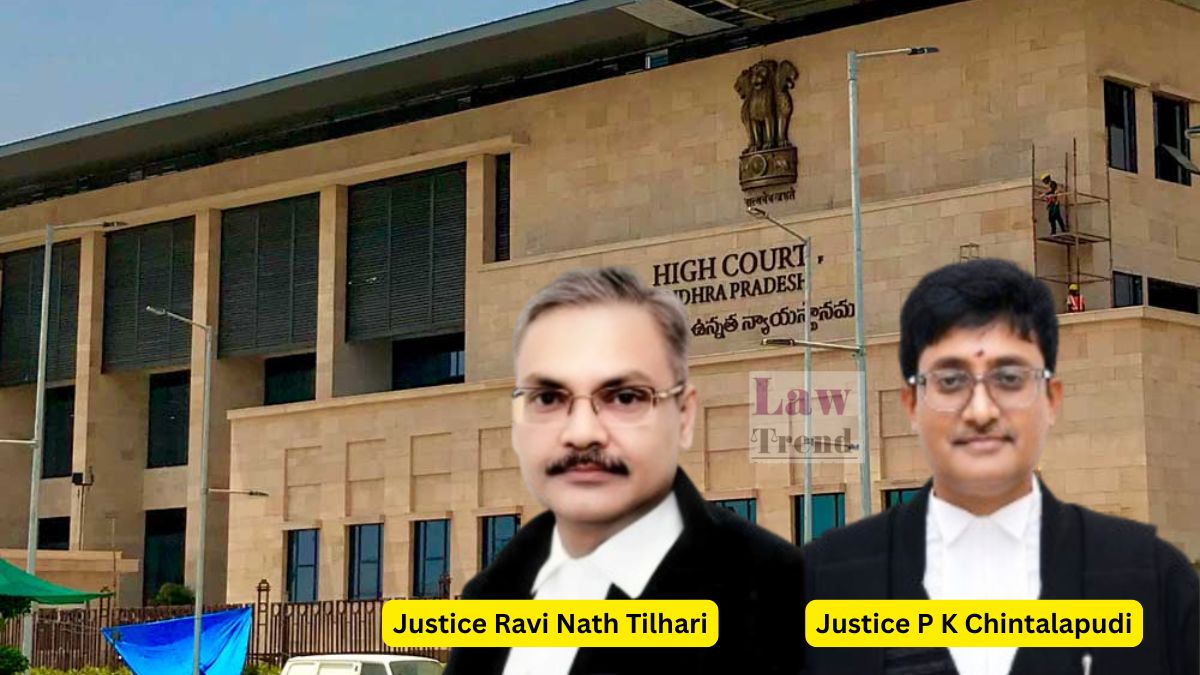
The High Court of Andhra Pradesh, comprising Justice Ravi Nath Tilhari and Justice Purushottam Kumar Chintalapudi, has ruled that even a minor deprivation of land for a public infrastructure project must strictly adhere to the procedure established by law under Article 300-A of the Constitution of India. Disposing of writ appeals concerning land acquisition for the E-3 Seed Access Road project in the capital region, the Division Bench directed the Single Judge to expeditiously decide the landowners’ interim relief application following the State’s counter-affidavit, while extending interim protection against dispossession to the appellants in one of the appeals until such determination.
Background of the Case
The dispute centers on land acquisition proceedings for the construction of the E-3 Seed Access Road, intended to provide road connectivity to the Capital City Region. Out of the total Ac.280.9956 required for the road alignment, the State Government obtained Ac.274.7416 through the Land Pooling Scheme (LPS), leaving a residual portion to be acquired under the Right to Fair Compensation and Transparency in Land Acquisition, Rehabilitation and Resettlement Act, 2013 (“the Act”).
On January 8, 2026, the State issued a preliminary notification under Section 11 of the Act for lands situated in Undavalli and Penumaka villages, Tadepalli Mandal, Guntur District. Landowners submitted preliminary objections, which were rejected by the District Collector-cum-Land Acquisition Officer on June 1, 2026. Subsequently, a declaration under Section 19(1) was published, followed by an award enquiry notice on June 12, 2026.
The landowners challenged the preliminary notification, rejection order, Section 19(1) declaration, and award enquiry notice in Writ Petition Nos. 17814 and 17813 of 2026, alleging non-compliance with statutory procedures under Sections 11, 16, 17, and 18 of the Act and apprehending forcible dispossession.
On July 3, 2026, the Single Judge declined to grant an interim stay on the acquisition, observing that “prima facie this Court is of the opinion it is not desirable in the public interest to interfere with ongoing acquisition proceedings at this stage.” The Single Judge further held that “all the legal submissions made above by the respective counsels require deeper examination and cannot be adjudicated at this interlocutory stage without filing of detailed counter affidavit,” while clarifying that “the acquisition proceedings and consequential award that may be passed shall be subject to final result in the Writ Petition.” Aggrieved by the refusal of interim relief, the landowners filed Writ Appeal Nos. 849 and 850 of 2026.
Arguments of the Parties
Senior Counsel Sri K.S. Murthy, representing the writ appellants, contended that the authorities were attempting to take forcible possession without following mandatory statutory procedures under the 2013 Act, violating Article 300-A. He pointed out an inconsistency between declarations: a prior declaration issued in 2018 for the same land noted that 16 families required rehabilitation and 329 families were affected, whereas the 2026 Form VII notification listed Project Displaced Families/Project Affected Families as “Nil” without implementing any Rehabilitation and Resettlement (R&R) scheme. Additionally, he argued that administrative sanction for the project was not obtained as mandated under Rule 3 and Form-I of the LA&RR Rules, 2014. The appellants placed reliance on Premji Nathu vs. State of Gujarat and another (2012) and Dhanjaya Reddy vs. State of Karnataka (2001) to argue that where a power is given to do a certain thing in a certain manner, it must be done in that way or not at all, and that affected landowners must be supplied copies of awards to exercise legal remedies under Section 18.
Advocate General Sri Dammalapati Srinivas, appearing for the State, submitted that the acquisition serves a vital public purpose under Section 2 of the Act by connecting the Capital City Region. He stated that after issuing the preliminary notification, an additional Ac.7.7768 was acquired via the LPS, leaving only Ac.2.725 cents to be acquired. The State highlighted a notification dated November 6, 2025, issued under Section 10(A) of the Act, which exempted capital region land acquisition from Social Impact Assessment and R&R requirements. The Advocate General informed the Court that an award was passed on July 10, 2026, and compensation cheques of Rs 85,64,361 and Rs 1,26,65,042 were prepared and deposited with the Land Acquisition Officer after the appellants refused receipt. The State relied on Dalpat Kumar and another vs. Prahlad Singh and others (1993), Kolkata Municipal Corporation and another vs. Bimal Kumar Shah and others (2024), Jayabheri Properties Private Limited and other vs. State of Andhra Pradesh and others (2010), and Estate Officer, Haryana Urban Development Authority and others vs. Nirmala Devi (2025) to argue that public interest projects should not be halted over minor residual land extents.
Court’s Analysis
During the appellate proceedings, the Division Bench observed that in Writ Appeal No. 850 of 2026, possession had already been taken to some extent and an award passed, leaving no surviving grievance regarding dispossession. In Writ Appeal No. 849 of 2026, interim protection regarding possession granted during the appeal remained in effect.
Addressing the legal standards governing property rights under Article 300-A of the Constitution, the Division Bench emphasized that procedural compliance is mandatory regardless of the size of the land parcel involved. The Court observed:
“No person can be deprived of the right to property save by authority of law. Deprivation of even a smaller portion of ones’ property has to be in accordance with law.”
The Court further elaborated on the scope of statutory compliance, stating:
“In accordance with law does not mean only by authority of law but also by following the procedure established by law.”
While acknowledging the balance between public interest and private property rights, the Bench held:
“It is no doubt true that in case of conflict between larger public interest and the interest of an individual, it is the larger public interest that should prevail and an individual interest should give way to the larger public interest, but the deprivation however small in the eyes of others cannot be, except in accordance with law.”
The Bench refrained from ruling on the ultimate merits of the statutory non-compliance claims, noting that doing so would affect the pending writ petitions that require examination after the State files its counter-affidavit.
Court Decision
The High Court disposed of Writ Appeal No. 849 of 2026 by directing the State respondents to file their counter-affidavit in the pending writ petition by the next scheduled date. It requested the Single Judge to consider and finally decide the interim relief application expeditiously within one week from the date of filing of the counter-affidavit. The Division Bench directed that the interim protection against dispossession granted in Writ Appeal No. 849 of 2026 shall continue solely for the appellants of that appeal until the Single Judge decides the interim application.
Regarding Writ Appeal No. 850 of 2026, the Court dismissed the appeal as withdrawn for appellant Singamsetti Anupama following her withdrawal memo. For the remaining appellants in Writ Appeal No. 850 of 2026, the appeal was disposed of without interfering with the Single Judge’s order, affirming that the acquisition proceedings and consequential award remain subject to the final result of the writ petition.
Case Title: Chodisetty Nirmalatha and Others v. The State of Andhra Pradesh and Others
Case No.: Writ Appeal Nos. 849 and 850 of 2026
Bench: Justice Ravi Nath Tilhari and Justice Purushottam Kumar Chintalapudi
Date: July 30, 2026