Public Prosecutor’s Extension Report Valid Even Without Annexing IO’s Report: Karnataka HC Denies Default Bail
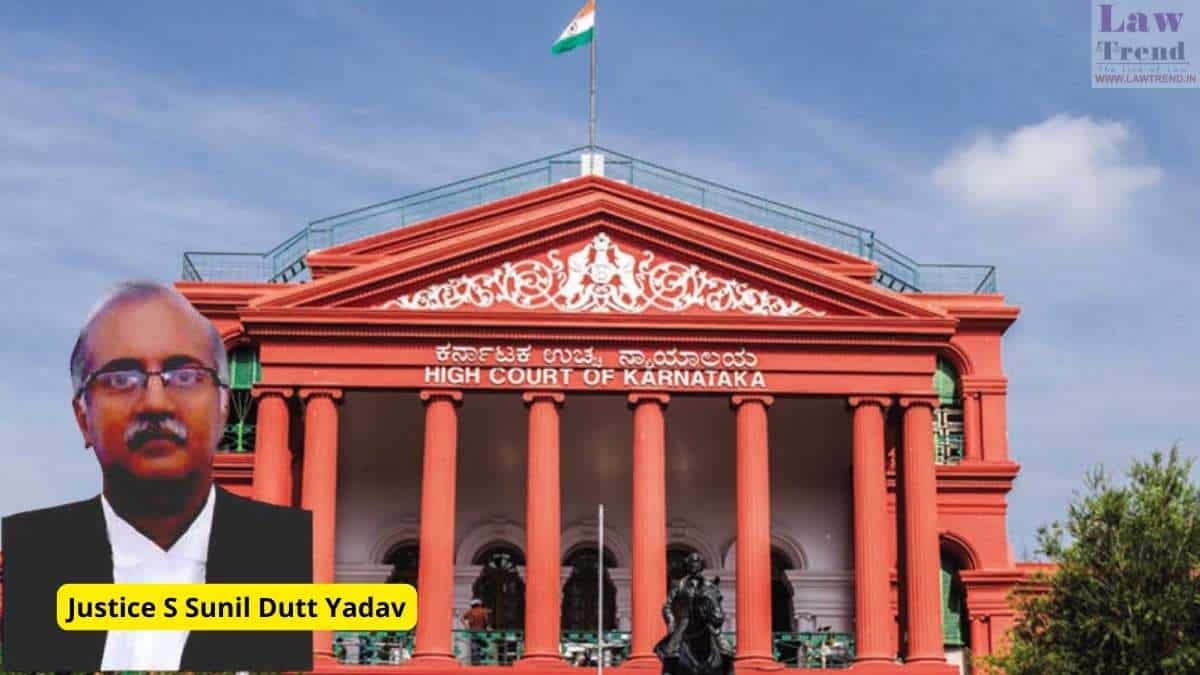

The High Court of Karnataka has dismissed a batch of criminal petitions challenging the extension of time granted to the prosecution to file a final report under the Karnataka Control of Organized Crimes Act, 2000 (KCOCA). The Court held that the report of the Public Prosecutor seeking an extension does not explicitly require the Investigating Officer’s report to be annexed, provided the Prosecutor’s report demonstrates an independent application of mind regarding the progress of the investigation and the specific reasons for the continued detention of the accused.

The High Court of Karnataka upheld the order of the LXXXI Additional City Civil and Sessions Judge, Bengaluru, which granted a 45-day extension to the Criminal Investigation Department (CID) to file a final report in a murder case involving charges under the Bharatiya Nyaya Sanhita (BNS), 2023, and KCOCA. Consequently, the High Court rejected the petitioners’ plea for default bail under Section 187(3) of the Bharatiya Nagarika Suraksha Sanhita (BNSS), 2023. The Court ruled that the Public Prosecutor had sufficiently applied his mind while seeking the extension and that the procedural requirements regarding the production of the accused were met.

Background of the Case

The case originates from Crime No. 73/2025, registered following a complaint filed on July 15, 2025, by Smt. Vijayalakshmi regarding the murder of her son. The State subsequently invoked provisions of the KCOCA against the accused, and the investigation was transferred to the CID.

On October 9, 2025, the Special Public Prosecutor filed an application under Section 22(2)(b) of the KCOCA seeking an extension of time to file the final report. Subsequently, on October 15, 2025, accused persons (Petitioners in Crl.P 15216/2025) filed an application seeking default bail, contending that the investigation report was not filed within the stipulated 90-day period.

The Trial Court, vide order dated October 17, 2025, allowed the prosecution’s request for an extension of 45 days and rejected the bail applications as infructuous. Aggrieved by this, the accused approached the High Court.

READ ALSO  [NI Act] Cause of Action For S.138 Complaint Arises Only After 15-Day Period, Even if Notice is 'Refused': Kerala High Court

Arguments of the Parties

The Petitioners’ Arguments: The counsel for the petitioners, relying heavily on the Supreme Court judgment in Hitendra Vishnu Thakur and Others v. State of Maharashtra and Others (1994), argued that the report of the Investigating Officer (IO) ought to have been a part of the Public Prosecutor’s report submitted to the Court. They contended that without the IO’s report being annexed, the Court could not discern whether the Public Prosecutor had independently applied his mind.

Furthermore, the petitioners alleged procedural violations, stating they were not properly notified or produced before the Court on all hearing dates when the extension application was considered.

The Respondent’s Arguments: The Additional State Public Prosecutor (SPP) submitted that the power of the Court to extend time is premised on the report of the Public Prosecutor indicating the progress of the investigation and specific reasons for detention. The SPP argued that the report submitted was detailed and satisfied the requirements of the proviso to Section 22(2)(b) of the KCOCA.

Court’s Analysis and Observations

1. On the Non-Enclosure of the Investigating Officer’s Report

Justice S. Sunil Dutt Yadav analyzed the precedent set in Hitendra Vishnu Thakur, clarifying that the Supreme Court’s observations must be read in the context of the factual matrix of that specific case, where an application was filed directly by a police officer without a valid report from the Public Prosecutor.

The High Court observed that while the Supreme Court emphasized the scrutiny of the IO’s request by the Public Prosecutor, it did not mandate the physical attachment of the IO’s report. The Court noted:

READ ALSO  Even in Death, Dignity Must Be Respected: Chhattisgarh HC Highlights Gaps in Law on Necrophilia

“The observations of the Apex Court… would reveal that the Apex Court has in fact in para 23 remarked that, ‘…. the Public Prosecutor may attach the request of the Investigating Officer along with his request or application and report…'”

The Court held that the absence of annexing the IO’s report “would not denude the legal value to be attached to the report of the Public Prosecutor.”

2. Fulfillment of Conditions for Extension under Section 22(2)(b) of KCOCA

The Court examined the Public Prosecutor’s report and found it to be comprehensive. The report detailed the progress of the investigation in 17 specific points (including forensic collections, CCTV footage analysis, and weapon recovery) and listed 30 points regarding the remaining investigation (including voice sample analysis, identification parades, and financial trail investigation).

The Court observed that the report satisfied the statutory requirements by:

  • Indicating the progress of the investigation.
  • Assigning specific reasons for the continued detention of the accused beyond 90 days.

3. Application of Mind by the Public Prosecutor

The High Court scrutinized the concluding paragraph of the Public Prosecutor’s report and found it reflected an independent application of mind. The Court stated:

“A reading of concluding paragraph clearly reflects the independent application of mind of public prosecutor which would be sufficient to stand legal scrutiny… This would constitute sufficient application of mind.”

4. Satisfaction of the Designated Judge

The High Court reviewed the Trial Court’s order and found that the Designated Judge had not acted mechanically. The Judge had considered the reasons assigned by the SPP—specifically the complexity of the case involving a real estate dispute and the need to confront accused persons with FSL reports—and found them plausible. The High Court noted:

READ ALSO  औद्योगिक न्यायाधिकरण में अधिकारी की नियुक्ति पर सकारात्मक कार्रवाई नहीं होने पर कर्नाटक हाई कोर्ट ने केंद्र को 10 लाख रुपये जुर्माने की चेतावनी दी

“Clearly the order reflects application of mind and such satisfaction of the designated Judge would satisfy the statutory mandate under Section 167 (2) (a) while extending judicial remand as well as the order extending time for investigation…”

5. Production of Accused and Notice

Addressing the contention regarding the non-production of the accused, the Court referred to the Constitution Bench judgment in Sanjay Dutt v. State through CBI, Bombay (II). The Court reiterated that the production of the accused to inform them that an extension is being considered is sufficient notice.

The record showed that the application for extension was filed on October 9, 2025. The accused were produced via Video Conferencing on October 10, 2025, and their counsel filed objections on October 14, 2025. The Court held:

“Their production on 10.10.2025 would be sufficient compliance in terms of the observation of the Apex Court in Sanjay Dutt (supra)… The contention that during the process of consideration of application seeking extension of time for investigation the petitioners were to be present on every date of hearing is rejected, as there is no such legal obligation.”

Decision

The High Court concluded that there were no grounds to interfere with the judicial discretion exercised by the Designated Judge. The Court dismissed the criminal petitions, thereby upholding the extension of the investigation period and the rejection of the default bail applications.

Petitions Dismissed.

Case Information

  • Case Title: Sri K. Kiran & Ors. vs. The State of Karnataka (and connected matters)
  • Case Numbers: Criminal Petition No. 15186 of 2025, C/W Criminal Petition Nos. 15187/2025 & 15216/2025
  • Coram: Justice S. Sunil Dutt Yadav

Law Trend
Law Trendhttps://lawtrend.in/
Legal News Website Providing Latest Judgments of Supreme Court and High Court

Related Articles

Latest Articles