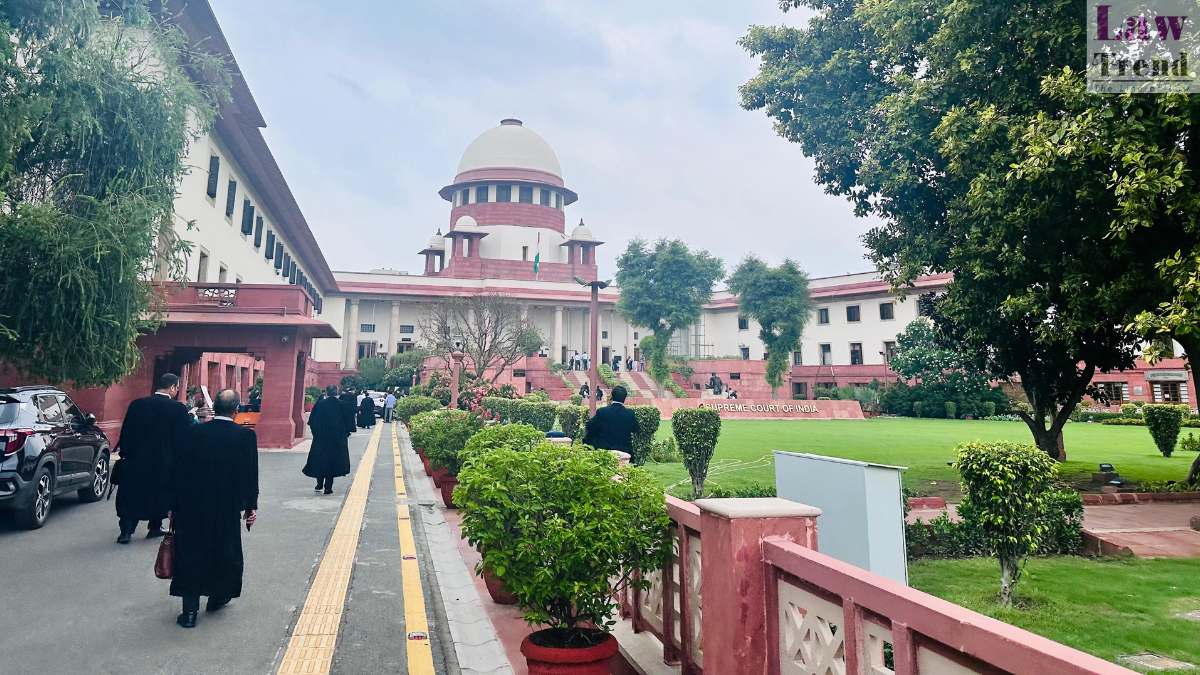
The Supreme Court was called upon to decide whether an appeal under Section 374 of the Code of Criminal Procedure, 1973 (corresponding to Section 415 of the Bharatiya Nagarik Suraksha Sanhita, 2023) is maintainable before the High Court against a judgment of conviction recorded by a Sessions Court while exercising appellate jurisdiction and reversing an order of acquittal passed by a Trial Court.
A two-judge Bench comprising Justice Aravind Kumar and Justice Prasanna B. Varale answered the issue in the negative, ruling that no such statutory appeal lies under Section 374 CrPC / Section 415 BNSS against a first-time conviction recorded in appellate jurisdiction. The Court held that the only statutory remedy available to the convicted person is to file a criminal revision petition under Section 397 read with Section 401 CrPC (corresponding to Section 438 read with Section 442 BNSS). Consequently, the Supreme Court dismissed the appeal while granting liberty to the appellant to approach the High Court in revision.
Background of the Case
The marriage between the appellant, Vishnu Kumar Gupta, and respondent No. 2, Smt. Shilpi Gupta, was solemnized on February 1, 2013, at Vidisha, Madhya Pradesh. Following the marriage, the couple relocated to the United States, where they resided together and had a son in 2015. In March 2018, respondent No. 2 travelled to India with her minor child and did not return to the matrimonial home, leading to separate living arrangements and deterioration of the matrimonial relationship.
Respondent No. 2 lodged a Zero FIR on January 19, 2020, at Police Station Lasudia, Indore, alleging cruelty, physical assault, and persistent dowry demands against the appellant, his father, and his mother under Sections 498-A, 323, and 34 of the Indian Penal Code (IPC) and Sections 3 and 4 of the Dowry Prohibition Act, 1961. The FIR was transferred to Police Station City Kotwali, District Bhind, M.P., as FIR No. 32 of 2020. Upon completion of investigation, a charge sheet was submitted before the Judicial Magistrate First Class, Bhind.
After a full-fledged trial, the Judicial Magistrate First Class, Bhind, vide judgment dated December 20, 2024, acquitted the appellant and his parents of all charges, holding that the prosecution failed to establish the allegations beyond reasonable doubt. Aggrieved by the acquittal, the complainant preferred an appeal under Section 419 BNSS (Section 378 CrPC) before the Sessions Court. The Seventh Additional Sessions Judge, Bhind, vide judgment dated May 27, 2025, in Criminal Appeal No. 3/2025, affirmed the acquittal of the parents but reversed the acquittal of the appellant. The Sessions Court convicted the appellant under Section 498-A IPC and Section 4 of the Dowry Prohibition Act, sentencing him to rigorous imprisonment for three years and two years respectively, along with fines.
Challenging this first-time conviction, the appellant filed a criminal appeal before the High Court of Madhya Pradesh at Gwalior under Section 374 CrPC (Section 415 BNSS). The High Court, vide order dated July 11, 2025, dismissed the appeal as not maintainable, holding that no statutory second appeal is provided against an appellate conviction and that the remedy lay only in revision. The High Court further noted non-compliance with Rule 48 of Chapter X of the M.P. High Court Rules, 2008, regarding surrender. The appellant then approached the Supreme Court.
Arguments of the Parties
Counsel for the appellant, Mr. A. Velan, submitted that the appeal before the High Court was not a “second appeal” but the first effective appeal against his conviction, as he had been acquitted by the Trial Court. It was argued that the expression employed in Section 374 CrPC is “convicted on a trial” and not “convicted in a trial.” The use of “on” denotes a conviction founded upon or arising out of a trial, regardless of whether it is recorded by the trial court or an appellate court. Relying on decisions such as Garikapati Veeraya v. N. Subbiah Choudhry, Dilip S. Dahanukar v. Kotak Mahindra Co. Ltd., and Maru Ram v. Union of India, it was submitted that the right of appeal against conviction is a substantive right under Article 21, and equating revision with appeal deprives the accused of complete evidentiary re-appreciation.
On behalf of the State, learned counsel Shri Rajan Chourasia, supported by Sri Sankalp Sharma for the complainant, contended that the right of appeal is purely a creation of statute. Section 374 CrPC permits appeals only against convictions recorded by courts exercising original trial jurisdiction. Relying on rulings of the Karnataka High Court in Jayanthilal Dave v. State Assistant Drug Controller and the Madras High Court in Purushoth v. Jayabal, they submitted that criminal procedural law does not contemplate a second statutory appeal against an appellate judgment, and the appropriate remedy is revision under Section 397/401 CrPC.
Court’s Analysis and Findings
The Supreme Court analyzed the statutory scheme governing appeals under the CrPC and BNSS, reiterating the well-settled principle that appeal is purely a creature of statute. Citing National Commission for Women v. State of Delhi, Mallikarjun Kodagali v. State of Karnataka, and Parvinder Kansal v. State (NCT of Delhi), the Court reaffirmed that in the absence of an express provision, no appeal can be maintained or inferred on grounds of equity or perceived legislative omissions.
Examining the meaning of the word ‘trial’ with reference to precedents including State of Bihar v. Ram Naresh Pandey, V.C. Shukla v. State, and Hardeep Singh v. State of Punjab, the Court noted that a criminal trial ordinarily commences upon the framing of charges and concludes with pronouncement of judgment and sentence. Citing Jamin v. State of U.P. and Shashikant Singh v. Tarkeshwar Singh, the Bench reaffirmed that where an acquittal is ordered, the trial comes to an end upon the passing of the order of acquittal by the trial court.
Deciding the true interpretation of Section 374 CrPC, the Court scrutinized the phrase “on a trial held by”. The Bench observed:
“A combined reading of the expressions ‘on a trial’ and ‘held by’ leads to the inescapable conclusion that the provision contemplates the Court which itself conducts the trial, namely, the Court before which the proceedings commence with the framing of charges and culminate in the judgment of conviction and the order of sentence. Thus, in the context of Section 374(3)(a), an appeal lies from the judgment of conviction and sentence passed by the Magistrate who has conducted the entire trial to the Court of Session exercising appellate jurisdiction. The provision, therefore, unmistakably contemplates an appeal only from the Court which has itself held the trial and not from a Court exercising appellate jurisdiction.”
The Court specifically rejected the appellant’s argument regarding the preposition “on” and disagreed with the High Court of Himachal Pradesh’s judgment in Arun Sharma v. State of Himachal Pradesh, which had held that an appeal against acquittal is a continuation of trial and thus a conviction therein is a conviction “on a trial”. Overruling Arun Sharma, the Supreme Court stated:
“The jurisdiction exercised by a Trial Court is fundamentally distinct from that exercised by an appellate court. Consequently, the expression ‘on a trial held by’ necessarily refers to the Court which has itself conducted the trial, namely, the Court before which the proceedings commenced and culminated in the judgment of conviction and the order of sentence. The said expression cannot be construed to include a Court exercising appellate jurisdiction, notwithstanding that the appeal is a continuation of the original proceedings. Thus, we hold that judgment in Arun Sharma does not lay down correct law and therefore it is over-ruled.”
Addressing the difference between appellate and revisional powers (referring to Chandrappa v. State of Karnataka and Amit Kapoor v. Ramesh Chander), the Supreme Court acknowledged that revisional jurisdiction is supervisory and discretionary. However, to ensure justice when an accused is convicted for the first time by an appellate court, the Supreme Court highlighted the amplitude of High Court powers under Section 401(1) CrPC (Section 442(1) BNSS) and laid down guidance for High Courts:
“Consequently, although the remedy available to the accused is one of revision and not appeal, the amplitude of the High Court’s powers under Section 401(1), read in the context of a first conviction by the appellate court, obliges the High Court to undertake a more searching examination of the correctness, legality and propriety of the conviction than ordinarily it would be warranted in revisions arising from concurrent findings of guilt.”
The Bench further observed:
“Revisions arising out of convictions recorded for the first time by an appellate court, upon reversal of an order of acquittal passed by the Trial Court, stand on a distinct footing from revisions arising out of concurrent findings of conviction. The former category of cases warrants a more liberal and careful exercise of the High Court’s revisional jurisdiction, bearing in mind that the accused has not had the benefit of a statutory appeal against the conviction.”
Decision of the Court
The Supreme Court concluded that an appeal under Section 374 CrPC / Section 415 BNSS is not maintainable against a judgment of conviction recorded by a Sessions Court while exercising appellate jurisdiction and reversing an acquittal order. The only available legal remedy is a revision petition under Section 397 read with Section 401 CrPC (Section 438 read with Section 442 BNSS). The Supreme Court refrained from commenting on the constitutionality of Rule 48 of the M.P. High Court Rules as it remains pending before the High Court. Dismissing the appeal, the Bench granted liberty to the appellant to file a revision against the Sessions Court’s conviction order.
Case Title: Vishnu Kumar Gupta v. State of Madhya Pradesh and Anr.
Case No.: Criminal Appeal No. OF 2026 (Arising out of SLP (Crl.) No. 13891/2025)
Bench: Justice Aravind Kumar and Justice Prasanna B. Varale
Date: July 30, 2026