

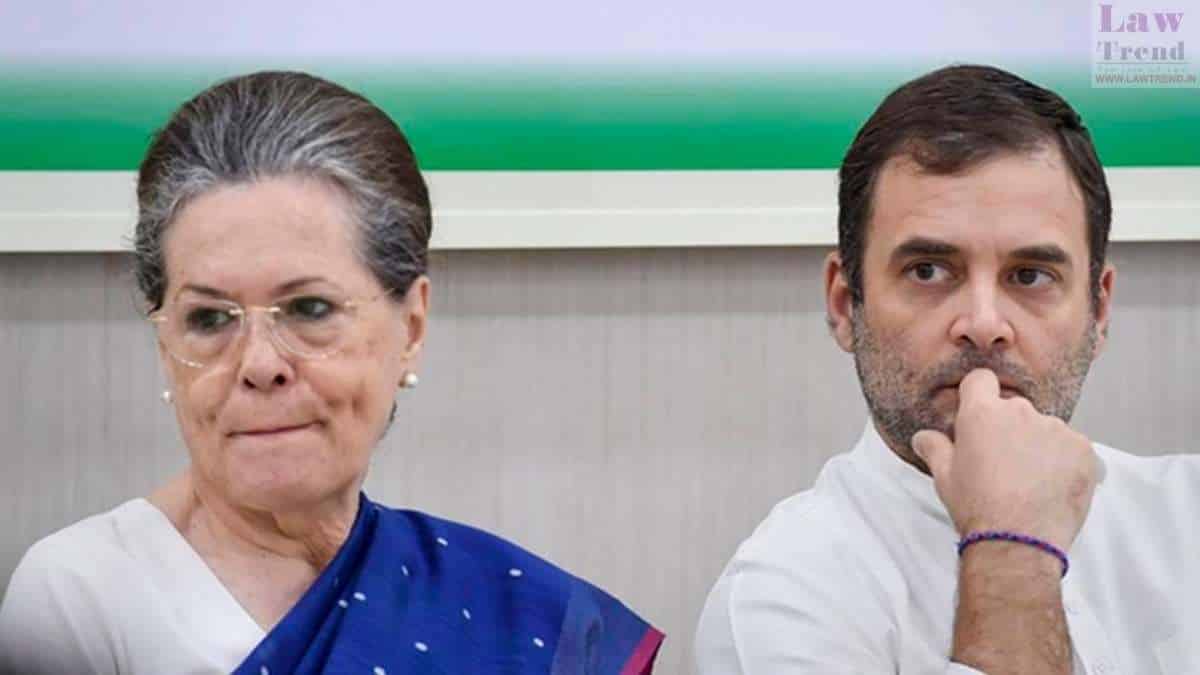
The Delhi High Court has granted Congress leaders Sonia Gandhi, Rahul Gandhi, and several co-respondents three weeks to submit their responses to a petition by the Enforcement Directorate challenging a lower court order in the National Herald-linked money laundering case.
Justice Manoj Jain scheduled the next hearing for September 10 after noting that the court could not take up the matter due to a heavy board and prior time-fixed proceedings.
During the hearing, senior counsel representing the respondents requested additional time to file their response to the anti-money laundering agency’s challenge. Solicitor General Tushar Mehta, appearing for the Enforcement Directorate, argued that the respondents had failed to submit a reply despite being given time two months prior. Maintaining that the petition rests purely on a point of law, Mehta asserted that the trial court’s decision was incorrect.
Challenge to Trial Court Order
The proceedings stem from a December 16 trial court ruling that refused to take cognisance of the Enforcement Directorate’s prosecution complaint, holding that money laundering investigations are legally impermissible without an underlying First Information Report for a scheduled offence.
In that decision, the trial court highlighted that the central agency’s investigation originated from a private complaint filed by Bharatiya Janata Party leader Subramanian Swamy rather than an official police FIR. It noted that despite Swamy’s complaint and a subsequent 2014 judicial summons, the Central Bureau of Investigation had not registered an FIR.
The High Court previously issued notices on December 22, 2025, regarding the financial agency’s main petition and its request to stay the trial court’s order. Alongside Sonia Gandhi and Rahul Gandhi, notices were served to Suman Dubey, Sam Pitroda, Sunil Bhandari, Young Indian, and Dotex Merchandise Pvt Ltd.
Allegations and Legal Arguments
The Enforcement Directorate contends that the trial court’s interpretation creates an unintended legal exemption for money laundering cases stemming from private magistrate complaints. The agency argues that judicial cognisance taken on a private complaint holds a stronger legal standing than a police FIR, where cognisance remains conditional on post-investigation chargesheets.
In its court submissions, the agency previously described the lower court’s reasoning as deeply flawed, stating that the ruling was adversely affecting other ongoing cases.
The core charges involve allegations of money laundering and criminal conspiracy against Sonia Gandhi, Rahul Gandhi, Suman Dubey, Sam Pitroda, Young Indian, and late Congress leaders Motilal Vora and Oscar Fernandes.
According to the agency, the accused fraudulently acquired assets valued at approximately Rs 2,000 crore belonging to Associated Journals Limited, the publisher of the National Herald. The probe agency alleges that Sonia Gandhi and Rahul Gandhi held a combined 76 percent stake in Young Indian, which took over the publisher’s assets in exchange for clearing a Rs 90 crore loan.


