

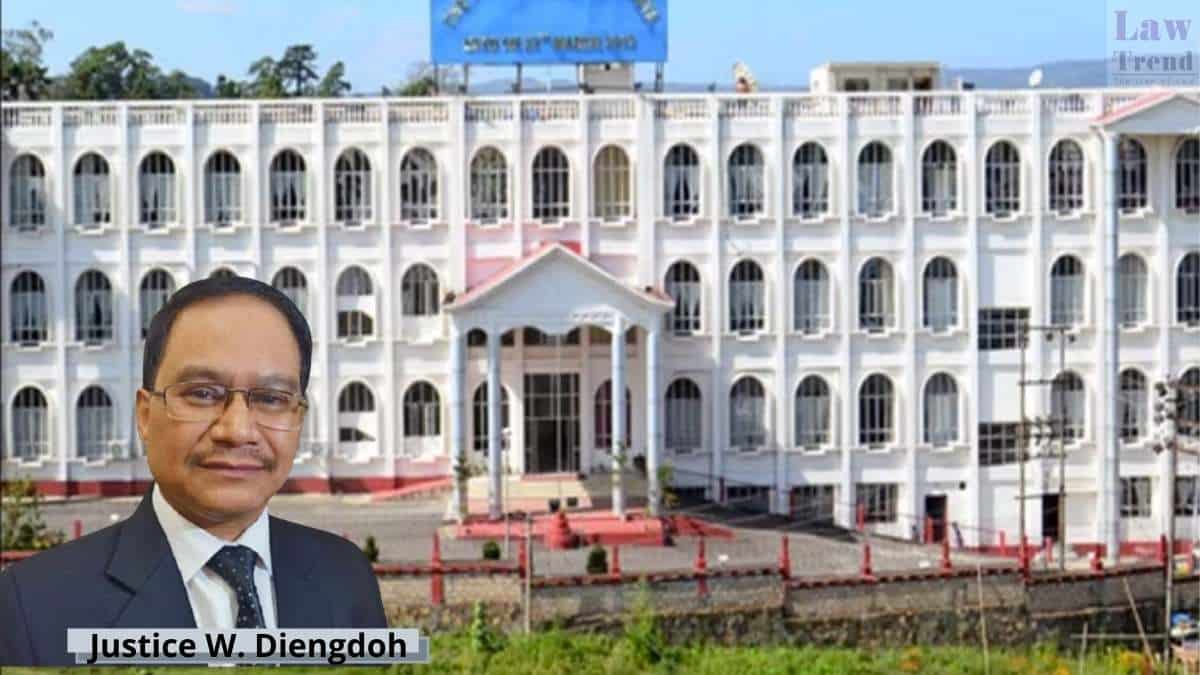
The High Court of Meghalaya has dismissed a criminal appeal filed by one Shri. Chanky Shadap against his conviction and seven-year rigorous imprisonment for the rape of a minor in 2010. The Court, presided over by Justice W. Diengdoh, held that the testimony of the victim was reliable and corroborated by medical evidence, ruling that minor procedural discrepancies and a four-day delay in filing the First Information Report (FIR) did not vitiate the prosecution’s case.
Background of the Case
The case originated from an incident on July 25, 2010. According to the prosecution, the victim, then approximately 14 years old, was returning from an evening church service at approximately 08:30 PM when the appellant met her, dragged her into a jungle, and raped her. An FIR was subsequently filed on July 29, 2010, at Jowai Police Station. Following an investigation, the appellant was charged under Section 376 of the Indian Penal Code (IPC). On November 25, 2021, the Trial Court found him guilty and sentenced him to seven years of imprisonment with a fine of ₹10,000.
Arguments of the Parties
The learned counsel for the appellant, Mr. S. Marpan, argued that the conviction resulted in a “serious miscarriage of justice.” He contended that:
- The victim’s testimony did not meet the standard of a “sterling witness” due to inconsistencies between her Section 164 Cr.P.C. statement and her court deposition.
- There was an unexplained four-day delay in lodging the FIR, suggesting “embellishment, afterthought and false implication,” citing Thulia Kali v. State of Tamil Nadu (1972).
- Medical reports showed no injuries suggestive of force or struggle, and no spermatozoa were detected.
- The charge framed under Section 376 IPC was “cryptic and mechanical,” failing to specify the exact clause of Section 375 IPC violated, thereby causing prejudice under Section 464 Cr.P.C.
Per contra, the learned Additional Advocate General (AAG), Mr. N.D. Chullai, submitted that:
- In cases of sexual offences, a four-day delay is not inordinate. He cited Marbet Nongsiej v. State of Meghalaya (2020), noting that victims in such cases often hesitate due to social stigma.
- The medical evidence confirmed a tear on the outer vaginal surface and hymen, which the doctor (PW-3) estimated to be 3-5 days old, aligning with the date of the incident.
- The appellant was fully aware of the nature of the charges and had participated in the trial without objection.
Court’s Analysis and Observations
Justice W. Diengdoh, after perusing the records, observed that the victim’s deposition was “reliable and believable.” The Court noted that the minor discrepancies between her statements did not affect the “core or fundamental recital of the facts.”
Regarding the medical evidence, the Court stated:
“The medical report… revealed that there were signs of recent forceful intercourse with multiple bruises on both buttocks, right outer thigh, left posterior thigh and right posterior thigh… This can only suggest that the victim has been subjected to forceful sexual assault a few days ago, and such, an assault can only be connected to the appellant being the perpetrator.”
On the issue of the delayed FIR, the Court referred to the Supreme Court’s stance in Tulshidas Kanolkar v. State of Goa (2003) and State of Himachal Pradesh v. Sanjay Kumar Alias Sunny (2017), emphasizing that delay per se is not a mitigating circumstance in rape cases. The Court accepted that the delay was explained by the fact that the victim first informed her father and a village meeting was subsequently convened.
Addressing the contention regarding the “cryptic” framing of charges, the Court noted that the charge was read out to the appellant in his native language in 2013, and he had claimed trial without raising any objections during the proceedings. Citing Willie (William) Slanney v. State of Madhya Pradesh (1955), the Court held that even if a formal charge is not in the proper format, it is not an “incurable error” unless the accused was misled, which was not the case here.
Decision
The High Court concluded that the prosecution had proved its case beyond reasonable doubt.
“This Court finds that the appellant has not been able to make out a case for the impugned judgment and sentence to be set aside and quashed. The same is hereby upheld.”
The appeal was dismissed, and the Trial Court records were ordered to be sent back.
Case Details:
- Case title: Shri. Chanky Shadap vs. State of Meghalaya & Anr.
- Case Number: Crl.A. No. 22 of 2025
- Bench: Justice W. Diengdoh
- Date of Decision: 20.03.2026




