

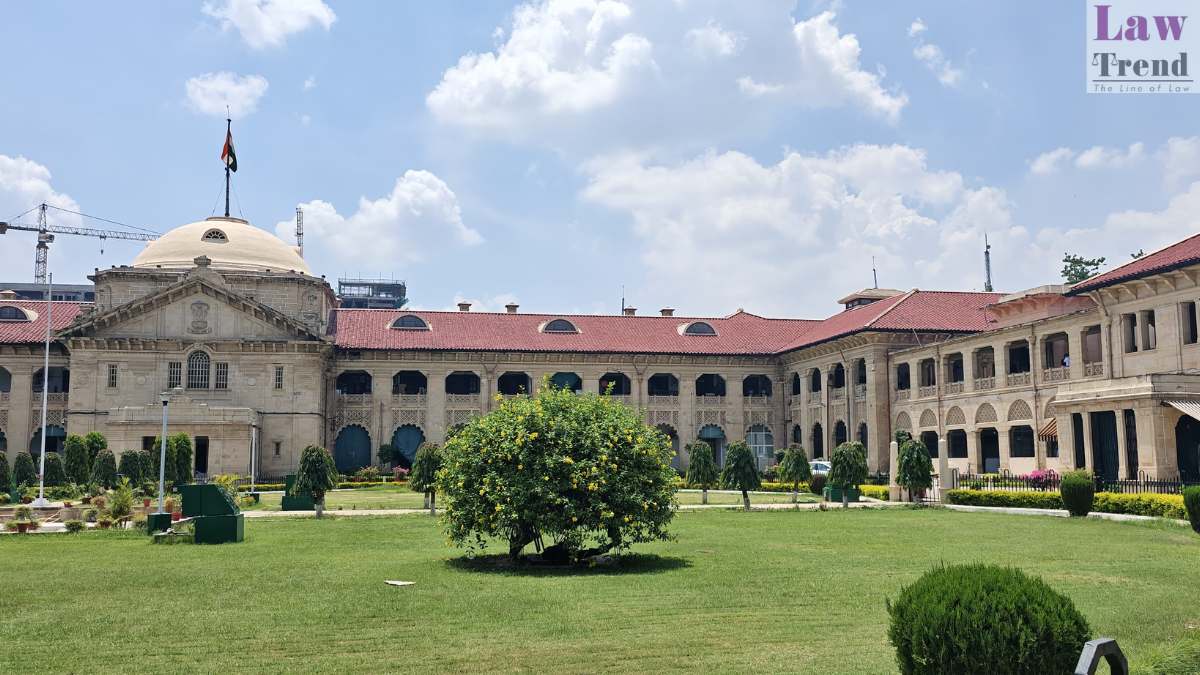
The High Court of Judicature at Allahabad has partially allowed a jail appeal, modifying the life imprisonment sentence of an appellant convicted under Section 304 of the Indian Penal Code (IPC) to the period already undergone. The Division Bench, comprising Justice Siddhartha Varma and Justice Jai Krishna Upadhyay, held that while the conviction was sustainable, the sentence of life imprisonment was “excessive” given the circumstances of the case and the principles of the reformative theory of punishment.
Background of the Case
The case originated from an incident on December 12, 2013. According to the First Information Report (FIR) lodged by the informant, Smt. Malti Devi, she had married the appellant, Baba Vishwakarma, six months prior to the incident. She had a daughter, Kajal (aged one and a half years), from her previous marriage.
The prosecution alleged that at approximately 8:00 PM, the appellant, in a fit of anger, picked up the child and threw her on the ground, subsequently striking her with an iron rod. The child was rushed to a hospital but was declared dead upon arrival. The Trial Court (Additional District & Sessions Judge, Court No. 5, Allahabad) convicted the appellant on August 2, 2019, sentencing him to life imprisonment and a fine of ₹20,000 under Section 304 IPC.
Arguments of the Parties
The learned counsel for the appellant challenged the conviction, contending that the prosecution failed to prove its case beyond reasonable doubt. They argued that the testimony of PW-1 (Malti Devi) was unreliable due to her “questionable character” and contradictions regarding her multiple marriages. It was further argued that the incident occurred “suddenly and in the heat of passion without premeditation” and that the appellant, not being a habitual offender, had already served over twelve years in incarceration.
Per contra, the learned AGA for the State opposed the appeal, asserting that PW-1 was an eyewitness and the mother of the deceased with no motive for false implication. The State maintained that the medical evidence corroborated the oral testimony and that the gravity of the offence did not warrant a lenient view.
Court’s Analysis and Observations
The Court dismissed the challenges to the appellant’s conviction, noting that the allegation against the character of the informant, even if accepted, “would in no way affect the merits of the case.” The Bench observed that since the incident occurred inside the house at night, PW-1 was the only possible eyewitness, and her testimony was found to be trustworthy.
However, the Court focused significantly on the “quantum of sentence.” Referring to Section 304 IPC, the Bench noted:
“Section 304 IPC does not prescribe any minimum punishment. The discretion lies with the Court to award a sentence proportionate to the circumstances of the case.”
The Court emphasized the Reformative Theory of Punishment, citing the Hon’ble Supreme Court’s observations in Mohd. Giasuddin Vs. State of AP (1977):
“The infliction of harsh and savage punishment is thus a relic of past and regressive times. The human today vies sentencing as a process of reshaping a person who has deteriorated into criminality… If you are to punish a man retributively, you must injure him. If you are to reform him, you must improve him and, men are not improved by injuries.”
The Bench also invoked the “Doctrine of Proportionality,” referencing several precedents including G. V. Siddaramesh Vs. State of Karnataka (2010), noting that the sentencing process must reflect the conscience of society while remaining stern where necessary.
The Decision
While upholding the conviction under Section 304 (Part-I) IPC, the High Court concluded that life imprisonment was “too harsh and severe” in this specific instance.
The Court observed:
“The appellant is in jail for the last more than twelve years… Adopting the same reformative approach, we consider that no accused person is incapable of being reformed and, therefore, all measures should be applied in order to bring them in the social stream.”
The Court modified the sentence to the period already served (over 12 years). The appellant was ordered to be released forthwith, subject to depositing the fine of ₹20,000 within two months of his release. In case of default in payment of the fine, the appellant will serve an additional two months of imprisonment.
Case Details Block
- Case Title: Baba Vishwakarma vs. State of U.P.
- Case Number: Jail Appeal No. 188 of 2021
- Bench: Justice Siddhartha Varma and Justice Jai Krishna Upadhyay
- Date: April 8, 2026




