

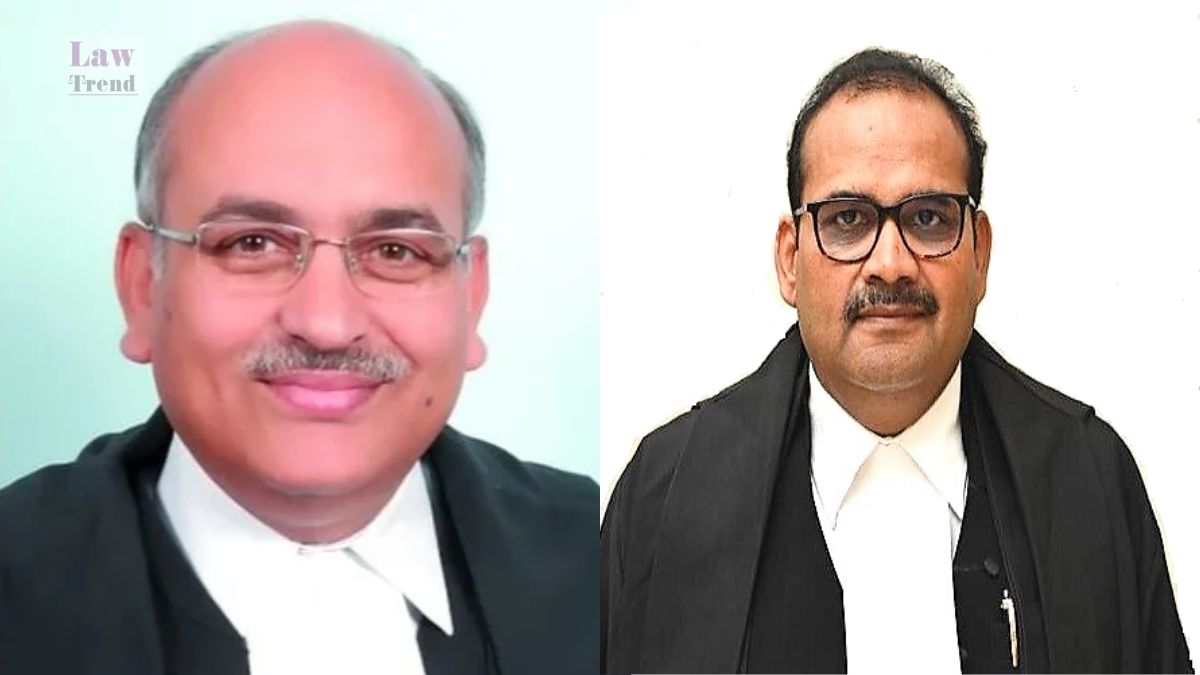
In an emotional and reflective ceremony, the Supreme Court of India on Friday bid farewell to two of its distinguished jurists, Justice J.K. Maheshwari and Justice Pankaj Mithal. Led by Chief Justice of India (CJI) Surya Kant, the apex court community gathered to honor the retiring judges on their final working day before the court transitions to partial working days from June 1 to July 12.
Justice Mithal is set to superannuate on June 16, followed by Justice Maheshwari, who will demit office on June 28.
Speaking at the farewell function organized by the Supreme Court Bar Association (SCBA), CJI Surya Kant lauded both judges for strengthening the judiciary with “dignity and unflinching commitment.”
“This evening is marked by a deep sense of gratitude and reflection,” CJI Kant said. “Both Justice Maheshwari and Mithal are individuals who gave the finest years of their lives to an institution far greater than themselves.”
Defining Legacies: Landmark Judgments That Shaped the Nation
During their tenure at the apex court, both judges left an indelible mark on India’s legal landscape through several high-profile and socially impactful rulings.
Justice J.K. Maheshwari: Humility and Integrity
Known for his discipline and humble beginnings, Justice Maheshwari’s career spanned multiple jurisdictions. Before reaching the Supreme Court, he served as Chief Justice in Andhra Pradesh and Sikkim, starting his legal journey in Madhya Pradesh.
Among his most notable contributions to the bench:
- The Bhopal Gas Tragedy Curative Petition: Justice Maheshwari was part of the Constitution bench that rejected the Central Government’s curative petition seeking an additional ₹7,844 crore from the successor firms of Union Carbide Corporation (UCC). The bench firmly noted that the government had provided no valid rationale to reopen the settlement issue more than two decades after the 1984 tragedy.
- The Karur Stampede Investigation: Last year, a bench led by Justice Maheshwari ordered a Central Bureau of Investigation (CBI) probe into the tragic Karur stampede in Tamil Nadu, which claimed 41 lives. He emphasized that the incident had “shaken the national conscience” and demanded an impartial inquiry.
Reflecting on his journey, Justice Maheshwari expressed his admiration for the Indian judicial system and the common citizen. “I witnessed different cultures, terrains, and languages, but what did not change was the aspiration of the common man for seeking justice,” he remarked.
Justice Pankaj Mithal: The Constitution as a ‘Living Promise’
Hailing from Meerut in Uttar Pradesh, Justice Mithal was praised by CJI Kant for his remarkable judicial temperament and deep human empathy. In a lighter moment, the CJI revealed that Justice Mithal is an avid stamp collector—a hobby that mirrors his judicial philosophy.
“A stamp collector is someone who finds meaning in details that others may overlook,” the CJI observed. “As a jurist, Justice Mithal has consistently embodied the understanding that the Constitution is simply not a textual document to be interpreted, but a living promise to be fulfilled.”
Justice Mithal’s landmark contributions include:
- Sub-Classification of Scheduled Castes: He was part of the historic seven-judge Constitution bench which ruled that states are constitutionally empowered to make sub-classifications within the Scheduled Castes (SC) to grant targeted reservation benefits to those who are socially and educationally more backward.
- A Fresh Look at Reservations: In his separate concurring judgment, Justice Mithal called for a re-evaluation of the reservation policy. He notably referenced a 1961 letter written by India’s first Prime Minister, Jawaharlal Nehru, which expressed concern over the habit of granting reservations and privileges based on caste or group identities.
A Poignant Warning on Case Pendency
While expressing gratitude for his journey, Justice Mithal used his farewell platform to address a critical systemic challenge: the mounting backlog of court cases. He noted that from the vantage point of the country’s highest court, the sheer volume of pending cases offers a “sobering view.”
“The mounting tendency of cases is not merely a statistical issue or an administrative concern; it directly affects the life, liberties, and aspirations of millions of citizens who approach courts with hope and faith,” Justice Mithal warned. “Every pending case represents a human story awaiting resolution—a family dispute, prolonged distress, an undertrial awaiting liberty, a commercial matter affecting livelihoods, or a citizen seeking protection of constitutional rights.”
The farewell event, characterized by warmth and affection, was widely attended by Supreme Court judges, their families, prominent advocates, and court staff, marking the end of a significant chapter in the history of the Indian judiciary.




