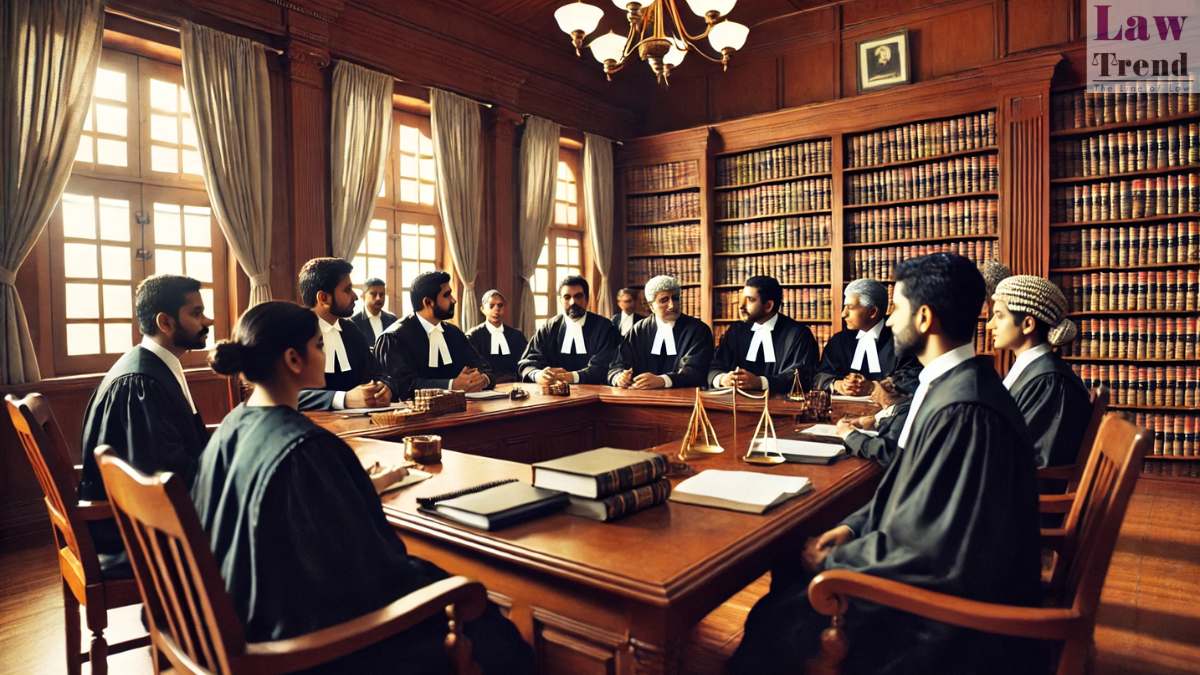
The Allahabad High Court, in a bench presided over by Justice Arun Kumar Singh Deshwal, has held that law graduates from the academic session 2009–10 onwards who fail to pass the All India Bar Examination (AIBE) within two years of provisional enrollment are not entitled to practice before any court, tribunal, or revenue authority. Addressing key procedural and statutory aspects governing advocate enrollments, the Court clarified that advocates may continue practicing beyond five years without a renewed Certificate of Practice (COP) until the State Bar Council officially publishes the list of non-practicing advocates under Rule 20.4 of the Bar Council of India Certificate and Place of Practice (Verification) Rules, 2015.
Background of the Case
The issue originated during the hearing of a bail application in Yogendra v. State of U.P. and 3 Others. Although the bail application was disposed of on July 6, 2026, a procedural question arose regarding the advocate representing the applicant, Sri Jaihind Gaund. The advocate had graduated after the 2009–10 academic session but had not cleared the AIBE despite the expiry of two years from his enrollment.
While the Court permitted the counsel to argue the matter as a one-time exception under Section 32 of the Advocates Act, 1961, it kept the legal question open for determination. The Court subsequently sought assistance from representatives of the Bar Council of India (BCI), the Bar Council of Uttar Pradesh, the High Court Bar Association, and the Advocates’ Association to clarify the legal requirements surrounding provisional enrollments, AIBE completion, and verification of practice certificates.
Arguments of the Parties
Appearing for the Bar Council of India, Standing Counsel Shri Sai Girdhar submitted that Rule 5 of the 2015 Verification Rules applies when the issue of verifying certified practice arises. Law graduates subject to the All India Bar Examination Rules, 2010 are required to verify or renew their COP after five years. He highlighted that under a BCI resolution dated April 12, 2013, law graduates post 2009–10 receive provisional enrollment for two years, during which they may practice. However, if they fail to pass the AIBE within two years, their enrollment automatically lapses, and they lose the right to practice in any court or tribunal until they clear the exam. A subsequent BCI clarification on January 31, 2017, confirmed that candidates may attempt the AIBE an unlimited number of times to regain practice eligibility.
Senior Vice President of the Allahabad High Court Bar Association, Shri K.K. Dwivedi, informed the Court that provisionally enrolled advocates are permitted to join the Bar Association, though voting rights are conferred only after three years. He noted that the High Court issues provisional advocate rolls for two years, which are subject to cancellation if proof of passing the AIBE is not submitted upon general notice.
Deputy Registrar of the High Court’s Advocate Roll Section, Sri Sarvesh Kumar Singh, confirmed that the High Court periodically updates its rolls and terminates provisional entries if advocates do not submit proof of passing the AIBE after two years.
Counsel for the Bar Council of Uttar Pradesh, Sri Ashok Kumar Tiwari, stated that verification under Rule 5 is currently ongoing, and the formal list of non-practicing advocates under Rule 20.4 has not yet been published.
The applicant’s counsel, Sri Jaihind Gaund, submitted that he had qualified the AIBE on July 18, 2026, and urged the Court to direct the Bar Council of U.P. to issue permanent enrollment numbers within one week of receiving result cards.
State AGA Sri D.P.S. Chauhan, assisted by Ms. Mayuri Mehrotra, emphasized that under Rule 5 of the 2015 Rules, an advocate without a valid COP cannot practice before any court, tribunal, or authority empowered to take evidence. He added that under Section 2(1)(a) of the Bharatiya Sakshya Adhiniyam, 2023, the definition of a court extends to revenue courts.
The Court’s Analysis
Examining the statutory framework of the Advocates Act, 1961, and the rules framed thereunder, the High Court emphasized the pivotal role of the legal profession in the administration of justice, observing:
“The legal profession is one of the respectable professions as it plays a critical role in protecting and promoting the Civil and constitutional rights of the people. The Bar and the Bench are two wheels of a chariot of justice, and one cannot function without the other.”
The Court analyzed Rule 9 of the AIBE Rules, 2010, which mandates passing the bar examination for all advocates graduating from 2009–10 onwards. It noted that under the explanation to Section 24(1) of the Advocates Act, a person is deemed to have obtained a law degree on the date the results are declared by the university.
The judgment referred to landmark precedents, including the Supreme Court ruling in Bar Council of India v. Bonnie Foi Law College (2023), which overruled V. Sudeer v. Bar Council of India (1999) and upheld the BCI’s authority to prescribe pre-enrollment examinations and quality control measures. The Supreme Court had highlighted that “quality control of entry into the Bar is the need of the hour.”
The High Court also noted that in Bonnie Foi, the Supreme Court suggested framing rules for advocates returning to practice after a long break in non-legal employment:
“We are inclined to accept the suggestion in principle that appropriate rules can be framed laying down that an enrolled advocate who takes up an employment in a non-legal context for a substantial length of time (say for five years) would be deemed to be a new enrolee and in order to regain the qualification, that person would be required to take the All India Bar Examination once more.”
The High Court remarked that the BCI appears to have ignored this direction.
Additionally, the Court cited Jamshed Ansari v. High Court of Judicature at Allahabad (2016), which upheld Rules 3 and 3A of Chapter XXIV of the Allahabad High Court Rules, 1952, confirming that an advocate’s right to practice under Section 24 is subject to High Court rules governing practice before its benches.
Key Conclusions and Directives
Answering the legal issues framed, the Court laid down the following conclusions and directives:
- Practice Rights Post 2009–10: Law graduates from the 2009–10 academic session onwards are entitled to practice for two years based on a provisional enrollment certificate issued by the State Bar Council. If they fail to pass the AIBE within two years, they lose the right to practice in any civil court, criminal court, tribunal, or revenue court (from the Tehsildar up to the Board of Revenue).
- High Court Appearance: Advocates with provisional enrollment must also hold a provisional High Court advocate roll to practice in the High Court. Those without a High Court roll may only appear alongside an advocate who is duly enrolled on the High Court roll.
- Validity of Practice Pending Verification: Under Rule 5 of the 2015 Verification Rules, advocates who have completed five years since receiving their COP may continue practicing even if verification/renewal is pending, until the Bar Council of U.P. officially publishes the list of non-practicing advocates under Rule 20.4.
- Consequences for Non-Compliance: Presiding officers of any court or tribunal are authorized to refuse audience or reject Vakalatnamas filed by advocates who failed to clear the AIBE within two years. Such advocates also face potential prosecution under Section 45 of the Advocates Act, 1961.
- Directives to High Court & Authorities:
- The Advocate Roll Section of the High Court is directed to strike off or suspend names of provisionally enrolled advocates who fail to submit proof of passing the AIBE within two years after notice.
- The Chairman and Secretary of the Bar Council of U.P. are directed to issue permanent enrollment numbers within four weeks of receiving an advocate’s AIBE result card.
- The Director General of Police, U.P., is directed to instruct all District Police Chiefs to complete police verifications for law graduates within two weeks of receiving verification forms from the Bar Council of U.P.
- Copies of the judgment are to be sent to the Chief Secretary of U.P. for circulation among revenue courts and tribunals, the State Bar Council, the DGP U.P., and the Chairman of the Bar Council of India.
Case Title: Yogendra Versus State Of U.P. And 3 Others
Case No.: Criminal Misc. Bail Application No. 17377 of 2026
Bench: Justice Arun Kumar Singh Deshwal
Date: August 07, 2026