

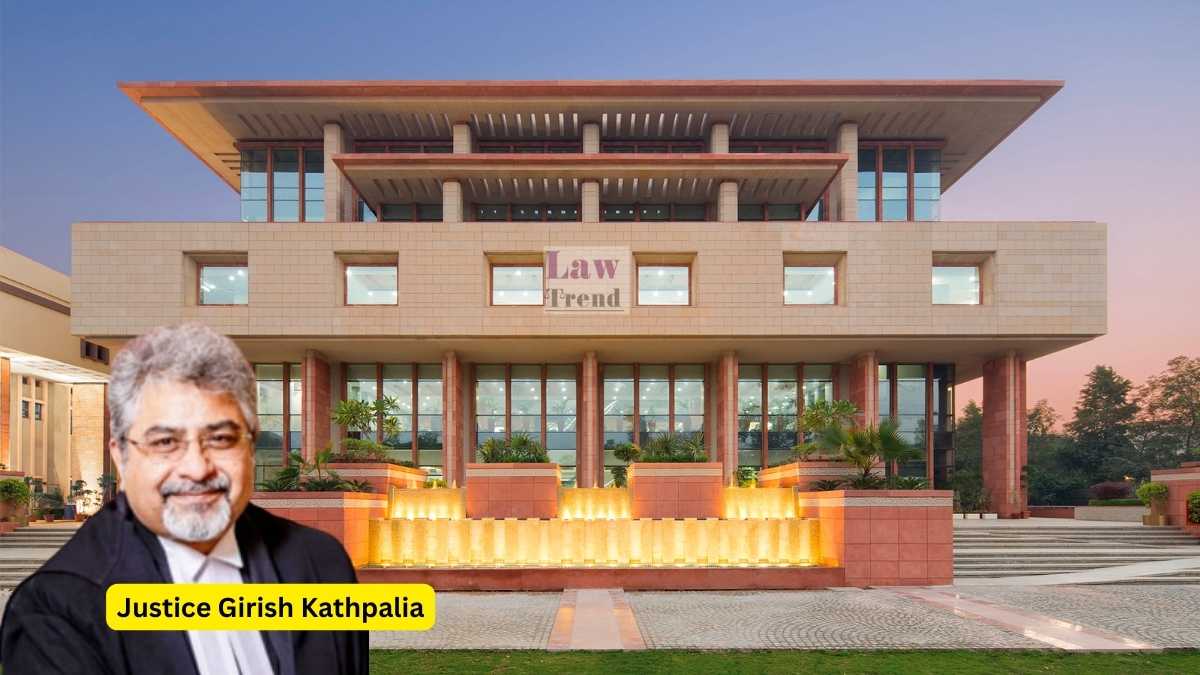
The Delhi High Court, presided over by Justice Girish Kathpalia, has dismissed a criminal writ petition seeking a Central Bureau of Investigation (CBI) probe into an alleged assault on protesting advocates at the Bar Council of India (BCI) premises, holding that the petition is not maintainable due to the availability of an alternative efficacious remedy under the Bharatiya Nagarik Suraksha Sanhita, 2023 (BNSS). The Court ruled that the allegations disclosed only a non-cognizable offence under the Bharatiya Nyaya Sanhita (BNS), which the police cannot investigate without magisterial orders, and observed that extraordinary constitutional writ jurisdiction under Article 226 cannot be invoked to bypass the statutory criminal procedure.
Background of the Dispute
The controversy stems from events in early August 2026, when the graduating batch of NALSAR University of Law, Hyderabad, wrote a letter to their university objecting to a convocation ceremony where they were scheduled to receive degrees from the Chief Justice of India. On August 13, 2026, respondent no. 1, Senior Advocate, Member of Parliament, and Chairman of the Bar Council of India Manan Kumar Mishra, issued a directive barring State Bar Councils from enrolling any 2026 NALSAR graduate until further orders. Following widespread criticism, the BCI modified the directive, claiming that the majority of students were innocent and had been instigated. On August 14, 2026, the Chief Justice of India remarked in open court that the issue was a dialogue between himself and the students, leaving no role for the BCI. Although respondent no. 1 tendered a public apology, the Bombay Bar Association issued a statement on August 18, 2026, rejecting it and calling for his resignation.
In response, the All India Young Advocates Association called for a peaceful demonstration outside the BCI premises on August 20, 2026. A group of advocates assembled, and representatives entered the premises to submit a written representation. Around 2:00 PM, 10 to 14 advocates, including the petitioners, commenced a peaceful sit-in protest inside the BCI building. Later that afternoon, an individual unconnected to the protestors allegedly broke open the lock of the gate.
According to the petitioners, between 1:15 AM and 1:20 AM on the intervening night of August 20 and 21, 2026, a group of 25 to 30 men—several wearing advocates’ attire—entered the BCI premises, surrounded the protestors, and began beating, slapping, thrashing, and dragging them. Petitioners on the first floor who came downstairs to intervene were also assaulted in the presence of police personnel. The petitioners filed a complaint on August 22, 2026, with the SHO of Police Station IP Estate, sent representations to the BCI, and approached the Delhi High Court Bar Association President on August 24, 2026, but alleged that no action had been taken. They consequently approached the High Court under Article 226 of the Constitution.
Prayers and Arguments of the Parties
The petitioners sought a writ of mandamus directing the CBI or another independent agency to register an FIR and conduct a court-monitored investigation into the assault, specifically examining the roles of respondent no. 1, BCI staff, unidentified assailants, and present police personnel. They also sought directions to preserve and seize CCTV recordings from the BCI premises and a direction compelling the BCI to decide their representation dated August 20, 2026.
Appearing for the petitioners, counsel submitted that an independent agency like the CBI was required because the Delhi Police functions under the Government, and respondent no. 1 is a Member of Parliament from the ruling party, creating an apprehension of an unfair investigation. Counsel further argued that the Delhi Police had taken no action, that a Magisterial court lacked the power to direct a CBI investigation or order the seizure of CCTV footage, and that the administrative prayer regarding the representation was intertwined with the investigation prayers.
Court’s Legal Analysis and Precedents
Addressing the maintainability of the petition under Article 226 of the Constitution, Justice Girish Kathpalia highlighted that the extraordinary writ jurisdiction of High Courts is governed by well-settled self-imposed restrictions:
“One of the restrictions placed on the power of the High Courts to entertain a writ petition or refuse to do so is the availability of an alternate efficacious remedy. Where an alternate efficacious remedy is available to the person aggrieved, he has to adopt the same, instead of seeking grant of writ.”
The Court reiterated that while this restriction has exceptions—such as enforcement of fundamental rights, violation of natural justice, lack of jurisdiction, or challenges to legislative vires—none applied to the case. The Bench cited the Constitution Bench judgment of the Supreme Court in Thansingh Nathmal vs Superintendent of Taxes (1964), reaffirming that writ jurisdiction cannot be exercised merely because it is lawful to do so when statutory remedies exist.
The Court referred to the Supreme Court’s rulings in Ashwini Kumar Upadhyay vs Union of India & Others (2026) and Sujal Vishwas Attavar & Anr. vs The State of Maharashtra & Ors. (2026 INSC 442). In Ashwini Kumar Upadhyay, the Supreme Court affirmed that the procedural framework under the CrPC and now the BNSS constitutes a comprehensive, multi-tiered mechanism where an aggrieved complainant can approach the Superintendent of Police under Section 173(4) BNSS (erstwhile Section 154(3) CrPC) and subsequently invoke Magisterial oversight under Section 175 BNSS (erstwhile Section 156(3) CrPC) or file a private complaint under Section 223 BNSS (erstwhile Section 200 CrPC). Similarly, Sujal Vishwas Attavar held that Article 226 is not a panacea for all grievances and cannot be used as a forum of first instance to bypass sequential statutory remedies.
Applying these principles, the High Court observed that the petitioners had only approached the local SHO on August 22, 2026, and had not approached the concerned Deputy Commissioner of Police (equivalent to the Superintendent of Police) or the jurisdictional Magistrate under Section 223 BNSS.
Non-Cognizable Offence and Rejection of Claims
Crucially, the Court examined whether the allegations revealed any cognizable offence warranting an FIR:
“From the said complaints lodged by the petitioners, it appears that no cognizable offence at all is made out. For, the only allegation is that the alleged aggressors (none of whom was allegedly armed with any weapon) beat, slapped, thrashed and dragged the petitioners. That, at the most constitutes offence of causing hurt, defined under Section 114 BNS, which is a non-cognizable offence. Consequently, in view of Section 174 BNSS it is only the concerned magistrate, who can act; and rather, in view of sub-section (2) of Section 174 BNSS, no police officer shall investigate such offence.”
The Court termed the petitioners’ contention that a Magistrate could not direct the seizure of CCTV footage as “fallacious, to say the least, in view of the scope of provisions under Chapter XVI of BNSS,” adding that the petitioners had themselves admitted the videos were already in the public domain. The Bench also declined the prayer regarding the representation dated August 20, 2026, noting that demands regarding resignation, BCI accountability, advocates’ welfare, and no-confidence motions had no bearing on an investigation into the alleged scuffle.
Disapproval of Allegations Against Police
Before dismissing the plea, the Court recorded strong disapproval of the petitioners’ arguments casting doubt on the Delhi Police:
“In the absence of any specific basis, it is not fair to tarnish the entire Delhi Police force in this manner, especially when petitioners’ own case fails to make out a cognizable offence. Besides, the apprehension argument must also fail because even CBI against whom mandamus to register case and investigate has been sought is a government body. One should resist the temptation to discredit any government organisation by such general, sweeping and baseless allegations. For, it generates counterproductive cynicism and distrust in the mind of common man against the entire ecosystem.”
Concluding that the petitioners possessed an efficacious statutory remedy by way of a complaint before the concerned Magistrate under Section 223 BNSS, the High Court dismissed the petition as not maintainable.
Case Title: Kunal Yadav & Ors. v. Manan Kumar Mishra & Ors.
Case No.: W.P.(CRL) 2850/2026, CRL.M.A. 28622/2026 & CRL.M.A. 28623/2026
Bench: Justice Girish Kathpalia
Date: September 21, 2026




