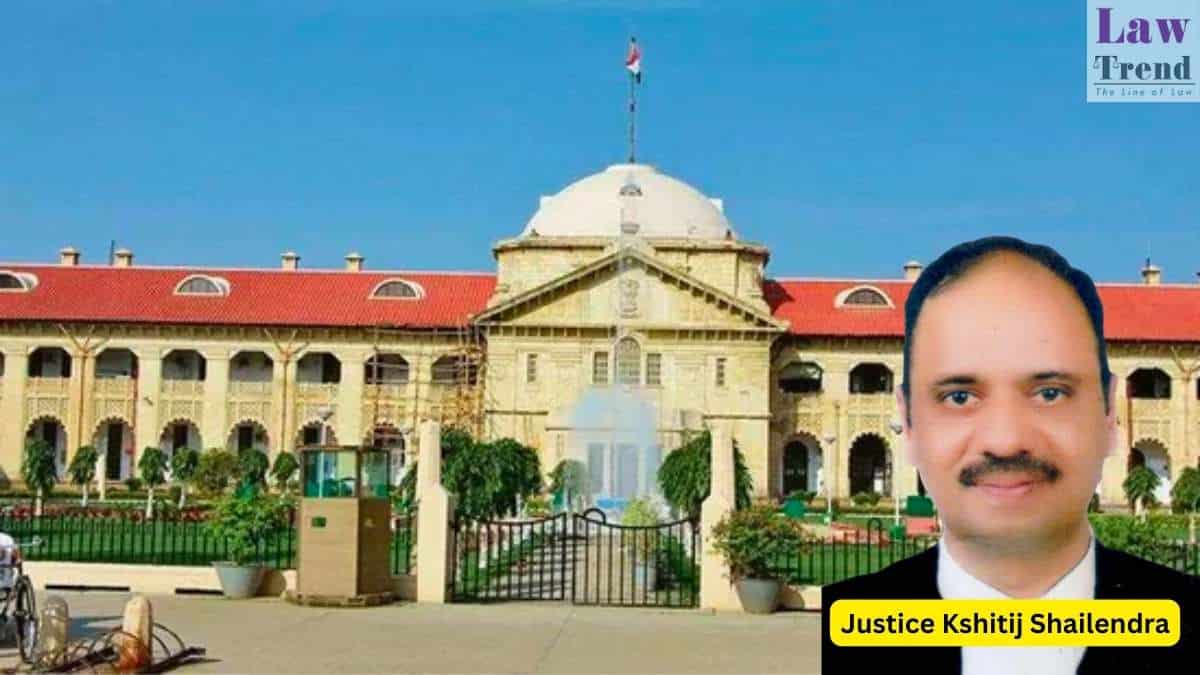
In a scathing indictment of administrative non-compliance, the Allahabad High Court has held the District Inspector of Schools (DIOS) of Ghazipur, Mr. Prakash Singh, guilty of contempt for failing to comply with a four-year-old interim order directing the payment of an employee’s salary.
Rejecting the State’s plea to defer proceedings due to a pending stay vacation application, Justice Kshitij Shailendra delivered a powerful defence of the rule of law and the dignity of the judiciary. Pointing to the staggering backlogs faced by constitutional courts, the court declared that judges cannot be expected to function as “super robots” while litigants openly treat active judicial commands as optional “decorative pieces of paper.”
The Workload Angle: Overburdened Courts and the “Super-Robot” Expectation
At the heart of the High Court’s ruling was a candid reflection on the immense workload of constitutional courts in India, particularly the Allahabad High Court. Justice Shailendra addressed the unrealistic expectations placed on judges to resolve massive backlogs while litigants delay proceedings and ignore active orders:
“In heavily burdened constitutional courts, like our Allahabad High Court, where around 400, 500, 600 and sometimes more than 800 cases are listed every day before every Judge, judicial proceedings may consume considerable time for disposal; sometimes years and sometime decades also. Still people all around may expect such overburdened judges to become ever-working super robots or super computers or super-human beings? If during such pendency, parties are permitted to openly defy operative directions, the administration of justice would descend into chaos and anarchy. The law does not countenance such audacity.”
The court emphasised that the dignity of the judiciary rests entirely on public confidence and the strict enforcement of its orders, warning against the erosion of constitutional governance:
“An order of a Constitutional Court is neither a mere advisory opinion nor a decorative piece of paper to be admired and ignored at convenience. It carries with it the full authority of the Constitution and the solemn mandate of the rule of law. The moment litigants are permitted to treat judicial directions as optional, the very foundation of constitutional governance begins to erode.”
Background of the Dispute
The contempt application arose from a writ petition filed in 2017 by the applicant, Radhey Shyam Yadav. On April 18, 2022, the writ court issued an interim order taking note of various interim orders passed in other identical writ petitions, directing that the applicant be paid his current salary during the pendency of the case.
Although a Special Appeal (No. 385 of 2022) against this order was dismissed as withdrawn on July 6, 2022, the DIOS failed to release the applicant’s salary. This prompted the filing of a contempt application in 2022, which has remained pending for four years. During the recent proceedings, the current DIOS of Ghazipur, Mr. Prakash Singh, was impleaded as opposite party No. 4 via Civil Misc. Impleadment Application No. 7 of 2025.
The State’s Defence: Pendency of Stay Vacation Application
Appearing personally before the court, DIOS Mr. Prakash Singh filed an affidavit explaining that the State of U.P. had filed an application to vacate the interim order on May 12, 2022, followed by a listing application on May 13, 2026. On these grounds, the State requested that the contempt proceedings be deferred until the stay vacation application was finalised in the writ petition, noting that May 25, 2026, was the next date fixed in the writ petition.
The learned Standing Counsel, Shri Brijesh Kumar, cited two Supreme Court rulings to justify this deferral:
- Vinay Kumar Pandey v. Committee of Management Shri Gandhi Inter College and another (Civil Appeal Nos. 4007-4008 of 2020)
- Anil Kumar Sisodiya v. Virendra Kumar Mishra (SLP No. 13990 of 2024)
However, the counsel for the applicant, Mr. Awadhesh Kumar Malviya, countered that the state had failed to pay the salary for four years and that merely filing a stay vacation application does not grant a licence to disregard a binding court order.
The Court’s Legal Analysis and Precedents Distinguished
Justice Shailendra systematically distinguished the Supreme Court rulings cited by the State:
- Distinguishing Vinay Kumar Pandey: The court noted that the Vinay Kumar Pandey case involved an “ad-interim order” that was only operative “till the next date of listing.” In contrast, the order in the present case was a continuing interim direction to pay current salary “during pendency of the writ petition.” Additionally, the State had made no effort to press its stay vacation application since 2022, only moving a listing application on May 13, 2026, after the court ordered the DIOS’s personal appearance.
- Distinguishing Anil Kumar Sisodiya: In that case, the Supreme Court deferred contempt proceedings because the State had actively and repeatedly tried to get its stay application heard, but was blocked by a massive backlog in the Division Bench. In the present case, the opposite parties had left the stay vacation application dormant for four years.
Filing an Application is Not a “Licence to Violate”
The court laid down a clear boundary regarding the legal status of pending applications:
“A person against whom an interim order operates, cannot be permitted to arrogate unto himself the authority to decide whether he shall obey the order or not merely because he has filed an application for recall, modification, clarification, or vacation of that order. Filing of such an application does not eclipse, suspend, neutralize or render dormant the subsisting order of the Court. Unless the competent Court modifies, stays, recalls, or vacates its earlier order, the order continues to operate with full binding force.”
The court added that if filing an application acted as an automatic stay, “every contemnor would conveniently avoid compliance by instituting repetitive applications and then taking shelter behind the pendency thereof.”
Invoking Mahatma Gandhi and the Doctrine of Restitution
The court referenced Mahatma Gandhi’s famous dictum from My Experiments with Truth—“no one can insult you without your permission”—to argue that courts themselves weaken the law if they tolerate disobedience:
“The majesty of the law stands diminished only when the Court permits its own command to be rendered ineffectual with impunity. In that sense, the continued non-enforcement of a subsisting judicial order amounts to a tacit permission for its violation, thereby attracting the very principle enunciated by Mahatma Gandhi—that insult survives not merely by the act of wrongdoer, but by the acquiescence of the authority which tolerates it.”
Furthermore, the court dismissed any administrative concerns about potential financial loss if the interim order is eventually reversed, pointing to the Doctrine of Restitution, which automatically restores parties to their original positions if an interim order is later vacated.
The Decision
The High Court concluded that the pendency of a stay vacation application does not justify withholding an employee’s salary for four years. The court issued the following orders:
- Guilt Established: The court found the opposite party, DIOS Mr. Prakash Singh, guilty of committing contempt of the interim order dated April 18, 2022.
- Framing of Charges: The case is connected with Contempt Application (Civil) No. 6489 of 2022 and listed on July 8, 2026 (in the top ten cases), on which date the DIOS must appear personally for the framing of charges.
- Opportunity to Purge: The court left a final option open, noting that the DIOS may still comply with the original order and “purge the contempt, if so advised” before the next hearing.
Case Details
- Case Title: Radhey Shyam Yadav v. Sri Ashok Nath Tiwari, the District Inspector of Schools
- Case No.: Contempt Application (Civil) No. 6468 of 2022
- Bench: Justice Kshitij Shailendra
- Date: May 19, 2026