

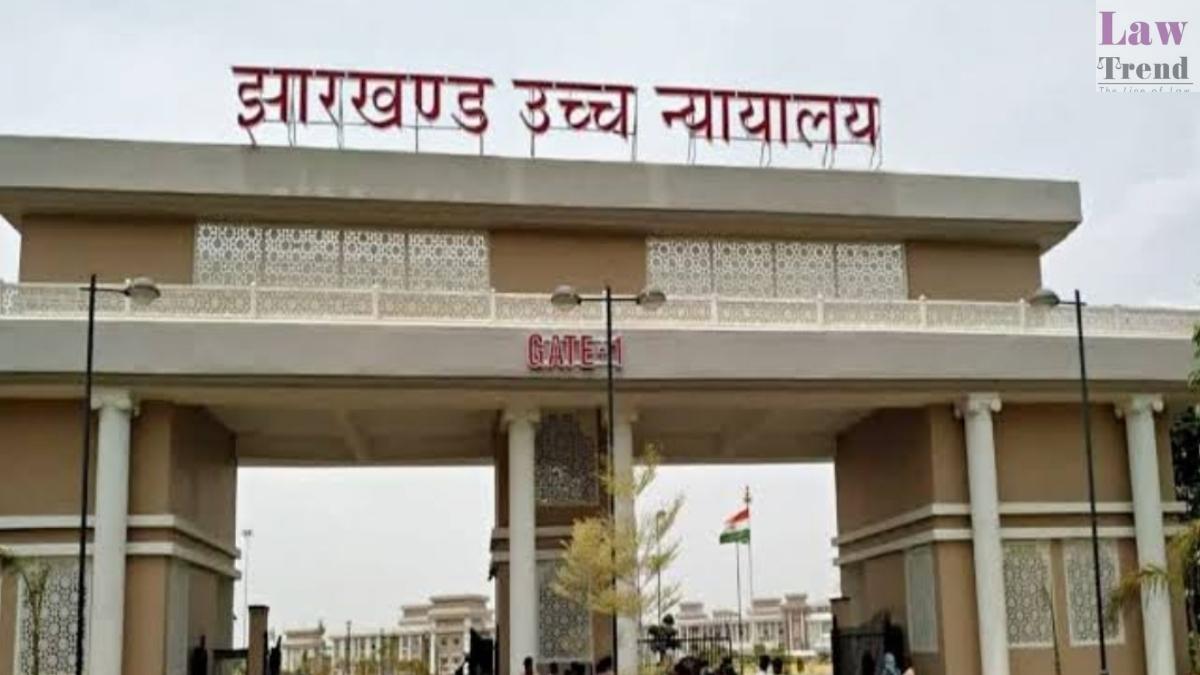
In a significant ruling concerning the fundamental right to a fair investigation and the enforcement of personal liberty under Article 21 of the Constitution of India, a Division Bench of the High Court of Jharkhand comprising Justice Sujit Narayan Prasad and Justice Sanjay Prasad has transferred the investigation into the mysterious disappearance of a 14-year-old girl to the Central Bureau of Investigation (CBI). Dealing with a habeas corpus petition filed by the victim’s mother after the minor remained untraceable for nearly six years, the Court held that the emergence of inter-State trafficking angles, digital trails spanning multiple states, and the absence of advanced forensic tools such as Gait Analysis within Jharkhand warranted the specialized resources and jurisdiction of a central agency.
Background of the Case
The case originates from a petition instituted under Article 226 of the Constitution of India seeking the tracing, recovery, and production of the petitioner’s minor daughter. According to the petition, on October 16, 2020, at approximately 10:45 AM, the 14-year-old girl left her residence in Bokaro to attend tuition classes but failed to return.
Shortly thereafter, at around 11:15 AM, a co-villager informed the father that a ladies’ bicycle, a pair of slippers, and notebooks were found scattered on the road leading towards Kurma Hospital. The father identified the articles as belonging to his daughter. A First Information Report (F.I.R. No. 161 of 2020) was registered on the same day at Pindrajora Police Station.
Despite the lapse of more than five and a half years, the local police failed to achieve any breakthrough. Although the competent Magistrate in September 2022 had permitted Narco-Analysis tests for four suspects, the tests were conducted on only three individuals in January 2023. The fourth suspect was left out on grounds of alleged medical unfitness without any medical report on record. The petitioner approached the High Court after learning of another habeas corpus proceeding concerning a missing minor from the same police station jurisdiction, expressing grave apprehension that her daughter was under unlawful confinement and that her life and liberty were in imminent danger.
Progress of Investigation and State’s Stand
During the pendency of the writ petition, the State government transferred the investigation to the Criminal Investigation Department (CID) on April 20, 2026, which constituted a Special Investigation Team (SIT). During hearings before the High Court, the CID technical team submitted that they had pursued a lead in Gopalganj, Bihar, where a female showed a 90% physical semblance to the missing child based on e-KYC records; however, the identity could not be conclusively established.
When the Court inquired why advanced scientific methods such as Gait Analysis were not deployed to corroborate identity, the technical team acknowledged that tools like Gait Analysis Technology are presently unavailable in the State of Jharkhand.
Subsequent inquiries and an affidavit filed by the State on August 17, 2026, revealed that the case involves potential cross-boundary and inter-State human trafficking, with digital IP activities traced to Delhi, Telangana, and West Bengal. Furthermore, obtaining critical historical digital records and IPDR/CDRs from foreign tech platforms such as Meta Platforms Inc. and Google LLC required specialized cross-border legal mechanisms such as Mutual Legal Assistance Treaties (MLAT).
Advocate General Rohitashya Roy, appearing for the State, submitted that the State had no objection to transferring the probe to the CBI, emphasizing that consent was a logistical and operational necessity rather than an admission of failure. Assistant Solicitor General of India (ASGI) Prashant Pallav, appearing for the CBI, also confirmed receipt of instructions stating that the central agency had no objection to taking over the investigation.
Court’s Analysis and Legal Precedents
The Court examined the constitutional scope of transferring investigations under Article 226 of the Constitution of India. The Bench reiterated that while constitutional courts possess wide powers, such extraordinary jurisdiction must be exercised cautiously and in exceptional circumstances where inter-state complexities demand central expertise.
The Court referred to the Constitution Bench judgment of the Supreme Court in State of W.B. v. Committee for Protection of Democratic Rights (2010) 3 SCC 571, quoting the established threshold:
“70. Before parting with the case, we deem it necessary to emphasize that despite wide powers conferred by Articles 32 and 226 of the Constitution, while passing any order, the Courts must bear in mind certain self-imposed limitations on the exercise of these constitutional powers. The very plenitude of the power under the said articles requires great caution in its exercise. Insofar as the question of issuing a direction to CBI to conduct investigation in a case is concerned, although no inflexible guidelines can be laid down to decide whether or not such power should be exercised but time and again it has been reiterated that such an order is not to be passed as a matter of routine or merely because a party has levelled some allegations against the local police. This extraordinary power must be exercised sparingly, cautiously and in exceptional situations where it becomes necessary to provide credibility and instill confidence in investigations or where the incident may have national and international ramifications or where such an order may be necessary for doing complete justice and enforcing the fundamental rights. Otherwise CBI would be flooded with a large number of cases and with limited resources, may find it difficult to properly investigate even serious cases and in the process lose its credibility and purpose with unsatisfactory investigations.”
The Court also highlighted that Article 21 encompasses not only the protection of the accused but also guarantees the victim the right to a fair, impartial, and effective investigation.
The Bench further relied upon Vinay Tyagi v. Irshad Ali (2013) 5 SCC 762, observing:
“43. At this stage, we may also state another well- settled canon of the criminal jurisprudence that the superior courts have the jurisdiction under Section 482 of the Code or even Article 226 of the Constitution of India to direct ‘further investigation’, ‘fresh’ or ‘de novo’ and even ‘reinvestigation’. ‘Fresh’, ‘de novo’ and ‘reinvestigation’ are synonymous expressions and their result in law would be the same. The superior courts are even vested with the power of transferring investigation from one agency to another, provided the ends of justice so demand such action. Of course, it is also a settled principle that this power has to be exercised by the superior courts very sparingly and with great circumspection.”
Reaffirming this mandate, the Court cited Dharam Pal v. State of Haryana (2016) 4 SCC 160:
“24. Be it noted here that the constitutional courts can direct for further investigation or investigation by some other investigating agency. The purpose is, there has to be a fair investigation and a fair trial. The fair trial may be quite difficult unless there is a fair investigation. We are absolutely conscious that direction for further investigation by another agency has to be very sparingly issued but the facts depicted in this case compel us to exercise the said power. We are disposed to think that purpose of justice commands that the cause of the victim, the husband of the deceased, deserves to be answered so that miscarriage of justice is avoided. Therefore, in this case the stage of the case cannot be the governing factor.”
Decision of the Court
Applying these settled principles, Justice Sujit Narayan Prasad observed that because time is of the essence and the case presents multi-state digital trails, suspected human trafficking, and a requirement for sophisticated forensic tools unavailable to the state police, entrusting the investigation to the CBI was necessary to serve the ends of substantive justice.
The High Court directed:
- The investigation into Pindrajora P.S. Case No. 161 of 2020 be forthwith handed over to the Central Bureau of Investigation (CBI).
- The Additional Director General (ADG), CID, Jharkhand, shall forthwith hand over the entire case records to the Joint Director, Eastern Zone, CBI, Ranchi.
- The Director, CBI, shall oversee the probe through periodic progress reviews.
- The CID and State authorities shall extend full and unconditional cooperation to the CBI.
- The CBI shall submit an affidavit indicating progress in the investigation on or before the next date of hearing.
Before concluding, the Court noted the sensitive nature of the case concerning a missing minor girl and cautioned against media interviews propagating the issue. The matter is scheduled for further hearing on October 27, 2026.




