

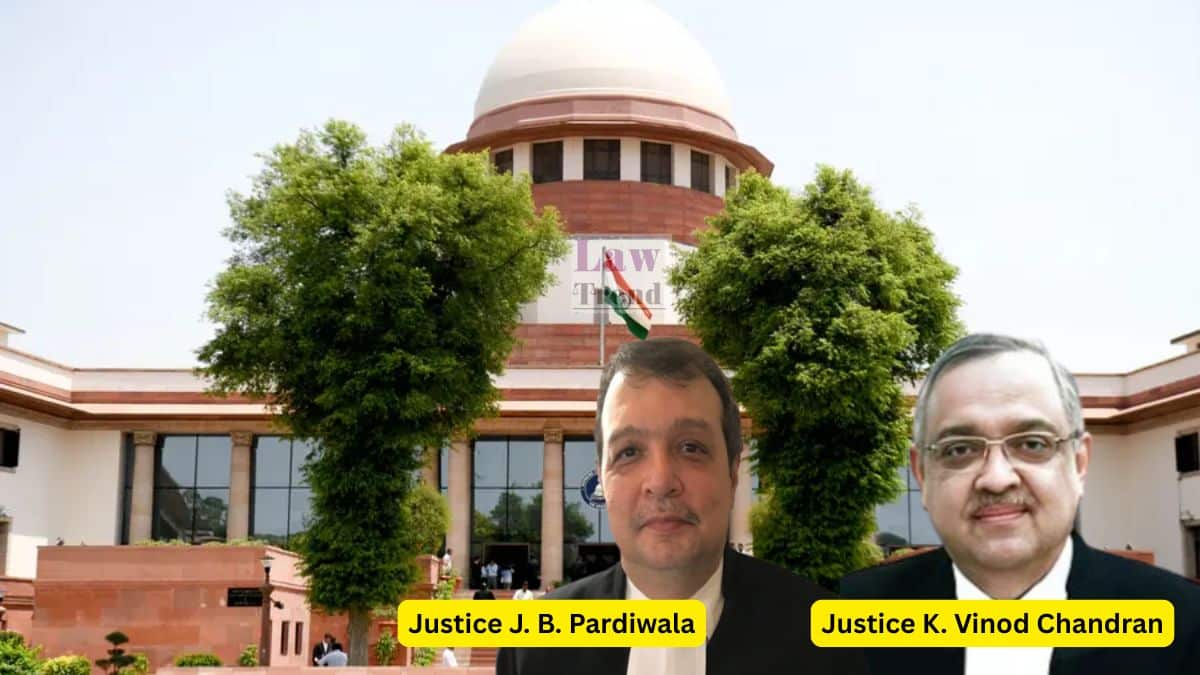
The Supreme Court has held that the right to access and use the internet is a fundamental right of every individual under Article 21 read with Article 19(1)(a) of the Constitution, and that children have this right too, whatever their age. The Court also refused to support a blanket ban on children’s access to the internet or social media. It said measures to protect children “must be directed at the harmful material and those responsible for the same, and not at the children themselves.”
A Bench of Justice J.B. Pardiwala and Justice K.V. Chandran gave the ruling on October 15, 2026, in Just Rights for Children Alliance & Anr. v. S. Harish & Ors. (M.A. Nos. 2553-2554 of 2026 in Criminal Appeal Nos. 2161-2162 of 2024; 2026 INSC 1149). In the same order, the Court laid down a detailed framework for detecting, removing and reporting Child Sexual Exploitation and Abuse Material (CSEAM) on social media platforms.
“Safety and Freedom of Children Are Not at Odds”
The Court noted a recent trend across the world of limiting children’s access to the internet, especially social media, in the name of their safety. It said it had given this idea “anxious consideration” and had “decided consciously not to endorse the same.”
The Bench made the central declaration in these words:
“In view of the foregoing, we have no hesitation in saying that the right to access and use the internet is a fundamental right of every individual under Article 21 read with Article 19(1)(a) of the Constitution. Our children, irrespective of their age enjoy the same rights, and to deny the same altogether would be as absurd as saying children below a certain age do not have a conscience worth protecting or a freedom of speech worth expressing. The safety of our children and their freedom are not at odds with each other. Our children are entitled to both.”
The Court accepted that the internet “as it exists today, is far from safe for our children.” But it said keeping children off the internet because of other people’s failures “would be to mistake the victim for the problem.” It explained that the wrongdoer is the person who creates, circulates, sells or seeks out CSEAM, along with the intermediary that fails to detect and remove it.
Question Left Open in Anuradha Bhasin Is “No Longer Res Integra”
The Bench traced how the law on this point has developed. It referred to Secretary, Ministry of Information & Broadcasting v. Cricket Association of Bengal (1995), which held that free speech under Article 19(1)(a) includes the right to receive and share information.
It then referred to Anuradha Bhasin v. Union of India (2020). In that case, a three-judge Bench held that free speech and the freedom to carry on trade through the internet are protected under Articles 19(1)(a) and 19(1)(g). It did not decide whether internet access is a fundamental right in itself. The present Bench said that question “is no longer res-integra,” relying on Pragya Prasun v. Union of India (2025 INSC 599). In that case, the Court held that “the right to digital access is an intrinsic component of the right to life under Article 21.”
The Court described the internet as “the marketplace of ideas, creative expression and information.” It said that for many children in remote areas, the internet is often their only source of learning. For children with special needs, it is often the only place where they can find others like them.
Why Blanket Age Bans Were Rejected
The Supreme Court gave several reasons against blanket age-based bans:
- Privacy and surveillance: Age checks require identifying every user and continuously collecting sensitive data. The Court said this carries a disproportionate risk of misuse and surveillance, “the kind which finds no place within the right to privacy of our people.”
- Unproven effectiveness: Experience in other countries shows that children do not stop using the internet because the law forbids it. They move to unregulated platforms that are even less safe.
- Fewer reports of abuse: Children who are being enticed or threatened online may not tell their parents for fear of being punished for using the internet. The Court said this would “defeat the avowed object of the POCSO Act.”
- The root problem stays: Keeping children off social media would not stop CSEAM from circulating.
The Bench summed up its view by saying that any blanket restriction on children’s internet access is “nothing more than unproven measures of proven disproportionality,” and that “no jurisdiction has, so far, been able to demonstrate that children are any safer on account of such measures.”
Suggestions: “Child Mode”, Parental Consent and Content Moderation
The Court made clear that it was not ruling out every kind of safeguard. It said some age-based measures are needed. It suggested a system based on parental consent, guidance and oversight, together with a dedicated “child mode” for children’s accounts. Such a mode could include:
- accounts that are private by default,
- limits on contact and messages from unknown adults, and
- moderation of the advertising and content shown to children.
The Court said these measures may apply to pre-teens, with a reasonable and proportionate way to verify parental consent. It left the details to the Union of India. It also clarified that the Union can still restrict children’s access to content that is harmful by nature, such as adult websites. The Hash and URL databases proposed in the judgment must be used only to detect and remove CSEAM and for no other purpose.
Background: CSEAM Still Spreading Despite the 2024 Judgment
The case arose from the Court’s landmark judgment of September 23, 2024, in Just Rights for Children Alliance (2024 INSC 716). That judgment dealt with the circulation of child sexual abuse material and held that social media platforms that fail to report it under the POCSO Act lose their “safe harbour” protection under Section 79 of the IT Act.
In its order dated August 14, 2026, the Court had raised concerns about serious lapses by platforms. These included news reports of paid promotion of CSEAM through redirect links and websites. In the present order, the Bench said that “despite more than two years having gone by since our judgment, it appears that there has been no progress worth the name.” Solicitor General Tushar Mehta appeared for the Union of India.
Key Directions Issued by the Supreme Court
Alongside the ruling on internet rights, the Court issued wide-ranging directions:
- National Hash & URL List Database: The Union must create a national database, which may be part of the Sahyog Portal, used only to detect and remove CSEAM. Each entry must be checked by at least three trained human analysts.
- Hash matching and URL listing: The Union must frame an SOP requiring significant social media intermediaries to use perceptual hash-matching and URL listing.
- Immediate removal: Content that matches the database (“Known Origin”) must be removed at once. Other CSEAM (“Unknown Origin”) must be verified, removed and reported within two hours.
- Reporting to authorities: Removals must be reported under Rule 11 of the POCSO Rules to the Special Juvenile Police Unit, the local police or the cyber-crime portal. Known-origin removals must be reported in a weekly consolidated report.
- Notices and grievance redressal: Platforms must display a notice wherever they remove content. They must provide a clearly labelled CSEAM reporting option that can be reached within two steps, acknowledge complaints within 24 hours, and have every report reviewed by trained grievance officers.
- Monthly compliance reports: Platforms must publish monthly compliance reports, with a separate section on CSEAM, subject to independent audit.
- Penalties: The Union must consider exemplary fines linked to the platform’s turnover, and disgorgement of revenue earned from CSEAM hosted behind paywalls or subscriptions.
- Digital safety education: Age-appropriate sex education and digital safety must form part of the core school curriculum, developed by NCERT and SCERTs. The Child Helpline 1098 and Cyber Crime Helpline 1930 must be displayed in every school. Teachers and parents must receive training.
The Court directed the Union of India, through the Ministry of Electronics and Information Technology and the Ministry of Law and Justice, to frame guidelines, SOPs and amendments to the IT Act and IT Rules where needed. The Union must file a compliance affidavit before the next hearing on December 10, 2026.
The ruling settles a question that Anuradha Bhasin had left open. Internet access is now a fundamental right, and children have it too. The Court has placed the burden of keeping children safe online on platforms, regulators and law enforcement agencies, not on children.
Case Title: Just Rights for Children Alliance & Anr. v. S. Harish & Ors.
Citation: 2026 INSC 1149
Bench: Justice J.B. Pardiwala and Justice K.V. Chandran
Date of Order: October 15, 2026




