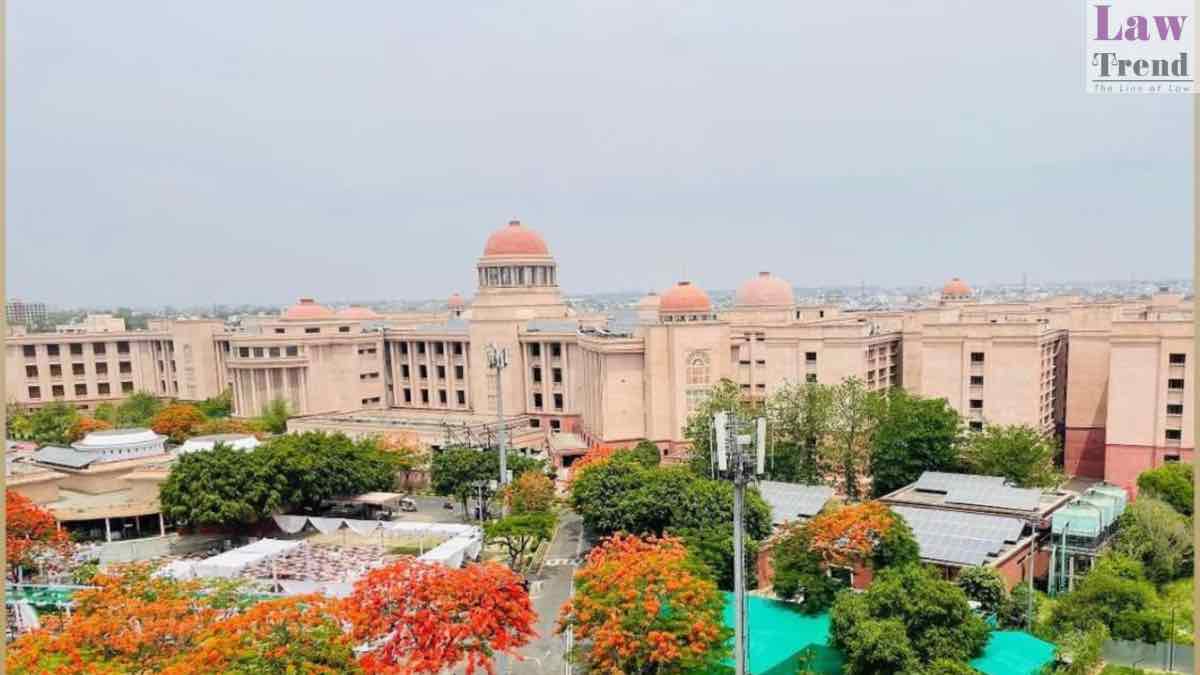
In a significant ruling on the law of limitation and arbitral jurisprudence, the High Court of Judicature at Allahabad, Lucknow Bench, comprising Justice Rajan Roy and Justice Abdhesh Kumar Chaudhary, has held that government departments cannot seek special concessions or cite administrative red tape as a “sufficient cause” to condone delays in challenging arbitral awards. Dismissing an appeal filed by the Ministry of Railways, the High Court affirmed an order of the Commercial Court, Lucknow, which had refused to condone a 28-day delay in filing objections under Section 34 of the Arbitration and Conciliation Act, 1996.
Background of the Case
The dispute originated from a lease agreement for a private railway siding required by M/s Gallant Ispat Ltd. for its integrated steel plant situated in Tehsil Sahjanwa, District Gorakhpur. To transport raw materials from Sahjanwa railway station to its plant, the company required 7,702.07 square meters of land on lease rent/license fee from the Ministry of Railways.
Initially, the Railway Authorities fixed the annual lease rent at Rs. 15,87,527/-. Upon representations by the company regarding excessive charges, the Railways re-categorized 3,660 sq. meters in village Luchai as non-agricultural (residential) and 4,502 sq. meters in village Domhermafi as agricultural, reducing the annual lease rent to Rs. 9,60,684/- per year. An agreement to this effect was executed on June 16, 2010.
Upon expiration of the agreement, the Railway Authorities proposed a fresh agreement on June 2, 2016, enhancing the lease rent to Rs. 13,47,409/- per year plus 7% service tax. The respondent company challenged this enhancement, leading to a dispute. As the agreement contained an arbitration clause, the High Court, vide order dated April 7, 2022, in Civil Misc. Arbitration Application No. 22 of 2021, appointed a Sole Arbitrator to resolve the dispute.
On December 8, 2023, the Sole Arbitrator delivered an award in favor of Gallant Ispat Ltd., directing the Railways to revise the annual lease rent to Rs. 1,23,300/- and to refund Rs. 1,79,26,701/- along with 8% interest for excess payments already collected.
Aggrieved by the arbitral award, the Railway Authorities filed objections under Section 34 of the Arbitration and Conciliation Act, 1996, before the Commercial Court, Lucknow (registered as Misc. Civil Case No. 51 of 2024), along with an application under the proviso to Section 34(3) seeking condonation of a 28-day delay. On June 5, 2025, the Commercial Court dismissed the delay condonation application and consequently rejected the objections, finding no “sufficient cause” explained by the Railways. The Railways then preferred an appeal under Section 13 of the Commercial Courts Act, 2015 read with Section 37 of the Arbitration Act, 1996.
Arguments of the Parties
Central Government Counsel Deepanshu Dass, representing the Ministry of Railways, argued that the 28-day delay fell within the 30-day extended period permissible under the proviso to Section 34(3) of the Act of 1996. He submitted that the delay was attributable to administrative exigencies and procedural movement of files across departments. Counsel emphasized that government entities, engaged in various statutory functionalities, ought to be granted concession due to inherent bureaucratic bottlenecks. He further urged the court to adopt a liberal approach on delay condonation given that the Railways had a strong case on merits. The underlying administrative timeline and file processing referenced opinions and filings prepared by counsel Anuj Dayal and Rajesh Kumar Singh.
Senior Counsel Gaurav Mehrotra, along with advocates Akash Mishra, Akber Ahmad, and Utkarsh Vardhan Singh, representing Gallant Ispat Ltd., countered that even within the 30-day extended window, condonation requires the establishment of “sufficient cause,” demonstrating that the party did not act in a negligent manner. He submitted that administrative movement of files does not constitute a valid ground. Emphasizing the principle of equal treatment under Section 18 of the Arbitration Act, he argued that the State cannot demand preferential treatment over private litigants.
To support his contentions, Senior Counsel cited several rulings of the Supreme Court and High Courts, including Basawaraj v. Land Acquisition Officer, Government of Maharashtra v. Borse Brothers Engineers & Contractors Pvt. Ltd., State of Madhya Pradesh v. Bherulal, State of Madhya Pradesh v. Chaitram Maywade, State of U.P. v. Succha Singh, State of Uttar Pradesh v. Satish Chand Shivhare & Brothers, and Executive Engineer Drainage Division v. M/s Ayush Construction.
Court’s Analysis
The Division Bench framed two primary questions for consideration:
- The scope of interference by an appellate court under Section 37 of the Arbitration and Conciliation Act, 1996.
- Whether the appellants demonstrated “sufficient cause” under the proviso to Section 34(3) of the Act to justify condoning the 28-day delay.
Scope of Section 37 Jurisdiction
Examining the statutory framework and recent precedents, the High Court observed that Section 37 jurisdiction is strictly circumscribed and narrow. Relying on MMTC Ltd. v. Vedanta Ltd., Konkan Railway Corpn. Ltd. v. Chenab Bridge Project, and Bombay Slum Redevelopment Corpn. (P) Ltd. v. Samir Narain Bhojwani, the Court held that an appellate court cannot independently re-assess the merits of an arbitral award under Section 37.
Referring to the Supreme Court’s ruling in Punjab State Civil Supplies Corpn. Ltd. v. Sanman Rice Mills, the Bench observed that appellate power under Section 37 is limited to ensuring whether the Section 34 court acted within its prescribed jurisdiction, stating:
“In view of the above position in law on the subject, the scope of the intervention of the court in arbitral matters is virtually prohibited, if not absolutely barred and that the interference is confined only to the extent envisaged under Section 34 of the Act. The appellate power of Section 37 of the Act is limited within the domain of Section 34 of the Act. It is exercisable only to find out if the court, exercising power under Section 34 of the Act, has acted within its limits as prescribed thereunder or has exceeded or failed to exercise the power so conferred.”
The Court noted that the appellate jurisdiction under Section 37 is “more akin to that superintendence as is vested in civil courts while exercising revisionary powers.”
Failure to Establish “Sufficient Cause”
Addressing the delay, the Court observed that the three-month statutory period under Section 34(3) expired on March 7, 2024. Analyzing the affidavit filed by the Railways, the Court scrutinised the timeline: it took 51 days for the initial legal opinion on January 29, 2024; 14 days to transfer the file to the Legal Department in Lucknow on February 12, 2024; 16-17 days for the Legal Department’s opinion on February 29, 2024; and over two weeks to nominate counsel on March 14, 2024.
The Court highlighted a glaring period of inaction where, after the paper book was prepared on March 18, 2024, it took 17 days for officials to sign and return the papers to counsel for filing on April 5, 2024, despite both the Railway office and the Commercial Court being located in the same city of Lucknow.
Referencing the Supreme Court’s judgment in Shivamma (Dead) by LRS v. Karnataka Housing Board, the Bench stated that “sufficient cause” cannot be used as a loose panacea for gross negligence, deliberate inaction, or casual indifference.
Rejecting the argument that government departments deserve leniency due to bureaucratic red tape, the Court referred to Postmaster General v. Living Media India Ltd., quoting the Apex Court:
“The law of limitation undoubtedly binds everybody, including the Government.”
“Condonation of delay is an exception and should not be used as an anticipated benefit for the government departments. The law shelters everyone under the same light and should not be swirled for the benefit of a few.”
The Bench also noted that under Section 18 of the Arbitration Act, both litigating parties must be treated equally. Furthermore, citing Shivamma (Dead) and Maniben Devraj Shah v. Municipal Corporation of Brihan Mumbai, the Court held that the strength of a case on merits cannot override the failure to prove “sufficient cause” for delay, as doing so would conflate preliminary procedural requirements with substantive adjudication.
Decision
The High Court held that the Railway Authorities acted negligently and failed to meet the minimum threshold of establishing “sufficient cause.” Finding no error in the Commercial Court’s order dated June 5, 2025, the Division Bench dismissed the appeal.
Case Details:
Case Title: Union Of India, Ministry Of Railways V. Gallant Ispat Ltd.
Case No.: Appeal Under Section 37 Of Arbitration And Conciliation Act 1996 No. 25 of 2025
Bench: Justice Rajan Roy, Justice Abdhesh Kumar Chaudhary
Counsel for Appellant(s): Deepanshu Dass (Central Government Counsel), Anuj Dayal, Rajesh Kumar Singh
Counsel for Respondent(s): Gaurav Mehrotra (Senior Counsel), Akash Mishra, Akber Ahmad, Utkarsh Vardhan Singh
Date: July 29, 2026