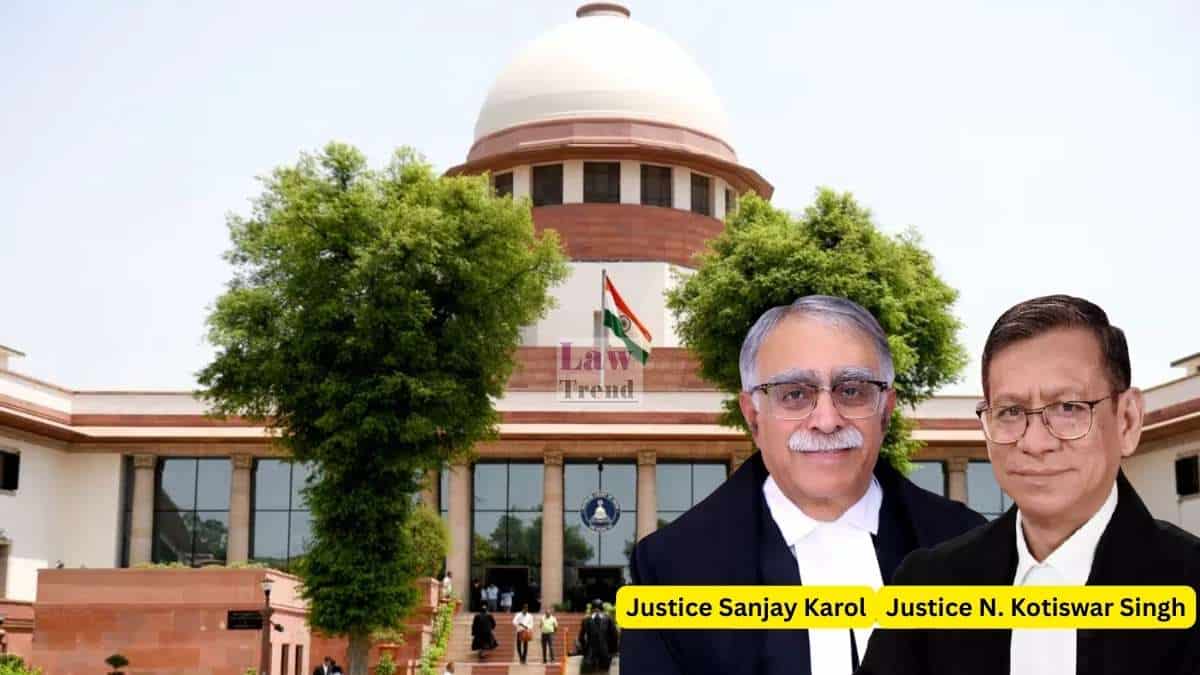
The Supreme Court of India has ruled that an employer cannot rely on its own administrative delays in processing a medical retirement application to defeat a dependent’s claim for compassionate appointment. A bench comprising Justice Sanjay Karol and Justice N. Kotiswar Singh set aside a Bombay High Court judgment that had upheld the rejection of a compassionate appointment claim by New India Assurance Company Limited. The Court held that when an employee applies for voluntary retirement on medical grounds before crossing the prescribed age threshold, the employer must act with reasonable promptitude and cannot later cite the passing of the age limit—caused by its own delay—as a ground for rejection.
Background of the Case
The matter arose from an appeal against a August 19, 2023, judgment of the High Court of Judicature at Bombay, Nagpur Bench. The second appellant, Ramnarayan Mahadeo Madankar, joined New India Assurance Company Limited as a sub-staff/Peon on October 18, 1984, and later worked as an Assistant Clerk-cum-Cashier.
On November 12, 2014, the company introduced the Scheme for Compassionate Appointment in Public Sector General Insurance Companies. The Scheme allowed for compassionate appointments of dependents in cases where an employee retired on medical grounds due to incapacitation before reaching 55 years of age.
Mr. Madankar, who suffered from serious neurological problems, was certified by the Civil Surgeon of General Hospital, Gondia, on July 21, 2015, as completely and permanently incapacitated for further service. He was 54 years old at the time. The very next day, on July 22, 2015, he submitted his application for voluntary retirement on medical grounds, enclosing the Civil Surgeon’s certificate.
Despite Mr. Madankar sending two written reminders on November 6, 2015, and December 1, 2015—both before he turned 55 on December 10, 2015—the company neither accepted his application nor rejected his medical certificate, nor called upon him to produce a Medical Board certificate.
It was only on February 3, 2016, after Mr. Madankar had crossed the age of 55, that the company demanded a disability certificate from a Medical Board. He obtained and submitted this certificate from the District General Hospital, Gondia, on February 10, 2016, within seven days of the demand. The company accepted his voluntary retirement on May 31, 2016, and relieved him on June 3, 2016. Subsequently, his son, Rahul (the first appellant), applied for a compassionate appointment.
On July 15, 2019, the company rejected the claim on the ground that Mr. Madankar had retired on June 3, 2016, after completing 55 years of age. The High Court upheld this rejection, ruling that the Civil Surgeon’s initial certificate did not satisfy the Scheme’s requirement for a Medical Board certificate, which was only obtained after the employee crossed the age threshold.
Arguments of the Parties
The respondent-company contended that Clause 1.1 of the Scheme strictly requires an employee to be “retired on medical grounds” before reaching the age of 55. They argued that because Mr. Madankar’s actual retirement took effect after he turned 55, and because the requisite Medical Board certificate was only issued post-threshold, the claim was ineligible. They maintained that compassionate appointment is an exception to general recruitment rules and must be strictly construed without scope for deviation based on sympathy.
The appellants argued that Mr. Madankar had done everything in his power to comply with the rules. He submitted his retirement application and a government medical certificate well before attaining 55 years of age and followed up repeatedly. They contended that the delay was entirely attributable to the company’s inaction and that they should not be penalized for administrative lapses beyond their control.
The Court’s Analysis
The Supreme Court examined Clause 1.1 of the Scheme, which outlines that incapacitation must be certified by a duly appointed Medical Board. It took note of established legal principles regarding compassionate appointments, referencing Umesh Kumar Nagpal v. State of Haryana (1994) 4 SCC 138 and Bhawani Prasad Sonkar v. Union of India (2011) 4 SCC 209, which state that compassionate appointment is an exception designed to help families tide over sudden financial crises and must be strictly governed by the applicable schemes.
However, the Court observed that these principles do not authorize an employer to delay processing an application to defeat a claim. The Bench referred to Malaya Nanda Sethy v. State of Orissa (2022) SCC OnLine SC 684, where it was held that applicants should not suffer due to delays by departments or authorities. The Court quoted:
“If the object and purpose of appointment on compassionate grounds as envisaged under the relevant policies or the rules have to be achieved then it is just and necessary that such applications are considered well in time and not in a tardy way.”
Applying the principle that an authority cannot take advantage of its own default, as established in Kusheshwar Prasad Singh v. State of Bihar (2007) 11 SCC 447, the Court noted:
“It is settled principle of law that a man cannot be permitted to take undue and unfair advantage of his own wrong to gain favourable interpretation of law.”
The Court observed that since the Scheme made the age of 55 a critical eligibility threshold, the company was required to scrutinize the application with reasonable promptitude. If the initial Civil Surgeon’s certificate was deemed insufficient, the company had a duty to inform the employee before the age threshold expired.
The Bench found that Mr. Madankar acted swiftly at every stage, obtaining the Medical Board certificate within seven days of the company’s first communication. The delay in obtaining the certificate before the age threshold was entirely a consequence of the company communicating its requirement only after the threshold had already been crossed. Critically criticizing the company’s approach, the Court stated:
“Such a technical construction adopted by the respondent-company would place the benefit of the Scheme at the mercy of administrative delay and would defeat the fairness inherent in the administration of a beneficial scheme.”
The Decision
The Supreme Court allowed the appeal and set aside both the Bombay High Court’s judgment of August 19, 2023, and the company’s rejection letter of July 15, 2019.
To prevent further delay from defeating the purpose of the beneficial scheme, the Court issued the following directives:
- The respondent-company must grant compassionate appointment to Rahul (the first appellant) under the Scheme in an appropriate post or cadre.
- The company must grant the necessary age relaxation if the first appellant crossed the upper age limit during the pendency of the legal proceedings.
- The appointment order must be issued within eight weeks from the receipt of the judgment.
- The first appellant will be entitled to monetary benefits only from the date of his actual appointment.
The Court did not interfere with the High Court’s directions regarding the verification and payment of any unpaid dues of Mr. Madankar, directing the company to release any such outstanding admissible dues within eight weeks. No order was made as to costs.
Case Details
Case Title: Rahul s/o Ramnarayan Madankar & Anr. Versus The New India Assurance Company Limited & Ors
Case No.: Civil Appeal No. of 2026 (Arising out of SLP (Civil) No. 27425 of 2025)
Bench: Justice Sanjay Karol and Justice N. Kotiswar Singh
Date: July 16, 2026