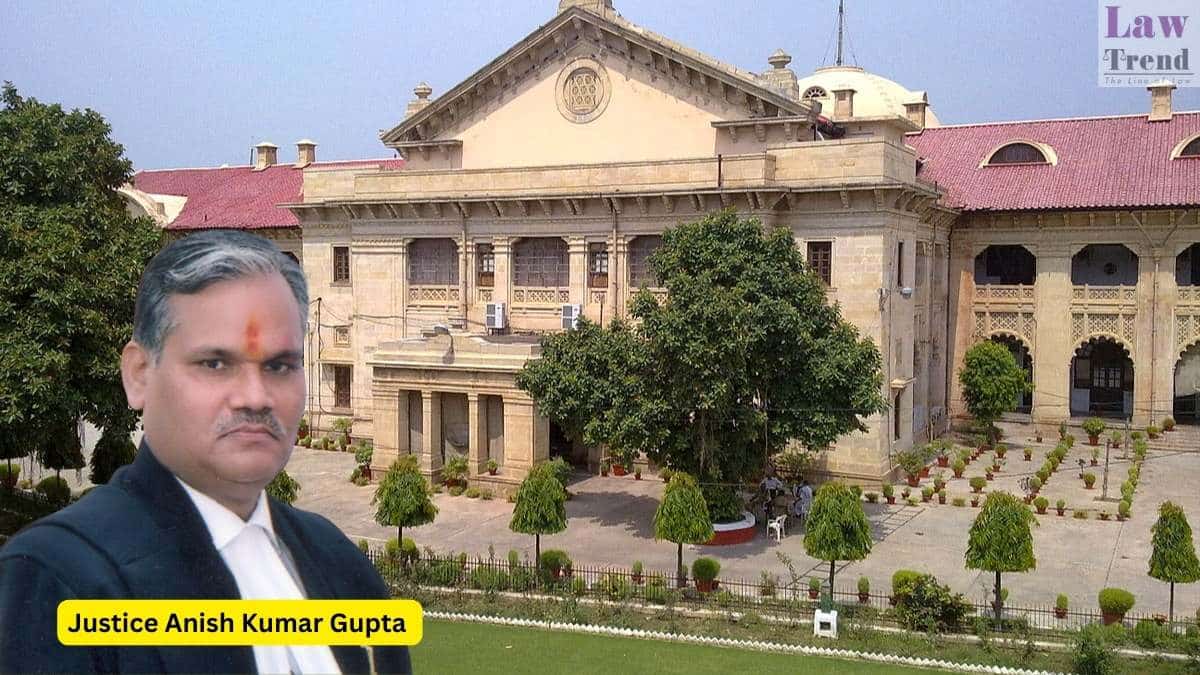
The Allahabad High Court, bench comprising Justice Anish Kumar Gupta, has ruled that the dependents of a candidate who participated in a selection process for public employment but died prior to the issuance of an appointment letter cannot claim compassionate appointment, as the candidate was never borne in service. Dismissing a writ petition challenging the rejection of a compassionate appointment claim, the Court clarified that statutory benefits under the U.P. Government Servants Dying-in-Harness Rules, 1974 and the Uttar Pradesh Police Constable and Head Constable Services Rules, 2015 are unavailable to such candidates.
Background of the Case
The case arose following an October 2018 recruitment advertisement for the posts of Constables in Civil Police and PAC in Uttar Pradesh. The petitioner’s husband applied for the post, successfully qualified the written examination, and appeared in the Physical Efficiency Test on December 29, 2019. He subsequently passed the medical examination on March 7, 2021, and was included in the final select list.
However, before the formal appointment letter was issued on June 5, 2021, the petitioner’s husband passed away on April 30, 2021. Following his demise, the petitioner applied for a compassionate appointment on the grounds of her husband’s selection. Her claim was rejected by the Superintendent of Police, Bulandshahr, through an order dated November 9, 2021. Aggrieved by the rejection, the petitioner approached the High Court seeking to quash the order.
Arguments of the Parties
Counsel for the petitioner argued that the recruitment process, which commenced in 2018, suffered from procedural delay. Had the selection process been completed in a timely manner, the petitioner’s husband would have joined as a constable prior to his death and acquired the status of a government servant, thereby entitling his dependents to claim compassionate appointment.
In support of the petition, counsel relied upon the interim order dated April 25, 2013, in Vandana Devi vs. State of U.P. and 3 Ors. (Writ-A No. 22449 of 2013) and the final judgment in Moni Devi vs. State of U.P. and Ors. (Writ-A No. 4216 of 2014, decided on February 7, 2018), arguing that relief should be granted on parity.
On behalf of the State, Additional Chief Standing Counsel Sri Rajiv Gupta contended that because the petitioner’s husband died before being issued an appointment letter, he had not entered service. He submitted that even if a candidate participates in a selection process and is finally selected, they cannot be treated as a government servant until they join service. Consequently, neither the U.P. Government Servants Dying-in-Harness Rules, 1974 nor Rule 5 of the Uttar Pradesh Police Constable and Head Constable Services Rules, 2015 apply.
The State further distinguished the cited precedents of Vandana Devi and Moni Devi, clarifying that those orders were passed under the peculiar circumstances of initial appointments being illegally cancelled by authorities and subsequently set aside by courts, which was not the case here.
Court’s Analysis and Findings
Upon examining the records and hearing both sides, the High Court observed that the petitioner’s husband died on April 30, 2021, prior to the issuance of the appointment letter.
The Court noted:
“In such circumstances, by no stretch of imagination, the husband of the petitioner could be said to be borne in service.”
Addressing the applicability of statutory rules governing compassionate appointments, Justice Anish Kumar Gupta held:
“Thus, the dependents of candidate, who has participated in the selection process for public employment, though selected, but had died prior to the issuance of appointment letter, cannot claim compassionate appointment due to his death, as such candidate had not borne in service prior to his death.”
Regarding the judicial precedents cited by the petitioner, the Court noted that both Vandana Devi and Moni Devi were rendered on their own unique facts and did not constitute binding legal precedent.
The Court observed:
“The interim order in Vandana Devi (supra) as well as the final order in Moni Devi (supra), which is also based upon the interim order passed in Vandana Devi (supra), was passed in peculiar facts and circumstances of the case and in the considered opinion of this Court, have not laid down any specific law to be applied or the aforesaid judgments to be treated as precedents.”
Decision
Finding no ground to grant the relief claimed by the petitioner, the High Court dismissed the writ petition.
Case Title: Sandhya Yadav v. State Of U.P. And 5 Others
Case No.: WRIT – A No. 6980 of 2022
Bench: Justice Anish Kumar Gupta
Date: August 18, 2026