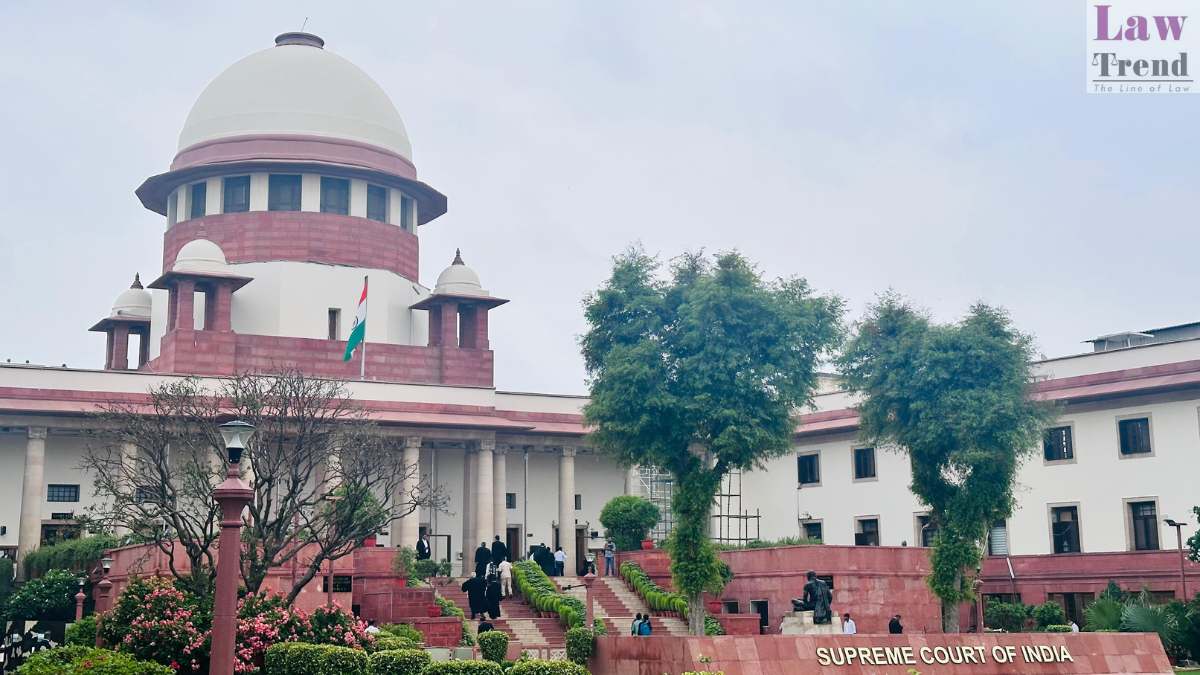
In a significant ruling on juvenile law and circumstantial evidence, the Supreme Court of India, comprising Justice Aravind Kumar and Justice Vipul M. Pancholi, held that a subsequent declaration of juvenility does not automatically erase or annul a finding of guilt recorded on evidence, though it renders the adult sentence legally ineffective. The apex court affirmed the conviction of appellant Dinesh Kumar under Sections 302/34 and 392/34 of the Indian Penal Code, 1860, while setting aside his sentences of life imprisonment and seven years’ rigorous imprisonment.
Background of the Case
The case stems from an incident that occurred on August 10, 1998. The deceased, Hari Om, worked as a driver for an Ambassador car used as a taxi from Bhiwani. On the morning of August 10, 1998, the appellant Dinesh Kumar, along with co-accused Manoj and Mukesh Kumar, hired the taxi for Sonepat. The deceased’s brother, Sumer Singh (PW-13), who knew all three accused beforehand, saw Hari Om depart with them.
When Hari Om failed to return, inquiries were made. On August 13, 1998, a decomposed male body was found in a sugarcane field near the Yamuna embankment in village Jaunpur. On August 14, 1998, PW-13 and the vehicle owner identified the body at the mortuary using the remaining physical features and clothes. FIR No. 265 of 1998 was subsequently registered at Police Station Gannaur.
On August 15, 1998, police intercepted the three accused at Taraori while they were attempting to dispose of the deceased’s Ambassador car along with its registration certificate and insurance papers. Following interrogation, discoveries were made pursuant to disclosure statements: a danda was recovered at Manoj’s instance, while the appellant Dinesh Kumar and Mukesh led police to a concealed tiffin carrier bearing an identifying engraving and Hari Om’s driving licence hidden in the sugarcane field.
The Additional Sessions Judge, Sonepat convicted all three accused on September 15, 2000, sentencing them to life imprisonment for murder and seven years’ rigorous imprisonment for robbery. The High Court of Punjab and Haryana affirmed the conviction and sentence on September 18, 2009.
During the pendency of the appeal before the Supreme Court, the appellant placed on record an order dated October 12, 2012, passed by the Principal Magistrate, Juvenile Justice Board, Sonepat. The Board declared that the appellant was seventeen years, six months, and seven days old on the date of the offence (August 10, 1998) and directed his release as he had already undergone more than three years in custody.
Arguments of the Parties
Counsel appearing for the appellant challenged the conviction on several grounds:
- The body was beyond visual recognition due to advanced decomposition.
- The medical officer (PW-9) could neither ascertain the precise cause of death nor find any bony injury.
- The broad post-mortem interval was inconsistent with the prosecution timeline.
- PW-13 was a related and solitary witness regarding the “last seen” circumstance.
- The recoveries were made from an accessible sugarcane field not owned by the accused.
- The prosecution failed to establish motive or an unbroken chain of circumstances.
Conversely, the State relied on the concurrent findings of the lower courts, arguing that:
- PW-13 knew the accused prior to the incident and saw his brother leave with them.
- All three accused were apprehended within five days in joint possession of the stolen taxi while trying to sell it.
- The appellant personally participated in the discovery of the deceased’s driving licence and tiffin carrier.
- The connected appeal of co-accused Manoj had already been disposed of by the Supreme Court on August 6, 2025, maintaining the conviction.
Court’s Analysis
Addressing the legal effect of juvenility on a trial court’s finding of guilt, the Supreme Court relied on the framework under Sections 7A and 20 of the Juvenile Justice (Care and Protection of Children) Act, 2000, along with precedents including Hari Ram v. State of Rajasthan, Dharambir v. State (NCT of Delhi), and Jitendra Singh @ Babboo Singh v. State of U.P. The Court observed:
“The subsequent declaration of juvenility does not, by itself, erase a finding of guilt recorded on evidence. It principally affects the forum and nature of the permissible disposition and renders the adult sentence legally ineffective.”
Examining the merits of the conviction, the Court reiterated the principles governing circumstantial evidence laid down in Sharad Birdhichand Sarda v. State of Maharashtra, stating that:
“A conviction based entirely on circumstantial evidence can be sustained only when each circumstance relied upon is firmly proved; the proved circumstances form a complete chain; and the chain is consistent only with the guilt of the accused and inconsistent with a reasonable hypothesis of innocence.”
Evaluating the evidentiary links, the Court highlighted:
- Last Seen & Identification: PW-13 was not a chance witness but the deceased’s brother who knew the accused beforehand. Despite facial decomposition, identification through clothes and physical features, reinforced by the disappearance of the vehicle and recovery of personal items, proved identity beyond doubt.
- Unexplained Possession of Stolen Vehicle: The joint possession of the deceased’s taxi within five days of the incident while attempting to sell it formed a critical link. Invoking Section 106 of the Evidence Act, 1872, which provides:
“106. Burden of proving fact especially within knowledge. When any fact is especially within the knowledge of any person, the burden of proving that fact is upon him.”
The Court noted:
“Once the foundational facts of last seen and recent, unexplained possession of the taxi belonging to deceased were independently proved, and the failure to furnish any plausible account became an additional link and not a substitute for proof.”
- Discoveries under Section 27: On the objection regarding the open nature of the sugarcane field, the Court observed:
“The fact that the field was not owned by the accused does not make the discovery valueless where the articles were concealed in a large standing crop and the precise location was demonstrably within their special knowledge.”
- Medical Evidence: The Court noted that while the inability of the doctor to determine the exact cause of death limited medical corroboration, it did not disprove homicidal death or override the established circumstantial chain given the decomposed state of the body.
Court’s Decision
The Supreme Court affirmed the conviction of Dinesh Kumar under Sections 302/34 and 392/34 IPC, holding that the chain of circumstantial evidence was complete and excluded any reasonable hypothesis of innocence.
However, accepting the declaration that the appellant was a juvenile on the date of the offence, the Court set aside the sentences of life imprisonment and seven years’ rigorous imprisonment, along with the fines and default stipulations. Since the appellant had already undergone custody exceeding the maximum statutory period of three years under the Juvenile Justice Act and had been released by the Juvenile Justice Board, Sonepat, the Court directed that he shall not be required to surrender and discharged his bail bonds.
Additionally, under Section 19 of the 2000 Act, the Court ruled that the appellant shall not suffer any disqualification attached to the conviction, directing the Juvenile Justice Board, Sonepat to ensure compliance regarding records. The appeal was accordingly partly allowed.
Case Title: Dinesh Kumar v. The State of Haryana
Case No.: Criminal Appeal No. 64 of 2011
Bench: Justice Aravind Kumar, Justice Vipul M. Pancholi
Date: August 12, 2026