

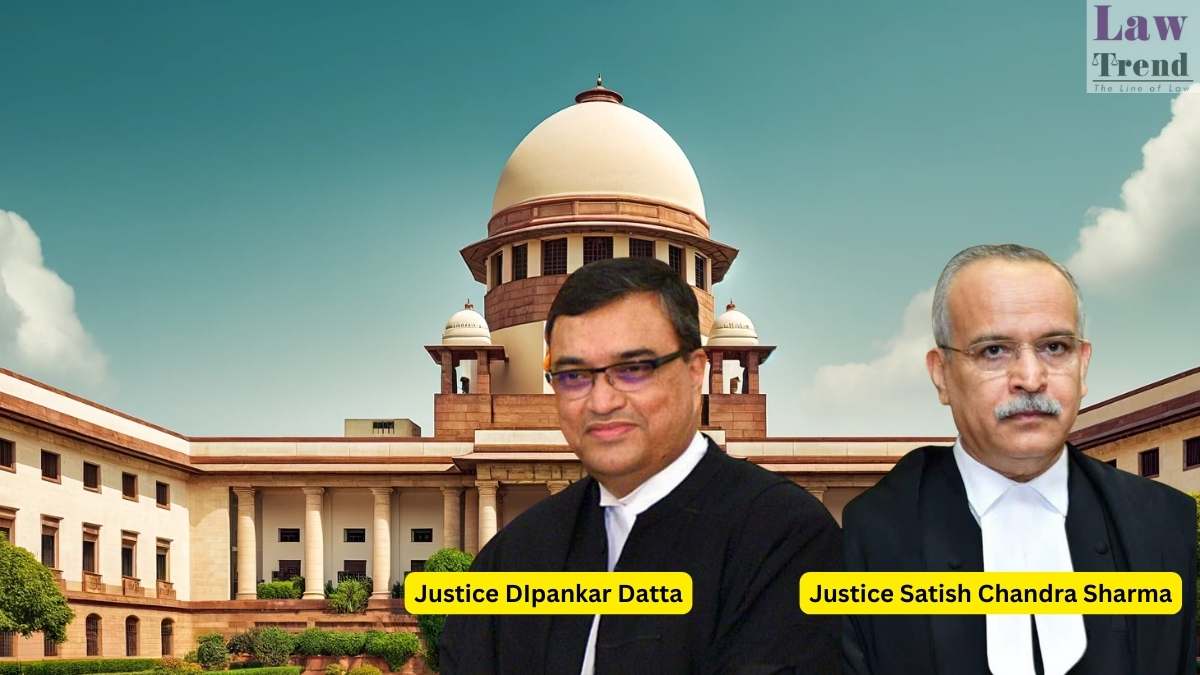
The Supreme Court of India has acquitted a constable of the Indian Reserve Battalion (IRB), Jay Prakash Yadav, who was previously convicted for the 2014 murder of his superior, Sub-Inspector Sunil Soren. A Bench of Justice Dipankar Datta and Justice Satish Chandra Sharma held that the prosecution failed to establish a complete chain of circumstantial evidence, noting that “even a single missing or weak link may prove fatal to the prosecution’s case.” The Court set aside the judgments of the Trial Court and the High Court of Jharkhand, ordering the appellant’s immediate release after nearly 12 years of incarceration.
Background and Trial History
The incident occurred on May 18, 2014, at approximately 7:30 PM at the IRBP Piparwar Camp. The prosecution alleged that the appellant shot S.I. Sunil Soren with an INSAS rifle because his request for leave had been denied.
On September 27, 2016, the Trial Court (II ASJ, Chatra) convicted Yadav under Section 302 of the Indian Penal Code and Section 27 of the Arms Act, sentencing him to life imprisonment. This conviction was subsequently affirmed by the High Court of Jharkhand on September 23, 2024. The appellant challenged these findings before the Supreme Court through a special leave petition.
Analysis of Witness Testimony
The prosecution’s case relied heavily on the testimony of the informant, a hawaldar (PW-3). In his examination-in-chief, PW-3 claimed to have seen the appellant coming from the direction of the victim’s room while holding the weapon of offence and confessing to the crime.
However, the Supreme Court highlighted a critical contradiction in PW-3’s cross-examination, where he admitted:
“After hearing the indiscriminate bullet sound, when I came out, by that time it was already darkness. It was not clearly visible on account of the darkness… From the voice of Jay Prakash, it seems that it was Jay Prakash.”
The Bench observed that this admission “materially undermines the reliability of his testimony,” as the identification was based on voice rather than visual recognition. The Court further noted that other witnesses (PW-4 to PW-9) were either hearsay witnesses or had turned hostile.
Ballistic Evidence and “Rifle Exchange” Theory
The prosecution argued that although the appellant was issued a rifle with butt no. 329, he used a rifle with butt no. 351 to commit the crime. A jawan (CW-3) testified that their rifles had been inadvertently exchanged ten days prior to the incident.
The Supreme Court expressed strong reservations about this claim:
“It is difficult to accept that in a disciplined force, exchange of rifles allotted to two jawans would remain unnoticed for long ten days. Significantly, the duty register for 18th May, 2014 was not led in evidence.”
The Court found that in the absence of the relevant duty register, it would not be safe to sustain a conviction based on “mere suspicion.”
Legal Principles on Circumstantial Evidence
Reaffirming the principles laid down in Sharad Birdhichand Sarda v. State of Maharashtra (1984), the Court emphasized that for a conviction based on circumstantial evidence, the chain must be so complete as to point unerringly to the guilt of the accused. The Bench stated:
“Where, on the same set of evidence, two views are reasonably possible, the benefit of doubt must necessarily be extended to the accused.”
The Bench further remarked that the High Court had “missed the woods for the tree” by failing to see how the appellant had successfully demolished the informant’s version during cross-examination.
Conclusion and Orders for Reinstatement
Finding the evidence “wholly insufficient,” the Supreme Court set aside the conviction. Noting that the appellant had been in custody for 12 years, the Court ordered his immediate release.
Regarding the appellant’s dismissal from service following his initial conviction, the Court provided the following directions:
“He is granted liberty to seek reinstatement before his appointing authority with such other consequential benefits… provided he is still mentally and physically capable of discharging his duties.”
The Court added that if the appellant is found unfit for duty, his appointing authority should ensure he is “financially compensated adequately.”
Case Details:
- Case Title: Jay Prakash Yadav vs. The State of Jharkhand
- Case Number: Criminal Appeal No. ___ of 2026 [Arising out of SLP (Crl.) No. 2536 of 2026]
- Bench: Justice Dipankar Datta and Justice Satish Chandra Sharma
- Date of Judgment: April 06, 2026




