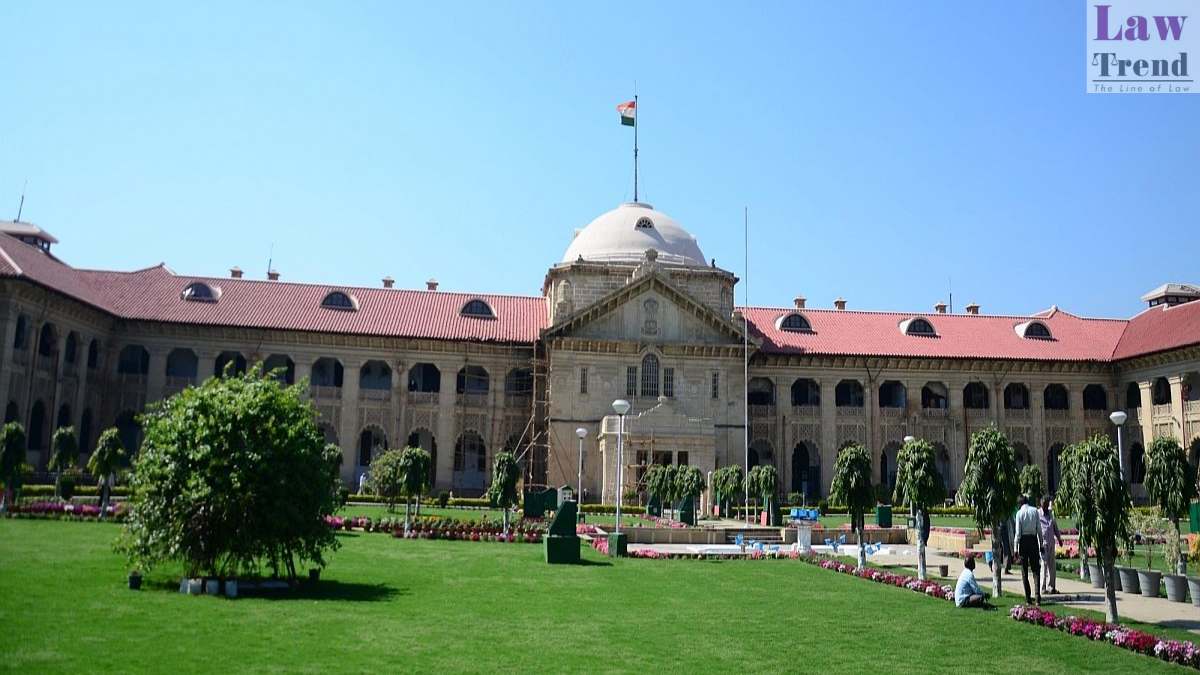
The Allahabad High Court has set aside a summoning order and charge-sheet against an appellant under the Scheduled Castes and Scheduled Tribes (Prevention of Atrocities) Act, 1989, ruling that a dispute essentially civil in nature over tenancy and rent was given a “criminal colour.” In an appeal decided by Justice Santosh Rai, the High Court emphasized that criminal proceedings must not be used as an instrument of harassment, oppression, or to settle personal scores in disputes that are predominantly civil.
Background of the Case
The case arose from an alleged incident on March 12, 2023, near a shop located near the Arya Samaj Temple premises in District Bulandshahr. The complainant (opposite party no. 2) was a tenant of the temple, while the appellant, Lalit Kumar (also known as Lalit Arya), worked as the temple’s cashier.
An First Information Report (FIR) was lodged on April 9, 2024—more than a year after the alleged incident—naming five known individuals (including the appellant, Vivek Sonkar, Vijay Solanki, Manoj Solanki, and Vijendra Singh) along with five to six unknown persons. The complainant alleged that the accused had caused injuries and made a casteist remark (“Chamar”) at the victim’s shop.
However, upon completing the investigation, the Investigating Officer found no credible material against the other named individuals and submitted the charge-sheet solely against the appellant. Consequently, the Special Judge, SC/ST (PA) Act, Bulandshahr, issued a summoning order on July 8, 2024, in Session Case No. 916 of 2024 (arising out of Case Crime No. 290 of 2024), which the appellant subsequently challenged before the High Court.
Arguments of the Parties
The counsel for the appellant argued that the FIR was lodged after an unexplained delay of more than one year, making the prosecution’s case highly doubtful. The counsel also highlighted that despite the FIR naming multiple accused, only the appellant was charge-sheeted. It was contended that the appellant was falsely implicated due to prior animosity arising from temple-related rent and tenancy affairs, where the victim was a tenant and the appellant served as the cashier.
The Government Advocate (AGA), representing the State of Uttar Pradesh, strongly opposed the appeal. The AGA argued that the material collected during the investigation, specifically the victim’s statement recorded under Section 161 of the Code of Criminal Procedure (Cr.P.C.), established a prima facie case against the appellant. The prosecution maintained that neither the delay in lodging the FIR nor the fact that other co-accused were not charge-sheeted justified discarding the case at this preliminary stage, as the allegations disclosed cognizable offences under the Indian Penal Code (IPC) and the SC/ST Act.
The Court’s Analysis and Precedents
Upon reviewing the records, the High Court noted that the prosecution failed to provide a satisfactory explanation for the substantial delay of over a year in lodging the FIR. It observed that the victim deposited rent with the temple where the appellant worked as its cashier, indicating that previous animosity concerning temple-related tenancy affairs was highly relevant and could not be ruled out.
The Court examined the statutory requirements of Sections 3(1)(r) and 3(1)(s) of the SC/ST Act, noting that the offences require the incident to have occurred in “public view” with the specific intent to humiliate or insult the victim solely because they belong to a Scheduled Caste or Scheduled Tribe category. In this case, the Court found that the incident allegedly occurred near the shop of the complainant.
The Court relied on several landmark rulings of the Supreme Court to analyze the case:
- Swaran Singh v. State (2008): The Apex Court distinguished between a “public place” and “any place within public view,” holding that while a private place visible to the public can be “within public view,” mere abuse or a quarrel without the requisite intent to humiliate does not attract the provisions of the SC/ST Act. The Court also noted that words like “Chamar” may amount to an offence if used as a casteist abuse with intent to humiliate, but criminal proceedings should only continue where the allegations disclose a prima facie offence.
- Gorige Pentaiah v. State of A.P. (2009): The Court cited this judgment to emphasize: “when the basic ingredients of the offence are missing in the complaint, then permitting such complaint to continue and to compel the appellant to face the rigmarole of the criminal trial would be totally unjustified leading to abuse of process of law.”
- Hitesh Verma v. State of Uttarakhand (2020): The Supreme Court held that a dispute arising inside a private house or area without the presence of independent public witnesses does not satisfy the statutory threshold of Section 3(1)(r).
- Inder Mohan Goswami v. State of Uttaranchal (2008) & Ganga Dhar Kalita v. State of Assam (2015): The Court noted that criminal prosecution should not be permitted to be used as an instrument of harassment or to settle personal scores in disputes that are predominantly civil. Giving a “criminal colour” to such matters amounts to an abuse of the process of law.
Applying these principles, the High Court observed:
“The dispute between the parties primarily emanates from a civil controversy relating to rent of tenancy, and the criminal proceedings appear to have been initiated in the backdrop of the said dispute.”
The Court further held:
“In the absence of any specific allegation of intentional caste-based insult or humiliation attracting the provisions of the SC/ST Act, permitting the criminal proceedings to continue would amount to an abuse of the process of law.”
The Decision
Finding that the essential ingredients of the offences under Sections 3(1)(r) and 3(1)(s) of the SC/ST Act were not prima facie disclosed, the High Court concluded that the impugned charge-sheet and summoning order could not be sustained in the eyes of law.
Accordingly, the High Court allowed the appeal and set aside the impugned order dated July 8, 2024, passed by the Special Judge, SC/ST (PA) Act, Bulandshahr. The Registrar (Compliance) was directed to communicate this order to the court concerned through the District and Sessions Judge, Mahoba, by e-mail or FAX within a week.
Case Details:
Case Title: Lalit Kumar @ Lalit Arya Versus State of U.P. and Another
Case No.: CRIMINAL APPEAL No.4147 of 2026
Bench: Justice Santosh Rai
Date: July 16, 2026