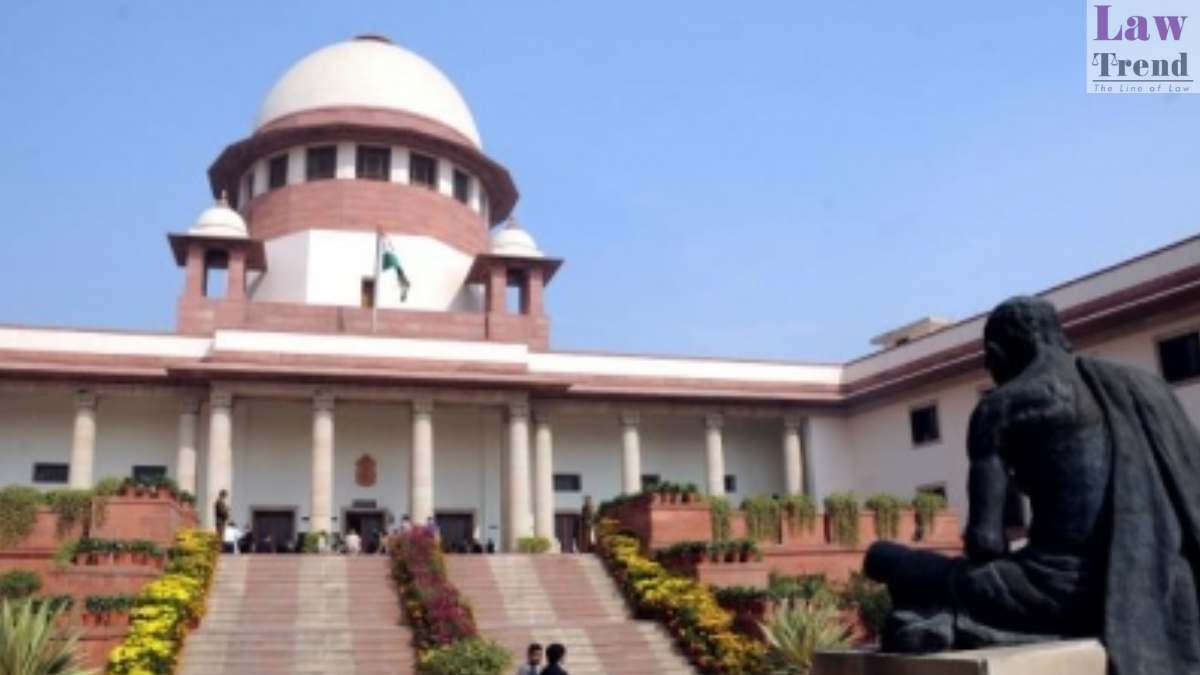
In a significant ruling on service jurisprudence, Justice Sanjay Karol and Justice Augustine George Masih of the Supreme Court of India held that an employee cannot be accused of suppressing information or submitting false declarations regarding a pending criminal case unless it is proved that the candidate had prior knowledge of such proceedings. Setting aside the dismissal of an employee from The Fertilizers and Chemicals Travancore Ltd. (F.A.C.T.), Justice Augustine George Masih, writing for the Bench, ordered the worker’s immediate reinstatement with 50% backwages, emphasizing that knowledge of a fact is an essential prerequisite for any charge of non-disclosure.
Background of the Case
The appellant, Shatrughn Yadav, was appointed on May 5, 2021, as a Technician (Process) on a consolidated pay for an initial tenure of two years by Fertilizers and Chemicals Travancore Ltd. Upon joining, he filled out an attestation form declaring that no criminal case was pending against him.
Six months later, the employer sought verification of his criminal antecedents from the District Magistrate. In a response dated March 22, 2022, the District Magistrate disclosed that a Non-Cognizable Report (NCR) dated April 3, 2019, had been registered against the appellant under Sections 323 and 504 of the Indian Penal Code (IPC). F.A.C.T. subsequently issued a show cause notice on April 30, 2022, calling upon the appellant to explain why his employment should not be terminated for providing false information.
In his reply, the appellant submitted that he acted in good faith and had not suppressed any information, as he was entirely unaware of the NCR. He clarified that he had never received any summons, nor was he ever arrested or called to the police station in connection with the case. In support of his position, he submitted a character certificate dated July 9, 2020, issued by the Superintendent of Police, District Maharajganj, which confirmed no adverse entries in police records. Later, on June 6, 2023, he produced a police report confirming that his name was deleted from the array of accused persons because no evidence was found against him.
Despite his explanations, F.A.C.T. issued a termination letter on August 5, 2023. The appellant challenged the termination before the High Court of Kerala. A Single Judge dismissed the writ petition, holding that the appellant’s claim of lack of knowledge involved a disputed question of fact. A Division Bench of the Kerala High Court affirmed this ruling in Writ Appeal No. 414 of 2025 on July 4, 2025, leading the appellant to appeal to the Supreme Court.
Arguments of the Parties
Counsel for the appellant contended that the High Court failed to examine whether there was deliberate suppression or submission of false information, rather than mere non-disclosure. Relying on Ravindra Kumar v. State of U.P. and Avtar Singh v. Union of India, it was argued that termination cannot be an automatic outcome of criminal antecedents and that each matter must be assessed on its own facts. Counsel submitted that the appellant truthfully answered the form to the best of his knowledge and that the High Court erred in refusing to exercise writ jurisdiction on the ground of disputed questions of fact when the legality of the termination was the core issue.
On the other hand, counsel for F.A.C.T. argued that non-disclosure rendered the candidate unfit for service because the employment offer was conditional on clear antecedents. The company contended it was implausible for the appellant to be unaware of the NCR since his parents were also named in it. Furthermore, the company argued that the appellant should have availed remedies under the Industrial Disputes Act, 1947, rather than filing a writ petition, and that any reinstatement should only be on a consolidated pay appointee basis.
Court’s Analysis and Legal Precedents
The Supreme Court first rejected the employer’s preliminary objection on maintainability, reaffirming that the existence of an alternative remedy under the Industrial Disputes Act does not operate as an absolute bar to writ jurisdiction, especially when the challenge is to the legality of a termination order.
On the substantive legal issue, the Bench examined the law summarized in the three-Judge Bench decision in Avtar Singh v. Union of India, specifically highlighting the core principle governing candidate knowledge:
“38.11. Before a person is held guilty of suppressio veri or suggestio falsi, knowledge of the fact must be attributable to him.”
The Court stressed that an employer must apply its mind rather than acting mechanically. Citing Ravindra Kumar v. State of UP and Umesh Chandra Yadav v. Inspector General and Chief Security Commissioner, Railway Protection Force, Northern Railway, New Delhi and others, the apex court reiterated that power must be exercised in a reasonable and objective manner. Referring to Umesh Chandra Yadav, the Bench cited:
“14. This cannot be disputed that the candidate who intend to participate in the selection process is required to furnish correct information relating to his character and antecedents in the verification/attestation form before or after his induction into service. At the same time, it is also true that the person who has suppressed the material information, cannot claim unfettered right of seeking appointment or continuity in service but, at the same time, he has a right not to be dealt with arbitrarily and power has to be exercised in reasonable manner with objectivity having due regard to the facts of the case on hand. The yardstick which has to be applied always depends upon the nature of post, nature of duties, impact of suppression on suitability has to be considered by the competent authority considering post/nature of duties/services and power has to be exercised on due diligence of various aspects at the given time and no hard-and-fast rule of thumb can be laid down in this regard.”
The Supreme Court summarized that employers must undertake a two-pronged inquiry prior to terminating an employee for non-disclosure:
- Factual Inquiry: Whether there was actual suppression or submission of false information, taking into account the candidate’s knowledge at the relevant time.
- Application of Mind: Whether the employer considered specific circumstances, including the gravity of the offence, duties of the post, and final outcome of criminal proceedings, to determine if termination is the only feasible option.
Applying these tests to the present case, the Bench noted that the appellant established his lack of knowledge through reliable documents, including police certificates showing he was never summoned, arrested, or interrogated. The Court dismissed the employer’s claim regarding the involvement of his parents as mere conjecture, observing:
“Needless to say, knowledge of a fact is a necessary pre-requisite for its non-disclosure. The very concept of suppression presupposes an awareness of that which is suppressed; one cannot be said to have withheld or concealed something of which one had no knowledge in the first place. It would be both illogical and unjust to hold a candidate liable for suppression of information that was never within his knowledge to begin with.”
The Court added that the onus of substantiating lack of awareness rests on the candidate through cogent material, which the appellant satisfied. The Bench found that F.A.C.T. failed on the second prong as well, as it acted on a mechanical presumption that any criminal antecedent automatically disqualified the candidate.
Decision of the Court
The Supreme Court held that the termination order was illegal and unsustainable. Consequently, the Court set aside the Kerala High Court judgments and the termination order dated August 5, 2023, directing F.A.C.T. to reinstate the appellant forthwith with all consequential benefits. Backwages were restricted to 50%, to be paid within eight weeks, failing which interest at 6% per annum will be applicable from the date due until payment.
Case Title: Shatrughn Yadav v. The Fertilizers and Chemicals Travancore Ltd. (F.A.C.T.) and Others
Case No.: Civil Appeal No. ______ of 2026 (Arising out of SLP (Civil) No. 7197 of 2026)
Bench: Justice Sanjay Karol and Justice Augustine George Masih
Date: August 11, 2026