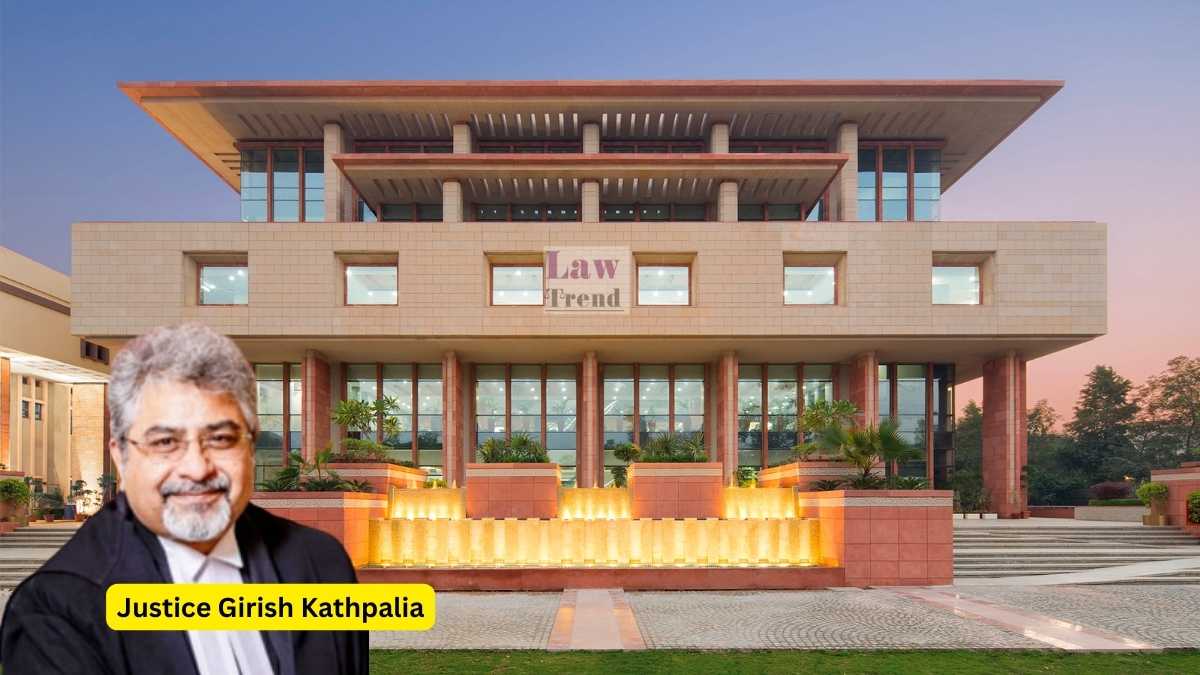
The Delhi High Court, presided over by Justice Girish Kathpalia, has ruled that the statutory bar against filing a second revision petition under Section 397(3) of the Code of Criminal Procedure (CrPC) [now Section 438(3) of the Bharatiya Nagarik Suraksha Sanhita (BNSS)] cannot be bypassed by invoking the court’s inherent powers unless a clear case of gross injustice is established. Rejecting a petition filed by an accused who challenged a revisional court’s order modifying interim compensation under the Negotiable Instruments (NI) Act, the High Court termed the plea “completely frivolous” and dismissed it with costs of Rs. 10,000.
Background of the Case
The case originated from a complaint filed by the respondent, Geeta Thakur, under Section 138 of the NI Act. According to the complaint, the respondent had advanced a friendly loan of Rs. 5,00,000 in several installments to the petitioner, Naginder Singh, and a co-accused (who was not made a party in the present petition) through multiple cheques at their joint request. The petitioner and the co-accused had assured the respondent that they would return the loan amount within two years.
In discharge of their liability, the petitioner issued a cheque, which was subsequently dishonoured due to insufficient funds in his bank account. Despite the service of a statutory demand notice, the cheque amount was not paid, prompting the respondent to file a complaint.
During the trial court proceedings, the magistrate directed both the petitioner and the co-accused to pay 20% of the cheque amount to the respondent as interim compensation under Section 143A of the NI Act. The petitioner and the co-accused challenged this direction by filing a criminal revision petition before the Court of Sessions.
By an order dated January 28, 2026, the revisional court observed that the petitioner and the co-accused had admitted in their defence that they received the Rs. 5,00,000 loan from the respondent by way of cheques. Consequently, the revisional court upheld the decision to award 20% interim compensation. However, relying on the Supreme Court precedent in Mrs. Aparna A. Shah vs M/s Sheth Developers P. Ltd. & Anr (Criminal Appeal No. 813/2013), the Sessions Court modified the order, holding that since the cheque was signed only by the petitioner, he alone—being the drawer of the cheque—was liable to pay the interim compensation.
The petitioner subsequently approached the High Court to challenge this modification.
Arguments of the Parties
Before the High Court, the legal issue of the petition’s maintainability was raised, specifically concerning whether the petition was barred under Section 397(3) CrPC [now Section 438(3) BNSS], which prohibits a party from filing a second revision petition.
The learned counsel representing the petitioner argued that the statutory bar under Section 397(3) CrPC does not operate when a party invokes the High Court’s inherent powers and presents a case of gross injustice.
To demonstrate “gross injustice,” the petitioner’s counsel contended that the petitioner had received only Rs. 50,000 out of the total Rs. 5,00,000 loan amount, and therefore, he could not be held liable to pay the entire cheque amount. The counsel further submitted that the petitioner had “only signed” the cheque.
The respondent was not represented by any counsel during the hearing.
Court’s Analysis and Observations
The High Court agreed with the petitioner’s legal proposition that the statutory bar does not entirely prevent the court from exercising its inherent powers if gross injustice is established. However, the Court emphasized that inherent powers cannot be used to circumvent explicit statutory prohibitions under normal circumstances.
Evaluating the maintainability of the petition, the Court observed:
It is trite that what is explicitly prohibited by law cannot be given backdoor entry by invoking inherent powers. But where the petitioner seeking invocation of inherent powers is able to establish a case of gross injustice, the High Court would certainly be justified in invoking inherent jurisdiction in the nature of second revision.
Applying this principle to the facts, the Court rejected the petitioner’s argument on merits. Addressing the petitioner’s claim of having received only Rs. 50,000, the Court remarked:
I am not at all convinced with this argument, because if he received only Rs.50,000/-, there was no reason for him to draw cheque of Rs.5,00,000/-.
The Court further noted that the petitioner’s argument of only signing the cheque made no difference in light of the admitted defence where the receipt of the Rs. 5,00,000 loan was acknowledged. The Court found no element of gross injustice in the case, noting:
Today, having heard the learned counsel for petitioner, I do not find this petition worth issuing notice. Rather, the petition is found completely frivolous.
The Court concluded that the plea was a clear attempt to bypass the statutory bar, stating:
It is certainly not a case of gross injustice for which this court would invoke inherent powers and allow backdoor entry to this second revision petition ignoring the bar under Section 397(3) CrPC [now Section 438(3) BNSS].
Decision of the Court
The High Court upheld the revisional court’s order dated January 28, 2026, and dismissed the petition. Additionally, the Court imposed costs of Rs. 10,000 on the petitioner, directing him to deposit the amount with the Delhi High Court Legal Services Committee (DHCLSC) within one week. The trial court was also sent a copy of the order to ensure compliance with the cost order.
Case Details: Case Title: Naginder Singh v. Geeta Thakur
Case No.: CRL.M.C. 2527/2026 & CRL.M.A. 10253/2026
Bench: Justice Girish Kathpalia
Date of Decision: 19.05.2026