

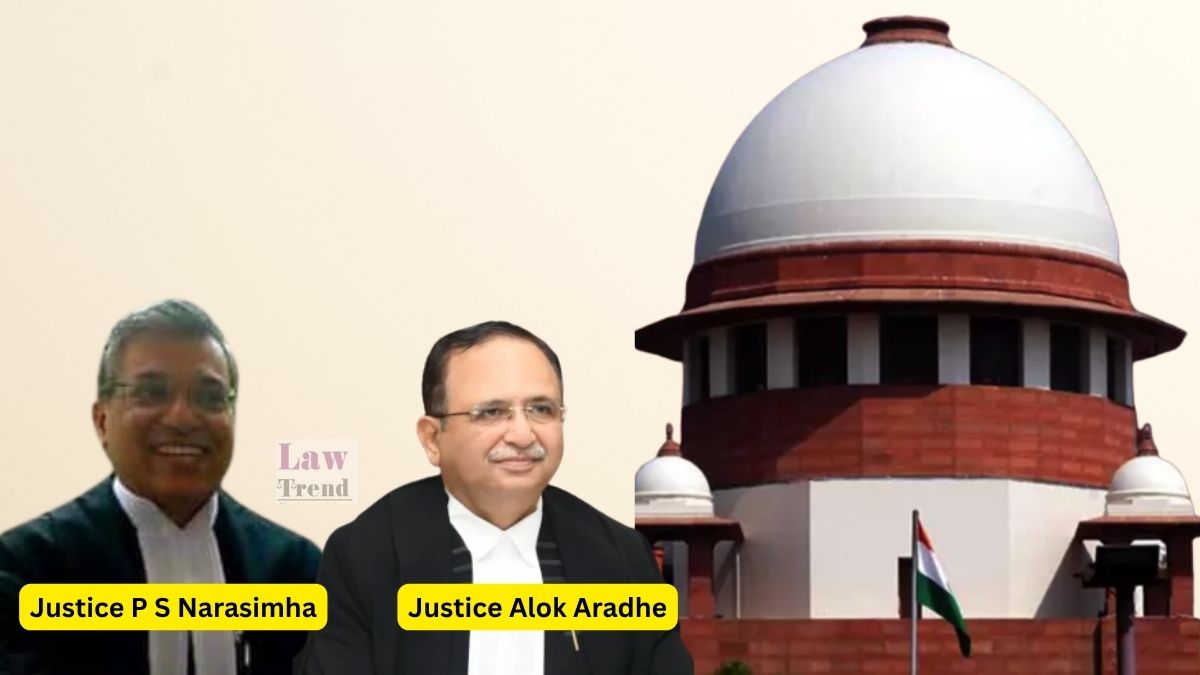
The Supreme Court has held that a Debts Recovery Tribunal (DRT) that issues a recovery certificate can execute it against property lying outside its own territorial limits. The Court ruled that the word “may” in Section 19(23) of the Recovery of Debts and Bankruptcy Act, 1993 (RDB Act) cannot be read as “shall”. Sending the certificate to the DRT where the property is located is therefore a matter of judicial discretion, not a mandatory step.
A Bench of Justice Pamidighantam Sri Narasimha and Justice Alok Aradhe allowed the State Bank of India’s appeal and set aside a Madras High Court ruling that only DRT Madurai could execute the certificate. The Bench also laid down a structured test and safeguards that DRTs must follow when deciding whether to keep execution with themselves or send the certificate to another Tribunal.
Background
S. Loganathan (the borrower) and his late wife were partners in a firm that took credit facilities from SBI’s Commercial Branch at Tiruchirappalli between 2004 and 2006. As guarantors, they mortgaged two properties in K. Sathanur Village, Tiruchirappalli District, which falls within the territorial jurisdiction of DRT Madurai.
After the account turned irregular, SBI filed a recovery application before DRT Madurai in 2010. The borrower alleged bias and sought a transfer. On his applications, the Debts Recovery Appellate Tribunal first moved the matters to DRT-II, Chennai, and then to DRT-III, Chennai.
On 16.09.2020, DRT Chennai held SBI entitled to recover ₹1,50,77,944, and on 07.01.2022 it issued the recovery certificate. Its Recovery Officer attached both properties and took physical possession of one of them. On a writ petition filed by the borrower, the High Court held on 22.08.2025 that DRT Madurai alone could execute the certificate and that it ought to have been transmitted there.
Arguments
Additional Solicitor General N. Venkataraman, appearing for SBI, argued that the Tribunal is not bound by the Code of Civil Procedure (CPC). He submitted that “may” in Section 19(23) is directory and leaves the Tribunal free either to execute the certificate itself or to send it on. He added that the proceedings had moved to Chennai at the borrower’s own request, that the borrower had filed about 49 applications and appeals, and that the dues stood at about ₹9.39 crore as on 28.02.2026.
The borrower, appearing in person, argued that since neither property lay within DRT Chennai’s jurisdiction, it was obligatory to transmit the certificate to DRT Madurai. He contended that execution by an officer acting without jurisdiction offended Article 300A of the Constitution.
Amicus Curiae Ms. Devanshi Singh submitted that the RDB Act contains no express territorial bar. She argued that Section 39(4) of the CPC cannot be imported into the Act to create one. She also drew the Court’s attention to the split among High Courts on the question.
Court’s Findings
The Court held that provisions of the CPC do not apply to execution proceedings under the RDB Act in a way that restricts the Tribunal’s powers. It drew a distinction between a Tribunal’s territorial jurisdiction to decide a claim, which Section 19(1) governs, and the territorial reach of its Recovery Officer when executing the certificate. Section 19(1) makes no reference to where the mortgaged property is located.
On Section 19(23), the Court noted that Parliament used “may” in the main provision and “shall” in the proviso. It observed that “Where Parliament intended a territorial restriction on execution under the Code, it enacted one expressly.” It added that the RDB Act provides no consequence for not transmitting a certificate. A mandatory reading, the Court said, would split execution across several Tribunals and defeat the Act’s goal of speedy recovery. In its words, “Execution proceedings, as this Court has emphasised, must not be permitted to become a means of delaying the fruits of an adjudication.”
The Bench, however, made clear that the discretion has limits. It observed, “It is a judicial discretion, which must be exercised according to the rules of reason and justice, not according to private opinion; according to law, and not humour.” The discretion lies with the Tribunal’s Presiding Officer, not with the Recovery Officer. A certificate holder cannot exercise it simply by filing an affidavit.
The Court approved the view taken by the Gujarat and Bombay High Courts, subject to the parameters it laid down. It held that the contrary rulings of the Delhi, Punjab & Haryana and Calcutta High Courts do not lay down the correct law.
Structured Test and Safeguards
Under the structured test, a DRT must do five things:
- determine the property’s location, its ownership and the question of territorial jurisdiction;
- identify what execution requires, including whether the property is occupied, tenanted, the debtor’s home, subject to third-party claims or already attached by another Tribunal;
- examine whether its own Recovery Officer can carry out execution with local assistance;
- weigh convenience, expedition, cost, multiplicity, the stage of execution, the parties’ conduct and possible prejudice; and
- pass a reasoned order.
The Court stated, “Neither the geographical location of the property, viewed in isolation, nor the convenience of one of the parties can constitute the sole basis for determining the appropriate course of execution.”
As a safeguard, the decision must ordinarily be taken when the certificate is issued, or as soon as possible after that. In any event, it must come before any coercive step is taken against property outside the Tribunal’s limits, and only after notice to both parties.
Application to the Case
The Court noted that both properties are in a single district, both have already been attached, and nothing on record shows any third-party occupation or prior attachment. It found that the remaining steps could be carried out by DRT Chennai’s Recovery Officer with local assistance. This was subject to the safeguards and to protection for a legal representative who is stated to have an intellectual disability.
On the borrower’s objection to jurisdiction, the Court held that “The Borrower was unable to demonstrate any prejudice caused to him, particularly when it was at his own instance that the proceedings were transferred to Chennai.” It declined to decide his other pleas, including those on abatement and fraud. It said these did not arise from the High Court’s judgment, which dealt only with territorial jurisdiction.
Outcome
The Supreme Court quashed the High Court’s judgment and restored the recovery proceedings, including the attachment order of 13.01.2023. It directed the Recovery Officer of DRT-III, Chennai to resume execution from the stage at which it was halted, following the structured test and safeguards. The Recovery Officer was asked to try to finish, preferably within six months. No costs were imposed.
Case Title: Asst. General Manager, State Bank of India v. S. Loganathan & Ors.
Case No.: Civil Appeal No. ___ of 2026 (arising out of S.L.P. (C) No. 38284 of 2025)
Bench: Justice Pamidighantam Sri Narasimha and Justice Alok Aradhe
Date: 27.11.2026


