

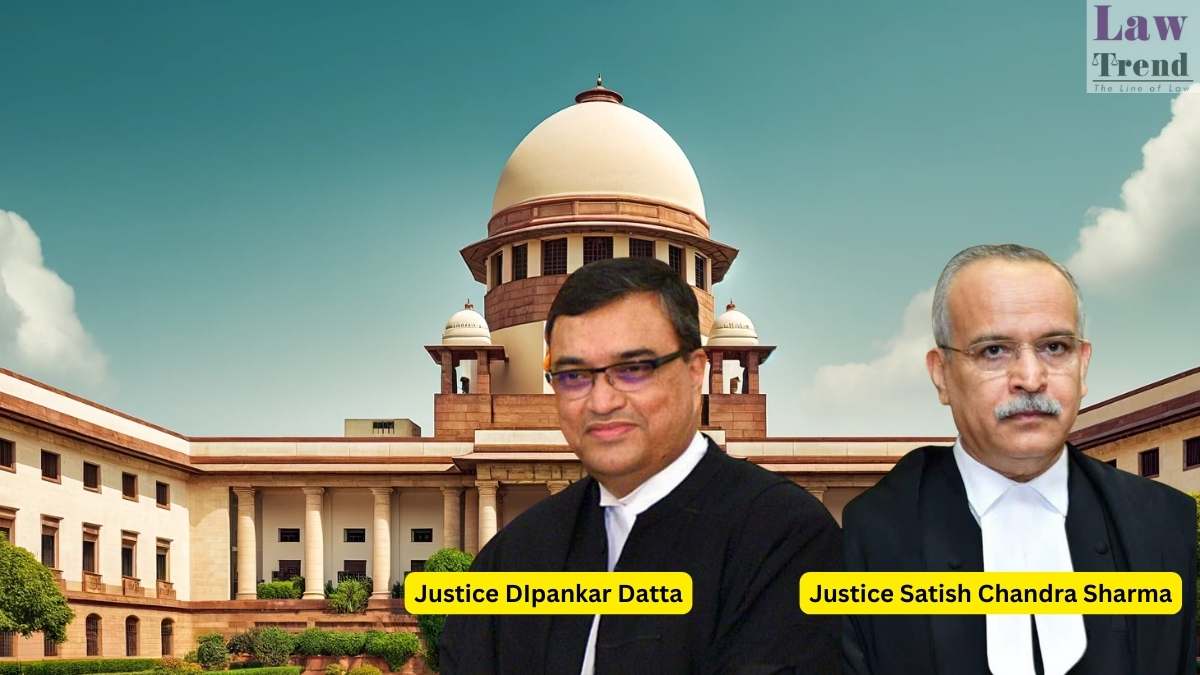
The Supreme Court has held that prior consent of the Gram Sabha is mandatory for acquiring land in Scheduled Areas under Section 41(3) of the Right to Fair Compensation and Transparency in Land Acquisition, Rehabilitation and Resettlement Act, 2013. Setting aside the acquisition of land in Odisha for mining operations by Dalmia Cements Bharat Limited, the Court ruled that statutory safeguards cannot be bypassed merely because a company already holds mining rights over the land.
A Bench of Justices Dipankar Datta and Satish Chandra Sharma, in a judgement delivered on November 18, 2026, also held that land acquisition for a private company requires prior consent of at least 80% of affected families under Section 2(2)(b) of the 2013 Act. Such consent must be obtained during the Social Impact Assessment (SIA) process and cannot be collected subsequently to justify an acquisition.
The Court overturned the Orissa High Court’s September 6, 2024 judgement, which had upheld the acquisition proceedings concerning agricultural land in Sundergarh district.
Gram Sabha Consent Is a Mandatory Statutory Requirement
The principal issue before the Supreme Court concerned the acquisition of land in Kukuda, Bihabandha and Lanjiberna villages, situated in a Scheduled Area under the Fifth Schedule of the Constitution.
Section 41(3) of the 2013 Act requires prior consent of the concerned Gram Sabha or other specified local body before the issuance of an acquisition notification in Scheduled Areas.
The High Court had treated this requirement as directory rather than mandatory, relying on expressions such as “as far as possible” and “demonstrable last resort” appearing in other subsections of Section 41.
Rejecting that interpretation, the Supreme Court explained that the three subsections address separate statutory requirements. While Section 41(1) discourages acquisition in Scheduled Areas and Section 41(2) permits it only as a demonstrable last resort, Section 41(3) independently requires prior consent once the government decides to proceed.
The Court held:
“Therefore, we hold that the requirement of Section 41(3) of the Act is mandatory in nature, and there is nothing to suggest it to be directory or advisory.”
The Bench noted that the concerned Gram Sabhas had unanimously rejected the acquisition proposal through resolutions passed on January 26, 2020. Despite this, the State proceeded with the acquisition.
There was also no material showing consent in Form M, as prescribed under Rule 41 of the Odisha Rules.
The Court observed:
“Far from a meaningful consent, there is not even paper consent of Gram Sabha in this case.”
It further held that the absence of an express statutory penalty for violating Section 41(3) did not make compliance optional. Constitutional courts retain the power of judicial review when the State breaches a mandatory legal requirement.
Consent of 80% Affected Families Must Precede Acquisition Decision
The Supreme Court separately examined whether the acquisition fell under Section 2(1), which governs land acquired for the government’s own use, or Section 2(2)(b), which applies when land is acquired for a private company for a public purpose.
The State and the company argued that the acquisition was undertaken by the government for a mining project and therefore did not require consent from 80% of affected families.
The Bench rejected this argument, finding that the land was being acquired exclusively to enable Dalmia Cements Bharat Limited, a private company, to undertake mining operations.
The Court clarified that the decisive consideration is the actual purpose of acquisition, not merely the fact that ownership may vest in the government.
It held that Section 2(2)(b) applied, making prior consent from at least 80% of affected families compulsory.
The Bench also disagreed with the High Court’s finding that obtaining consent could be treated as a continuing exercise throughout the acquisition proceedings.
Under the statutory scheme, consent must be obtained alongside the Social Impact Assessment study and must already exist when the government examines the acquisition proposal under Section 8.
Although the State claimed to have secured consent from 482 families, the Court found no material establishing compliance with the prescribed Form J procedure. More importantly, the claimed consent had not been obtained at the legally required stage.
The judgement stated:
“The statute provides for prior consent and there is no basis to justify subsequent consent, even if assumed to have been taken.”
Social Impact Assessment Process Found Defective
The Court also identified serious irregularities in the Social Impact Assessment process.
A public hearing had been scheduled for April 16, 2021, in the affected villages. However, responses obtained under the Right to Information Act indicated that the hearing could not take place because of COVID-19 restrictions.
The respondents maintained that a hearing had been conducted but could not be recorded because of non-cooperation by certain villagers.
The Bench found no material establishing that the public hearing had actually occurred. It also noted that the final SIA report did not contain the affected persons’ views, which were required for examination by the Expert Group and the government.
Another defect concerned the independence of the Expert Group responsible for evaluating the SIA report.
The group included Ashok Kumar Sahoo, who was connected with Dalmia Cements Bharat Limited as an Adviser, Land Acquisition.
The Supreme Court held that Section 7 of the 2013 Act requires an independent multidisciplinary Expert Group. A person having a direct professional and financial connection with the project proponent could not be expected to independently evaluate its public purpose and social consequences.
The Bench concluded:
“Therefore, we are of the considered opinion that the inclusion of Mr. Sahoo in the Expert Group compromised with the statutory requirement of independence of the Group.”
It consequently found a violation of Section 7 of the Act.
Mining Lease Cannot Override Landowners’ Property Rights
The Supreme Court also considered the relationship between the 2013 Land Acquisition Act and the Mines and Minerals (Development and Regulation) Act, 1957 (MMDR Act).
The State and the company contended that the mining lease conferred statutory rights to enter the land and conduct mining operations, subject to compensation for losses under Section 24A of the MMDR Act.
The Bench explained that the two statutes regulate different matters. The MMDR Act governs mining concessions and operations, while the 2013 Act regulates land acquisition and protects the rights of affected landowners.
It observed that a mining lease between the State and a private company cannot, by itself, extinguish the proprietary rights of third-party landowners.
The Court stated:
“A bilateral relationship based on lease between two parties cannot affect the proprietary rights of third-party land owners, who are independent to such lease.”
It further distinguished compensation for damage caused during mining operations from compensation payable for acquisition of land.
However, the Bench clarified that it was not finally deciding whether mining could have been undertaken through another statutory mechanism without acquisition. Its examination was confined to the legality of the acquisition process actually initiated under the 2013 Act.
Once the respondents chose that procedure, they could not defend statutory violations by subsequently arguing that acquisition was unnecessary.
Supreme Court Sets Aside Acquisition, Permits Fresh Proceedings
The Court also rejected the State’s objection that the appellants lacked the standing to challenge the acquisition.
It noted that the authorities had failed to update the records of rights during the acquisition process. The State could not rely on its own failure to question the appellants’ connection with the affected land.
The Bench held that the High Court should not have rejected the challenge on curable technical defects when substantive statutory violations were alleged.
Allowing the challenge, the Supreme Court set aside the land acquisition, the relevant notifications and orders, and the Orissa High Court judgement.
The Court nevertheless clarified that its decision would not prevent the authorities from initiating fresh acquisition proceedings in accordance with law and the findings recorded in the judgement.
The ruling establishes that mandatory safeguards concerning Gram Sabha consent, participation of affected families and independent social impact assessment must be followed when acquiring land in Scheduled Areas for private mining projects.
Case Details
Case Title: Bibol Toppo & Ors. v. State of Odisha & Ors.
Case Number: Civil Appeal No. 8294 of 2026 | 2026 INSC 1244
Bench: Justice Dipankar Datta and Justice Satish Chandra Sharma
Date of Judgement: November 18, 2026


