

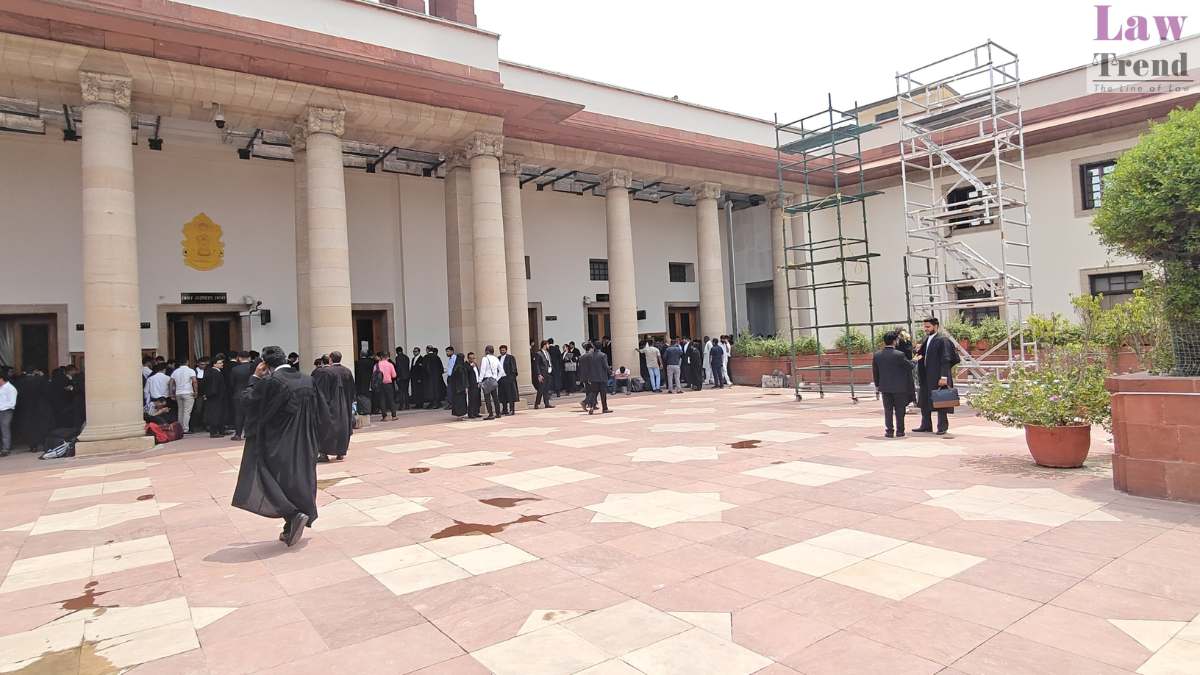
The Supreme Court has awarded ₹10 lakh each to two former school employees whose services were wrongfully terminated, observing that defective drafting of their writ petitions had prevented them from securing the relief they otherwise deserved. Exercising its extraordinary powers under Article 142 of the Constitution, the Court held that disciplinary action taken contrary to an express judicial order could not be allowed to stand merely because the employees had failed to raise the appropriate legal grounds.
A Bench of Justice Dipankar Datta and Justice Sheel Nagu, in its judgement dated November 18, 2026, granted compensation to Prithviraj S. Singh, who has since died, and Shivadatta R. Singh, after finding serious defects in the disciplinary proceedings initiated against them by a Maharashtra school.
The Court described the litigation as an instance where a meritorious case had suffered because of inadequate drafting.
“The present case illustrates how a meritorious cause was allowed to fail by reason of inept drafting of a writ petition, the substance having been eclipsed by form.”
Failure to Plead Essential Grounds Before High Court
The Supreme Court observed that the employees’ writ petitions before the Bombay High Court had failed to challenge a crucial aspect of their disciplinary proceedings: the school’s failure to produce evidence before the School Tribunal despite an earlier High Court order permitting it to do so.
Instead, the employees had principally sought treatment similar to that given to the school’s in-charge headmaster, whose punishment of termination had been converted into compulsory retirement.
The Bombay High Court dismissed their petitions on June 17, 2016, finding that the employees and the headmaster were not similarly placed. The headmaster had served the institution for approximately three and a half decades and was nearing retirement, whereas the two employees had served for only a few years.
Before the Supreme Court, Senior Advocate B.H. Marlapalle appeared for the appellants, while Senior Advocate Sudhanshu S. Choudhari represented the school.
The Supreme Court acknowledged that arguments concerning the tribunal’s failure to examine the evidence went beyond the pleadings before the High Court.
It reiterated that litigants must make the necessary factual assertions in support of their claims and that courts are not obliged to consider grounds unsupported by their pleadings.
However, the Bench found that the circumstances warranted intervention despite these procedural shortcomings.
School Failed to Produce Evidence Despite Earlier Court Order
Prithviraj S. Singh was employed as a senior clerk and Shivadatta R. Singh as a head clerk at a school managed by a trust in Maharashtra.
Both employees, along with in-charge headmaster Kamalkant S. Mishra, faced departmental proceedings over allegations of misappropriation of public funds and related misconduct.
An inquiry committee constituted under the Maharashtra Employees of Private Schools (Conditions of Service) Rules, 1981, proceeded against the employees.
The employees challenged the committee’s composition and subsequently abstained from participating in the inquiry. The proceedings continued ex parte, resulting in reports dated November 13, 2004, and November 11, 2004, holding the charges established.
The school thereafter terminated their services without furnishing them copies of the inquiry proceedings or final inquiry reports.
The employees challenged their termination before the School Tribunal, Mumbai, which initially stayed the termination orders on March 10, 2005, and directed the school to permit them to resume service with payment of 50% salary.
The school challenged those interim directions before the Bombay High Court.
On March 17, 2005, the High Court passed a consent order replacing the tribunal’s interim arrangement. It permitted the school to seek permission from the tribunal to lead evidence substantiating the misconduct charges.
Despite receiving this opportunity, the school did not apply to produce evidence. The tribunal also did not insist on fresh evidence and dismissed the employees’ appeals on July 19, 2006, relying on the available records.
No Evidence Worth the Name to Establish Charges: Supreme Court
Examining the proceedings, the Supreme Court expressed serious concern over the school’s failure to act in accordance with the earlier High Court order.
The Bench noted that the school’s counsel had not attempted to justify the omission.
It observed:
“What, therefore, emerges is that there was no evidence worth the name before the tribunal resting whereon the charges against the appellants could be held ‘established’.”
The Court also identified a serious procedural defect in the school’s failure to provide the employees with the final inquiry reports before terminating their services.
Despite this deficiency, the tribunal had found no infirmity in the disciplinary proceedings.
The Bench emphasised that although a High Court ordinarily cannot grant relief under Article 226 where the petitioner has failed to plead the necessary grounds, the present case justified relief because the disciplinary action was inconsistent with an express judicial order.
The Court relied on the principle that an action or order wholly contrary to a judicial direction issued by a competent court is a nullity and cannot be accepted. It referred to Ram Saran Varshney v. State of U.P., (2016) 3 SCC 724.
Article 142 Invoked to Award Compensation
The Supreme Court observed that the appellants could have obtained greater relief had their writ petitions been properly drafted and the relevant legal grounds argued.
However, considering the circumstances and the passage of time, the Bench exercised its powers under Article 142 rather than reopening the disciplinary proceedings.
It directed the school to pay ₹10 lakh each as lump-sum compensation for wrongful termination.
The amount payable to deceased appellant Prithviraj S. Singh is to be received by his heirs or legal representatives, while Shivadatta R. Singh or his authorised representative is entitled to receive the compensation awarded to him.
The school must make the payments within three months from receipt of the order from the respective claimants. Any delay beyond that period will attract interest at 12% per annum until actual payment.
The Court clarified that the compensation would constitute full and final settlement of all dues and that no further claims would be entertained.
The appeals were accordingly disposed of.
Case Details
Case Title: Prithviraj S. Singh (Deceased) Through LRs. Etc. v. The Secretary, School Education Department, State of Maharashtra & Ors.
Case Numbers: Civil Appeal Nos. 10193–10194 of 2016
Bench: Justice Dipankar Datta and Justice Sheel Nagu
Judgement Date: November 18, 2026
Counsel for Appellants: Senior Advocate B.H. Marlapalle
Counsel for School: Senior Advocate Sudhanshu S. Choudhari


