

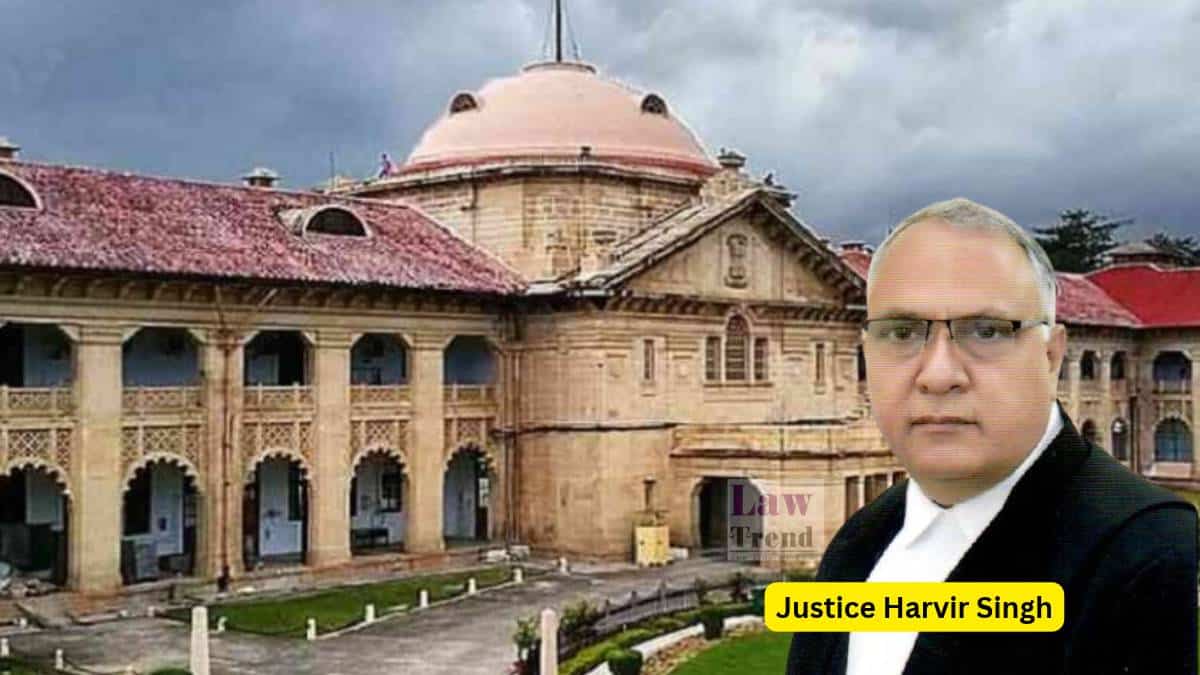
The Allahabad High Court has held that maintenance proceedings under Sections 144 to 147 of the Bharatiya Nagarik Suraksha Sanhita, 2023 (BNSS) are to be decided by a First Class Magistrate. It also asked the Chief Justice to consider posting Magistrates within the Family Court system, to remove what it called an overlap in jurisdiction.
Justice Harvir Singh dismissed a husband’s application under Section 528 BNSS as not maintainable and gave him liberty to file a revision instead. In a connected revision, the Court also upheld a maintenance order passed against him in 2003.
Background
In 2003, the Additional Principal Judge, Family Court No. 2, Agra, passed an ex parte order in Maintenance Case No. 209 of 2003. It awarded ₹1,000 a month to the wife and ₹1,000 a month to opposite party no. 3.
In 2024, the husband, Rajendra Singh, moved an application under Section 145(2) BNSS / Section 126(2) Cr.P.C. to recall that order, along with a plea to condone a delay of about 21 years. The Family Court rejected the delay plea on 08.04.2025.
The wife then filed Execution Case No. 327 of 2024. On 27.06.2025, the Family Court rejected the husband’s application in the execution case, and on 23.07.2025 it issued a recovery warrant. The husband challenged these two orders under Section 528 BNSS, and the 2003 order in a separate Criminal Revision No. 4610 of 2025.
Arguments
Advocates Manvendra Narain Pathak, Rajeev Kumar Tiwari and Sanjay Tiwari appeared for the husband. They argued that he was never properly served, had no knowledge of the 2003 order, and that the execution orders were illegal and arbitrary.
Advocate Kuldeep Singh Chahar appeared for the wife. He argued that a Section 528 BNSS application against orders under the maintenance provisions is not maintainable because a revision is available, and relied on the High Court’s decision in Kapil Sirohi v. State of U.P.
He went further and argued that giving Family Courts jurisdiction over maintenance cases had made the scheme redundant and opened the floodgates of litigation before the High Court. He pointed out that Magistrates already decide maintenance-related matters under the Gram Nyayalayas Act, 2008 and the Protection of Women from Domestic Violence Act, 2005. If First Class Magistrates decided these cases, he said, the aggrieved party could file a revision at the district level.
Petition Not Maintainable
Following Kapil Sirohi, the Court held that the application was liable to be dismissed as not maintainable, without going into the merits. It gave the husband liberty to pursue the remedy of revision.
Court Flags Overlap in Jurisdiction
The Court then examined how maintenance jurisdiction is currently divided. It noted that while Family Courts presided over by Higher Judicial Service officers hear maintenance cases, Gram Nyayalayas and Magistrates under the DV Act also deal with the same subject. It said this created “not only a dichotomy, but also an overlapping of the powers and jurisdiction exercised by a First Class Magistrate and those exercised by an officer of the higher judicial services”.
The Court noted that an order passed by a Magistrate under the DV Act can be appealed before the District Judge, but an order of a Family Court under Chapter X BNSS has to be challenged before the High Court in revision.
Observing that the litigants in such cases are generally women, children and aged parents, the Court said they must have an opportunity to challenge orders at the district level. It noted that High Court seats are situated far from the districts. The Court observed that “any legislation, which takes away such a valuable right and opportunity of the litigant being heard at the district level, becomes redundant and impracticable”.
It added, “It is only a matter of posting and attaching a Magistrate of the First Class within the scheme of the Family Court”.
Holding and Directions
The Court held, “The adjudication of proceedings under Sections 144, 145, 146 and 147 of the BNSS, 2023 falling under Chapter X is to be conducted and carried out by a First Class Magistrate, being the latest legislation on the subject.”
It directed the Registrar General to place a copy of the judgment before the Chief Justice, with a request to consider posting or attaching one or more Magistrates within the Family Court system. This exercise is to be completed within three months.
The Registrar (Compliance) was directed to send the judgment to all District Judges and Principal Judges of Family Courts, and to the Central Law Commission and the State Law Commission of Uttar Pradesh.
Revision Dismissed
In the connected revision against the 2003 order, the Court found that the husband had applied for certified copies of the orders on 26.08.2008, and that the Family Court’s registered notices had been duly received by him. It held that his claim “that the revisionist did not receive any notice of the Family Court or he was not having any knowledge of the pendency of case under Section 125 CrPC is totally false”.
The Court upheld the Family Court’s order of 08.04.2025 rejecting the delay plea. It held that once that plea stood rejected, the 2003 maintenance order also called for no interference, and dismissed the revision.
Case Title: Rajendra Singh v. State of U.P. and Another (with Criminal Revision No. 4610 of 2025)
Case No.: Application U/S 528 BNSS No. 37393 of 2025
Bench: Justice Harvir Singh
Date: November 6, 2026


