

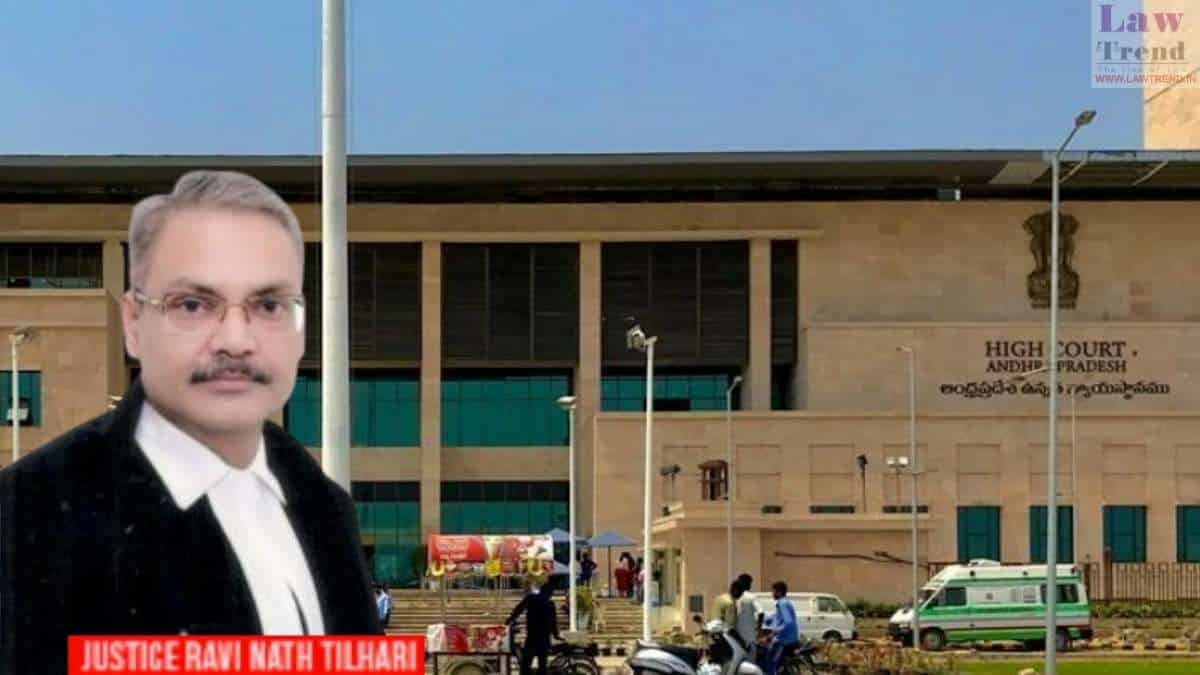
The Andhra Pradesh High Court has held that the 30-day limit in Order 39 Rule 3A of the Code of Civil Procedure (CPC), for deciding an injunction application where an ad-interim injunction was granted without notice, is not mandatory. The Court said the provision gives a litigant no statutory right to a direction that the trial court decide the application within that time.
Justice Ravi Nath Tilhari disposed of the civil revision petition. Relying on Supreme Court rulings, he declined to set a timeline for the trial court and gave the petitioner liberty to approach that court for early disposal.
Background
The respondent, who is the plaintiff, filed a suit (O.S. No. 74 of 2025) seeking a permanent injunction to stop the defendant, the present petitioner, from interfering with the plaintiff’s peaceful possession and enjoyment of the schedule property. Along with the suit, the plaintiff filed an application for a temporary injunction (I.A. No. 743 of 2025).
On 12.09.2025, the trial court granted an ad-interim temporary injunction without notice to the defendant. The defendant filed her affidavit and counter on 12.02.2026.
Because the injunction application had still not been decided, the defendant filed a Civil Revision Petition. She asked the High Court to direct the Civil Judge (Junior Division)-cum-Judicial First Class Magistrate, Bantumilli, Krishna District, to dispose of it expeditiously.
Arguments
Advocate S.Syam Sunder Rao, appearing for the petitioner, argued that the trial court had adjourned the application several times to give the plaintiff time to file a reply. He submitted that under Order 39 Rule 3A CPC, the matter deserved to be decided quickly.
He relied on Nama Ramaprasad v. Kristam Reddy Raju (2022 SCC OnLine AP 3240), in which directions were issued for the trial court to dispose of an application within a fixed time. He also relied on Tirumala Sundara J.C.Nath v. Kottam Ayyanna (CRP No. 1583 of 2026, decided on 11.06.2026).
Order 39 Rule 3A CPC: 30-Day Limit Not Mandatory
The Court noted that the two decisions cited by counsel say courts must keep the Rule 3A time limit in mind. It also accepted that under the provision, a court that grants an injunction without notice must try to decide the application within 30 days, or record its reasons if it cannot.
The Court then went further:
“However, I am of the further view that the time limit of 30 days is not mandatory. The expression used is “the Court shall make an endeavour” to dispose of within that period and if it is not so possible, it shall record the reasons.”
The Court examined the docket orders from 05.08.2026 to 05.10.2026. They showed that the case had been taken up on those dates and time had been given to the plaintiff to file a reply. Other docket orders had not been placed on record. The Court observed:
“Therefore, it cannot be said that the Court is not making endeavour to dispose of the injunction matter. The time line of 30 days is not mandatory, though it deserves to be observed. There is no statutory mandate to decide within a period of thirty days and so no statutory right to be enforced by issuance of a direction to the learned Court.”
Supreme Court Caution on Time-Bound Directions
The Court relied on the Constitution Bench decision in High Court Bar Association, Allahabad v. State of Uttar Pradesh [(2024) 6 SCC 267]. There, the Supreme Court held that constitutional courts should ordinarily refrain from fixing a time-bound schedule for disposing of cases pending in other courts. Such directions may be issued only in exceptional circumstances, and prioritising cases is best left to the court where they are pending.
The Court also referred to Sangram Sadashiv Suryavanshi v. State of Maharashtra (2024 SCC OnLine SC 3526). In that case, the Supreme Court noted that High Courts were routinely issuing directions meant only for exceptional circumstances, without noticing the Constitution Bench ruling.
Applying these principles, the High Court held:
“No exceptional circumstance has been shown to issue direction as requested in the CRP. The party desirous of expeditious disposal, should approach the Court concerned where the matter is pending.”
Outcome
The Court declined to issue any direction to the trial court. It disposed of the Civil Revision Petition with liberty to the petitioner to approach the court concerned for expeditious disposal of the pending application. No costs were ordered, and any pending miscellaneous petitions were closed.
Case Title: Vardhanapu Priskilamma @ Priskilla v. Kambattula Suryakantham
Case No.: Civil Revision Petition No. 3040 of 2026
Bench: Justice Ravi Nath Tilhari
Date: 06.11.2026


