

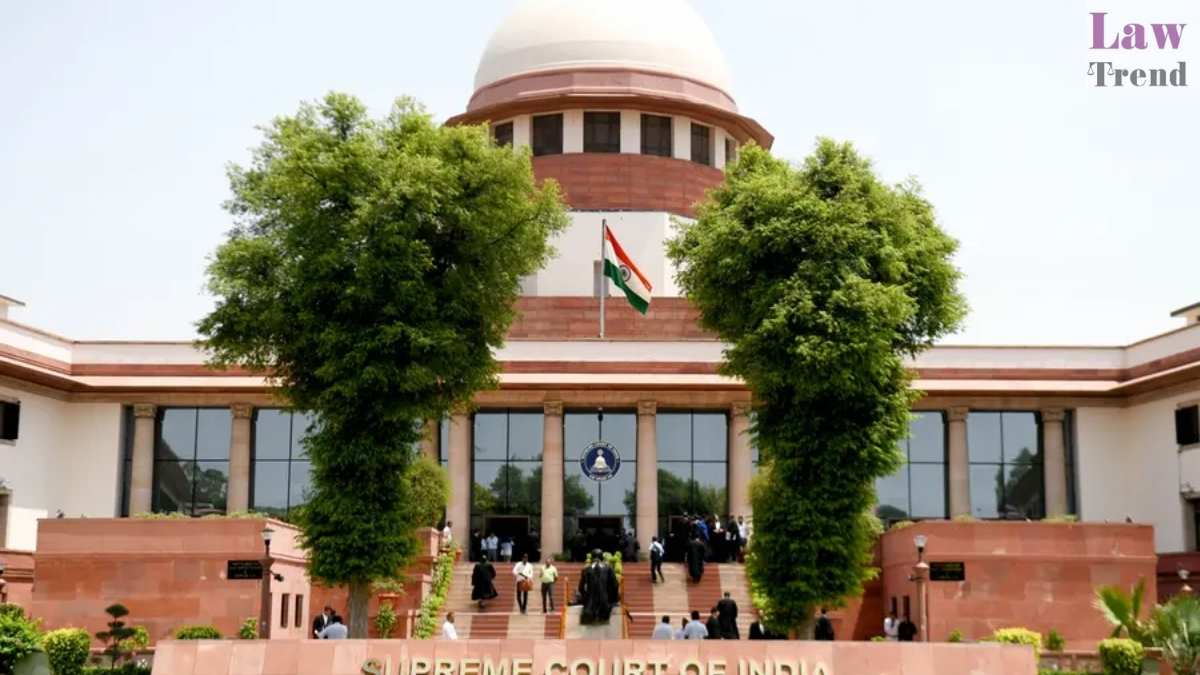
The Supreme Court has held that its reference on whether a surcharge computed on sales tax amounts to a ‘tax on tax’ has been rendered infructuous. The Court said the question stands answered by the Constitution Bench ruling in S. Kodar v. State of Kerala, which continues to hold the field.
A seven-judge Bench of Chief Justice Surya Kant, Justice S.V.N. Bhatti, Justice Joymalya Bagchi, Justice N.V. Anjaria, Justice Arun Palli, Justice V. Mohana and Justice K.V. Viswanathan directed that the pending appeals be listed before regular Benches for decision on their individual merits.
Background of the Sales Tax Surcharge Reference
The lead matter challenged Section 5-A of the Orissa Sales Tax Act, 1947, which was inserted with effect from 01.07.1990. It required every dealer with a gross turnover above ₹10 lakh to pay a surcharge of 10 per cent of the total tax payable. Connected matters from Punjab challenged a similar surcharge under Section 5(1-C) of the Punjab General Sales Tax Act, 1948, and Section 30-AA, which made exempted industrial units liable to pay it. Another set of matters challenged a cess under the Punjab Social Security Act, 2000.
On 13.08.1998, a two-judge Bench referred the matter to a larger Bench. It saw a divergence between Hoechst Pharmaceuticals v. State of Bihar and the seven-judge ruling in India Cement v. State of Tamil Nadu. On 06.10.1999, a five-judge Bench noted that S. Kodar would also have to be considered, and placed the matter before a seven-judge Bench.
Arguments
Shubhranshu Padhi and Sandeep Sudhakar Deshmukh appeared for the assessees. The assessees’ case, as set out in their appeals, was that a surcharge computed on the tax payable is measured by the existing tax burden rather than the sale. It was therefore a ‘tax on tax’ that no entry in List II authorises. They relied on India Cement and argued that Hoechst rested on a concession.
Solicitor General Tushar Mehta, Additional Solicitor General N. Venkataraman, Odisha Advocate General Pitambar Acharya and Punjab Additional Advocate General Vivek Jain appeared for the States. The States contended that the issue was squarely covered by S. Kodar. They argued that the surcharge was only an enhancement of the sales tax rate and that India Cement dealt with an altogether different levy. The Solicitor General also informed the Court that a curative petition has been filed against the nine-judge ruling in Mineral Area Development Authority.
What the Supreme Court Held
The main judgment found that India Cement concerned a cess on royalty in a field covered by the MMDR Act, not a levy under Entry 54 of List II. The Court observed that the conflict was “more apparent than real, even at the time the reference was made.”
The Court noted that the nine-judge Bench in Mineral Area Development Authority has since held that royalty is not a tax and overruled India Cement to that extent. It held: “The conflict which occasioned the reference, whether real or apparent, has ceased to exist.”
On the ‘tax on tax’ argument, the Court explained that a surcharge on sales tax is, by simple arithmetic, a further percentage of the same taxable turnover. It observed that “a surcharge of 10 per cent upon a sales tax levied at the rate of 10 per cent of the turnover is, in substance, nothing but an additional levy of 1 per cent upon the turnover.”
The Court also rejected the contention that the surcharge was a tax on income. It stated: “A levy which is payable irrespective of the existence of income, and which bears no relation to the quantum of income, cannot, by any stretch, be characterised as a tax on income.”
The Bench further noted that Entry 54 of List II has been substituted by the Constitution (One Hundred and First Amendment) Act, 2016. The Orissa and Punjab sales tax regimes have also been replaced by VAT laws and then by GST, so the question is of no prospective significance. Remarking on judicial resources, the Court said that “a Seven Judge Bench is a scarce institutional resource.”
In his separate judgment, Justice Viswanathan held that S. Kodar “has been correctly decided, continues to be a good law and needs no reconsideration.”
Outcome
The reference was answered as infructuous. The legislative competence of the States to levy the impugned surcharges will be governed by S. Kodar. Two questions were left open: the validity of Section 30-AA of the Punjab Act, and whether the Punjab Social Security cess could be credited directly to the Punjab Social Security Fund without first forming part of the Consolidated Fund of the State under Article 266. All other contentions were also left open.
The Court recorded its appreciation for the assistance of Advocate-on-Record Samapika Biswal, the nodal counsel.
Case Title: Arjun Flour Mills v. The State of Odisha Finance Department Secretary & Ors.
Case No.: Civil Appeal No. 8763 of 1994 (with connected matters)
Bench: Chief Justice Surya Kant, Justice S.V.N. Bhatti, Justice Joymalya Bagchi, Justice N.V. Anjaria, Justice Arun Palli, Justice V. Mohana, Justice K.V. Viswanathan
Date: November 4, 2026