

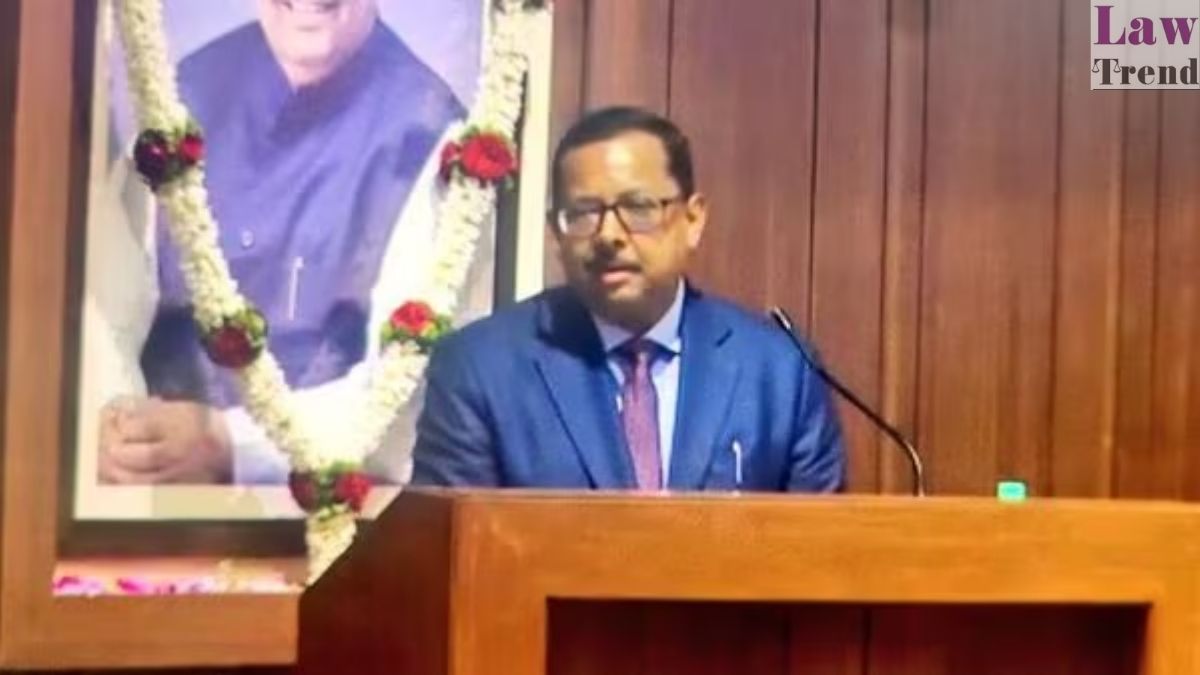
Supreme Court Justice Ujjal Bhuyan has emphasised that scientific temper, access to information and the freedom to question established beliefs are essential to sustaining the rule of law and a participatory democracy. He cautioned that unquestioning acceptance of authority and traditions could leave society vulnerable to authoritarianism, misinformation and the continuation of unjust practices.
Addressing students at the 12th convocation ceremony of the University of Science and Technology Meghalaya on Saturday, Justice Bhuyan said that arbitrary power flourishes where ignorance, fear and unquestioned beliefs prevail.
He explained that scientific reasoning helps people examine claims through evidence rather than accepting them without scrutiny. Societies that discourage questioning, he observed, risk becoming susceptible to authoritarian tendencies, while traditions placed beyond criticism may prevent necessary social reforms.
Access to Information Essential for Democracy
Justice Bhuyan identified public reasoning as a fundamental requirement of a functioning participatory democracy. He said meaningful public discussion depends on informed citizens, who must have access to information to evaluate competing claims and participate in democratic processes.
Referring to Nobel laureate economist Amartya Sen’s 2009 book The Idea of Justice, he discussed the distinction between institutional democracy and functional democracy.
According to Justice Bhuyan, the circulation of information and its examination through public reasoning form part of the process through which democratic societies pursue justice.
He stressed that public reasoning cannot develop effectively without an informed citizenry, making access to information central to democratic participation.
Universities Must Encourage Respect for Diversity
Turning to the role of educational institutions, Justice Bhuyan said universities provide opportunities for students to engage with people from different linguistic, religious, regional, ethnic and cultural backgrounds.
Such interactions, he explained, expose students to different experiences, perspectives and ways of thinking, helping them reconsider their assumptions and identify shared values.
He urged students to recognise diversity as a collective strength rather than a source of division.
Justice Bhuyan also observed that education extends beyond textbooks and classrooms. Understanding differing opinions and respecting other people’s perspectives, even amid disagreement, can help build a more inclusive and accommodating society.
He cautioned that competing social claims and conflicts frequently encourage exclusionary attitudes, pushing people towards a divisive distinction between their own communities and others.
Constitutional Idea of ‘We’ Rejects Divisive Identities
Justice Bhuyan called for moving beyond the division between ‘us’ and ‘they’ and adopting a broader understanding of collective belonging.
He linked this principle to the opening words of the Preamble to the Constitution, ‘We, the People of India’, explaining that the constitutional framework recognises all citizens as equal participants, irrespective of their individual or group identities.
The Constitution, he said, does not speak for any particular section of society but encompasses people from diverse backgrounds within a common constitutional order.
Justice Bhuyan emphasised that differences in identity need not weaken constitutional unity. Instead, the idea of ‘we’ reflects a shared sense of belonging that accommodates diversity while recognising the equal standing of every citizen.
He urged students to embrace this inclusive understanding of society, stressing that moving away from divisive identities is necessary to create a more just and humane social order.


