

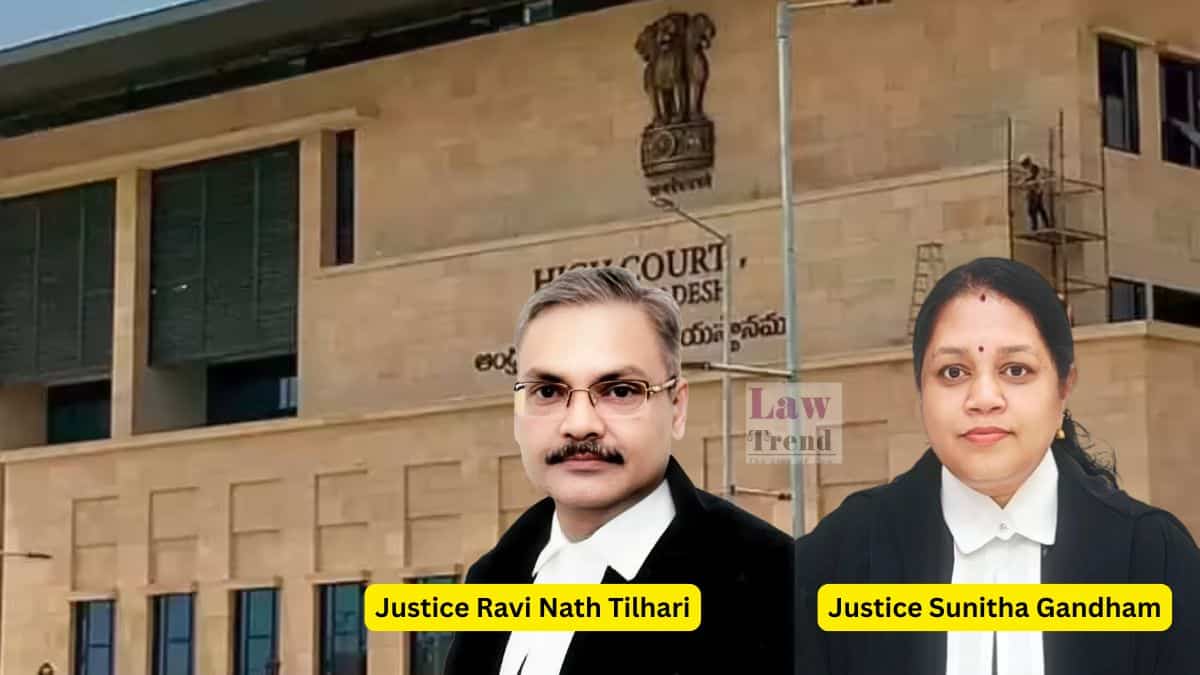
The Andhra Pradesh High Court has held that a fresh declaration under Section 6 of the Land Acquisition Act, 1894, issued after a court-directed enquiry under Section 5-A, must still be published within the one-year limit from the Section 4(1) notification. It cannot be saved by treating it as an “addendum” to an earlier declaration.
A Bench of Justice Ravi Nath Tilhari and Justice Sunitha Gandham allowed four writ appeals and set aside the acquisition proceedings for the appellants’ lands at Dorasanipadu and Dwaraka Tirumala in West Godavari District.
Background
The State issued two notifications under Section 4(1) read with Section 17(4) of the Act, dispensing with the Section 5-A enquiry. The first, dated 02.02.2005, covered Ac.103.8 cents in Dorasanipadu Village. The second, dated 23.02.2005, covered Ac.0.49½ cents of buildings and sheds in Dwaraka Tirumala Village. Section 6 declarations followed on 10.03.2005 and 16.03.2005.
On 29.08.2005, in W.P. No. 5784 of 2005 and batch, the High Court found no urgency to justify dispensing with the enquiry and directed the Land Acquisition Officer to hold a Section 5-A enquiry. Notices later issued under Sections 9(3) and 10 without a fresh declaration were set aside on 27.12.2005.
The Government published a fresh Section 6 declaration on 12.04.2007. A Single Judge dismissed the challenge to it on 08.06.2010. The Single Judge held that the earlier declarations had not been set aside and that the 2007 declaration was a continuation of them, applying the principle of “erratum and addendum”.
Arguments
Senior Counsel K.S. Murthy, assisted by P.S.P. Suresh Kumar, appeared for the appellants in W.A. No. 848 of 2010. He argued that the 2007 declaration came after one year from the Section 4(1) notification, even after excluding the stay period, so the proceedings had lapsed. He also argued that there is no concept of an addendum for a second Section 6 declaration. He relied on Padma Sundara Rao, Vijay Narayan Thatte and Anil Kumar Gupta, among others. P. Durga Prasad, for the appellants in W.A. Nos. 637 and 849, and S. Suman Raju, representing S. Lakshminarayana Reddy in W.A. No. 919, adopted these submissions.
Senior Counsel V. Venugopal Rao, assisted by Pulipati Radhika, appeared for Sri Venkateswara Swamivari Devasthanam. He contended that the first round of litigation had not disturbed the Section 4(1) notification or the Section 6 declarations. He argued that the 2007 declaration was an addendum to which the limitation proviso did not apply. He also submitted that a stay granted in W.P. No. 7223 of 2005 had held up the proceedings. The Government Pleader for Land Acquisition adopted these arguments.
Court’s Findings
Relying on the Constitution Bench ruling in Padma Sundara Rao, the Court held that the proviso to Section 6(1) is mandatory. The only period that can be excluded is a period of stay. It noted there was no dispute that the 2007 publication fell outside the one-year period even after excluding the stay.
On the effect of the 2005 directions, the Bench observed:
“Even if the notification under Section 6 was not expressly quashed by the learned Single Judge, the necessary consequence of directing the holding of enquiry proceedings under Section 5-A would result in the automatic cancellation or setting aside of the publication under Section 6(1).”
The Court explained that the two declarations stand on different footing. One was made without an enquiry, and the other followed the Government’s satisfaction after the enquiry. It held:
“It cannot be said that the second declaration, after the enquiry, is a continuation of the first declaration.”
The Bench rejected the corrigendum analogy. It held that the principle can apply only to a Section 4(1) notification, and that the Section 6(1) limitation period cannot be extended in that way. While accepting that more than one declaration is permissible, it added:
“There is no dispute with the legal proposition that there can be more than one declaration or publication under Section 6(1), but in our view, following Padma Sundara Rao (supra) all such declarations are to be made within the statutory period, after excluding the period of stay.”
The Court distinguished Moti Ratan Estates, noting that the question in this case was not under consideration there. On the stay in W.P. No. 7223 of 2005, it held:
“The stay granted in the case of one person with respect to different land cannot be made applicable to the case of other petitioners, in whose case there is a specific direction by the Court and which has been implemented.”
Outcome
The Court allowed the writ appeals and set aside the Single Judge’s order dated 08.06.2010. The declarations dated 10.03.2005, 16.03.2005 and 12.04.2007 were set aside only for the appellants’ land, and the acquisition cannot proceed further for that land. The respondents are at liberty to proceed afresh in accordance with law. No costs were awarded.
Case Title: Avanigadda Seetha Rama Rao and Others v. State of Andhra Pradesh and Others
Case No.: Writ Appeal Nos. 848, 637, 849 and 919 of 2010
Bench: Justice Ravi Nath Tilhari and Justice Sunitha Gandham
Date: 14.10.2026


