

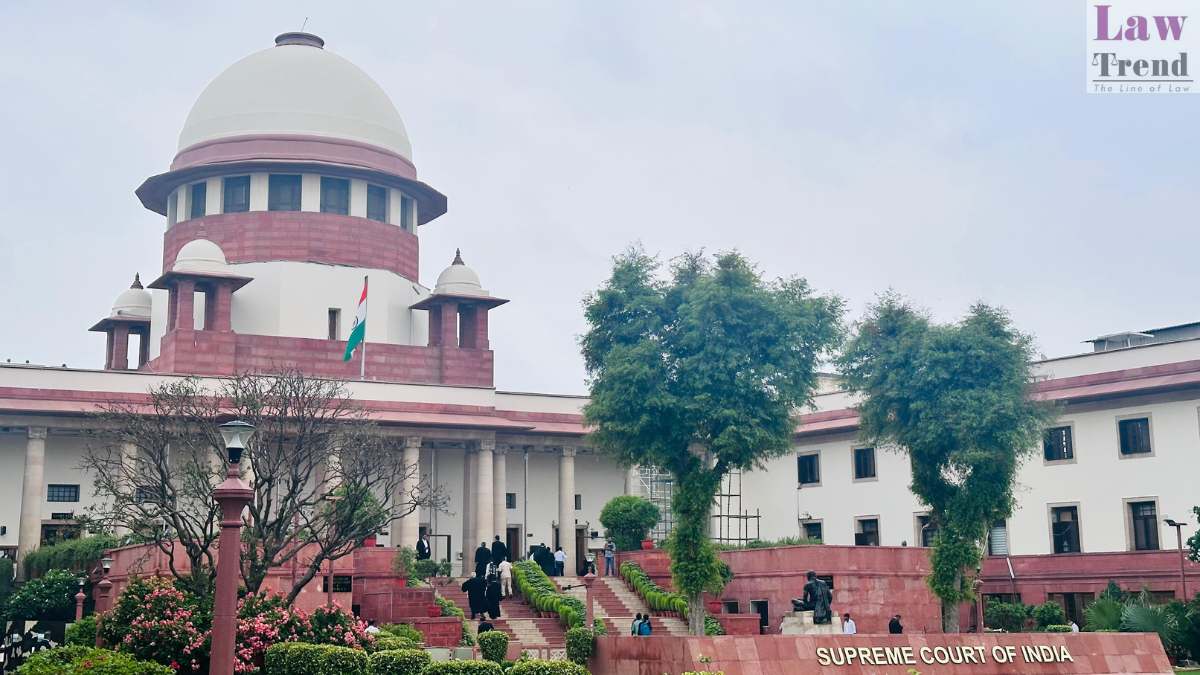
The Supreme Court has held that the bar on bail for foreign nationals under Section 43D(7) of the Unlawful Activities (Prevention) Act, 1967 (UAPA) applies only when the accused’s entry into India was itself unauthorised or illegal. A foreigner who entered on a valid visa and later overstayed does not fall within the provision. The Court dismissed the Union of India’s appeal and upheld a Madras High Court order restoring the bail of an alleged Sri Lankan national accused in a UAPA case.
The Bench also held that Section 43D(7) does not bar statutory (default) bail under Section 167(2) of the Code of Criminal Procedure.
Background
The respondent, Mohamed Rifas @ Mohamed Rigbas, was named as an accused in FIR No. 46/2018, registered at PS Keelakarai, Tamil Nadu, under Sections 153A and 120B IPC, Sections 15, 17, 18, 19 and 20 of the UAPA, and the Arms Act. He was alleged to have conspired to disrupt communal harmony and to wage armed struggle against the Government. On 05.07.2018, the Sessions Court at Ramanathpuram granted him default bail under Section 167(2) CrPC because the chargesheet had not been filed within the statutory period.
The NIA took over the investigation in January 2019. On 29.11.2019, a separate FIR No. 188 of 2019 was registered under the Foreigners Act, the Passport Act and other laws. It was based on the respondent’s alleged confession to a Village Administrative Officer that he was a Sri Lankan national who had entered India in 2009, overstayed his visa, and illegally obtained Indian identity documents.
On 29.04.2022, the Union sought cancellation of his bail, alleging that he had suppressed his nationality to avoid Section 43D(7). The NIA Special Court at Chennai cancelled the bail on 05.07.2022. The Madras High Court set that order aside on 12.12.2023, and the Union appealed to the Supreme Court.
Arguments
Additional Solicitor General Aishwarya Bhati, appearing for the Union of India, argued that the court that grants bail may cancel it on new material. She submitted that the respondent’s suppression of his Sri Lankan nationality was a supervening factor. She also argued that default bail can be cancelled where the chargesheet makes out a strong case, and that the respondent’s Sri Lankan passport was prima facie proof that he was not an Indian national.
A Velan, counsel for the respondent, submitted that the default bail had attained finality, and that the respondent held a voter ID, Aadhaar, family card and birth certificates. He argued that the alleged confession had no evidentiary value under Section 25 of the Evidence Act. He further contended that the non-obstante clause in Section 43D(7) is limited to sub-sections (5) and (6) and does not override default bail under Section 43D(2).
Court’s Findings on Section 43D(7) UAPA
A Bench of Justice Aravind Kumar and Justice Vipul M. Pancholi set out three conditions for Section 43D(7) to apply. The person must be accused of a UAPA offence, must not be an Indian citizen, and must have entered India unauthorisedly or illegally. The Court said the word “and” requires these conditions to be read together.
The Court observed that “where a foreign national enters India under an authorization or through a legal process such as a valid visa, mere fact that subsequently, such authorization is revoked or the stay becomes illegal will not retroactively convert a lawful entry into an ‘unauthorized or illegal entry'”.
Where the conditions are met, the Court said, bail may still be granted only in “very exceptional circumstances” with reasons recorded in writing. It added that “The burden of showing such ‘very exceptional circumstances’ will solely lie on the shoulders of the accused person”.
On the confession, the Court held that a Village Administrative Officer is not a police officer for the purposes of Section 25 of the Evidence Act. Prima facie, it said, the alleged confession “holds some veracity and cannot be brushed aside altogether”, although its probative value is for the trial court to assess.
However, the Court noted that even FIR No. 188 of 2019 records that the respondent entered India on a valid visa and that his stay became illegal only after the visa expired. The Court found that the Union had placed no material to show that his entry was illegal.
Default Bail Not Barred
Rejecting the suppression argument, the Court noted that the respondent had been granted statutory bail as a matter of right. It held that “the overriding effect of sub-section (7) of Section 43D is confined to sub-sections (5) and (6) of Section 43D and not sub-section (2), as such, it does not bar the grant of statutory bail.”
The Court also found that the Union had made out no “special and strong ground” for cancellation. It had not explained why it waited from the filing of the chargesheet on 23.01.2021 until 29.04.2022 to seek cancellation, and the Court was not satisfied with its explanation that it had been verifying the respondent’s nationality.
Outcome
The Supreme Court dismissed the appeal and affirmed the Madras High Court’s order dated 12.12.2023.
Case Title: Union of India v. Mohamed Rifas @ Mohamed Rigbas
Case No.: Criminal Appeal No. ___ of 2026 (Arising out of SLP (Crl.) No. 7177 of 2024)
Bench: Justice Aravind Kumar and Justice Vipul M. Pancholi
Date: October 27, 2026


