

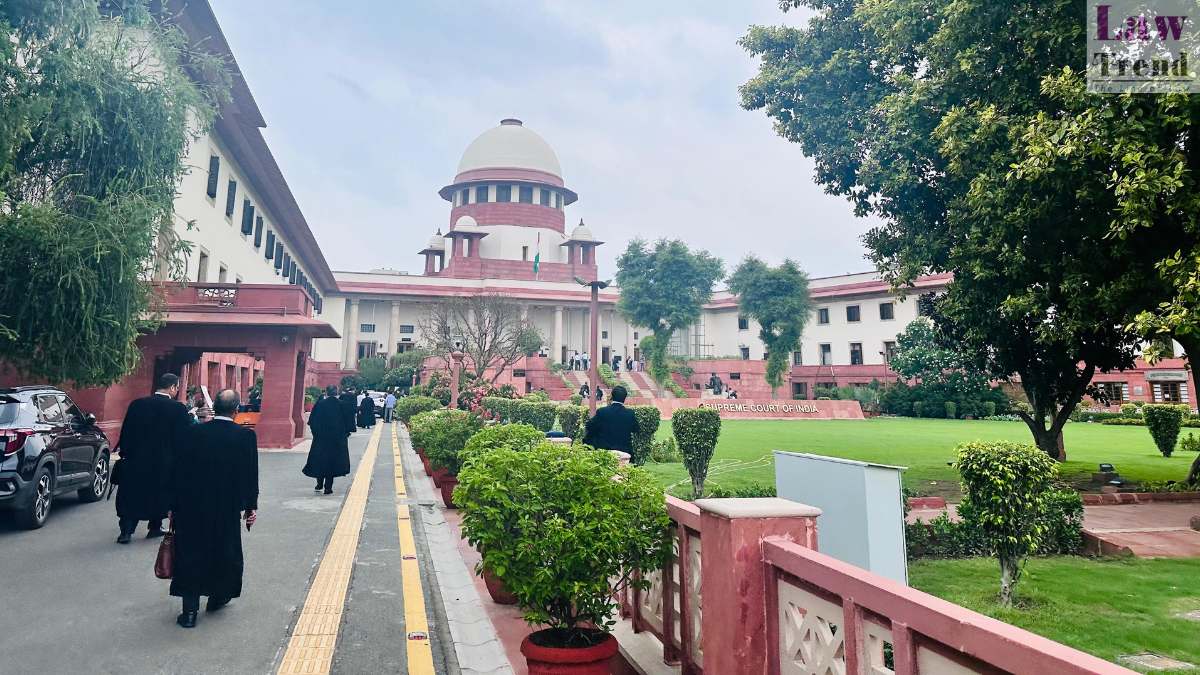
The Supreme Court has held that an application filed under Order XXI, Rules 97 to 101 of the Code of Civil Procedure, 1908 (CPC) is on par with a regular suit, and has faulted the Karnataka High Court for treating the Executing Court’s jurisdiction as limited. Allowing the appeal, the Court declared the legal heirs of an objector who held the original Hakkupatra the lawful owners and possessors of a disputed site in Bengaluru.
A Bench of Justice Sanjay Kumar and Justice Sanjeev Sachdeva set aside the concurrent findings of the Executing Court and the High Court, and also set aside the 1999 decree that had gone against the objector.
Background
G.N. Kanniah Naidu filed a suit in 1987 against Srikanta Rao, claiming title to Site No. 261 in Munnekolala New Extension, Varthur Hobli, Bangalore South Taluk. He said the site was granted to him by the Tahsildar under a Hakkupatra dated 05.01.1972. He did not produce the original and marked only a photocopy, claiming the Tahsildar had taken back the original because multiple allotments had been made for the same sites.
As the defendant did not seriously dispute the grant and produced no documents, the Trial Court decreed the suit in part on 08.10.1999 for declaration of title and possession.
When the plaintiff sought execution, Balakrishna filed IA No. ‘A’ under Order XXI, Rules 97 to 101 CPC. He claimed the site was granted to him under a Hakkupatra of the same date, that he and his son Ananda had built a house there along with three shops let out to tenants, and that the decree was fraudulent and collusive. The Executing Court dismissed the application on 27.09.2008, and the Karnataka High Court dismissed the appeal on 17.08.2011.
Supreme Court’s Findings
The Court noted that the High Court found fault with Balakrishna for not approaching the Trial Court and for resisting execution. Rejecting this, the Court observed, “It is only when steps are taken during execution that a person, behind whose back such a decree has been obtained, would come to know of those proceedings.”
On the High Court’s view that the Executing Court had limited jurisdiction, the Court said the finding “reflects total non-application of mind to the scheme of Order XXI, Rules 97 to 101 CPC.” Relying on Shreenath and another vs. Rajesh and others (1998) 4 SCC 543 and N.S.S. Narayana Sarma and others vs. Goldstone Exports (P) Ltd. and others (2002) 1 SCC 662, it held, “An application filed thereunder is on par with a regular suit and that is the reason why an order passed on such application is appealable as a regular first appeal”.
The Court further held that the High Court’s suggestion that the applicant approach the Civil Court for a declaration “is in utter derogation of the mandate of Order XXI, Rule 101 CPC which explicitly bars a separate suit being filed.”
On the evidence, the Court noted that Ananda produced the original Hakkupatra issued to Balakrishna, while the decree holder had only a photocopy. If the Tahsildar took back the decree holder’s original but left Balakrishna’s with him, the Court said, the only inference was that Balakrishna’s allotment was genuine and not cancelled.
The Court also relied on the decree holder’s own cross-examination, in which he admitted that Balakrishna had built an RCC house with three shops on the site. It held, “This admission on his part was fatal to his claim that it was Srikanta Rao, the defendant, who trespassed upon the site and built a hut there.”
Addressing the reliance on tax receipts by the lower courts, the Court observed, “Tax payments, at best, could lead to an inference only as to possession but not title.” It held that “The claim to title and ownership by Balakrishna stood settled in his favour by the original Hakkupatra dated 05.01.1972.”
The Court also noted that the Tahsildar, Bengaluru East Taluk, in an affidavit dated 09.02.2023, stated that no records of 1972 grants were available, but voiced no doubt about the original Hakkupatra issued to Balakrishna.
Outcome
The Supreme Court allowed the appeal and set aside the High Court’s judgment, the Executing Court’s order, and the decree dated 08.10.1999 in O.S. No. 2198 of 1987. Balakrishna’s legal representatives were declared the lawful owners and possessors of Site No. 261, Munnekolala New Extension, Varthur Hobli, now in Bengaluru East Taluk. Parties were directed to bear their own costs.
Case Title: Balakrishna (Dead) Thr. LRs. vs. G.N. Kanniah Naidu (Dead) Thr. LRs. and Another
Case No.: Civil Appeal arising out of SLP (C) No. 29808 of 2011
Bench: Justice Sanjay Kumar and Justice Sanjeev Sachdeva
Date: October 26, 2026


