

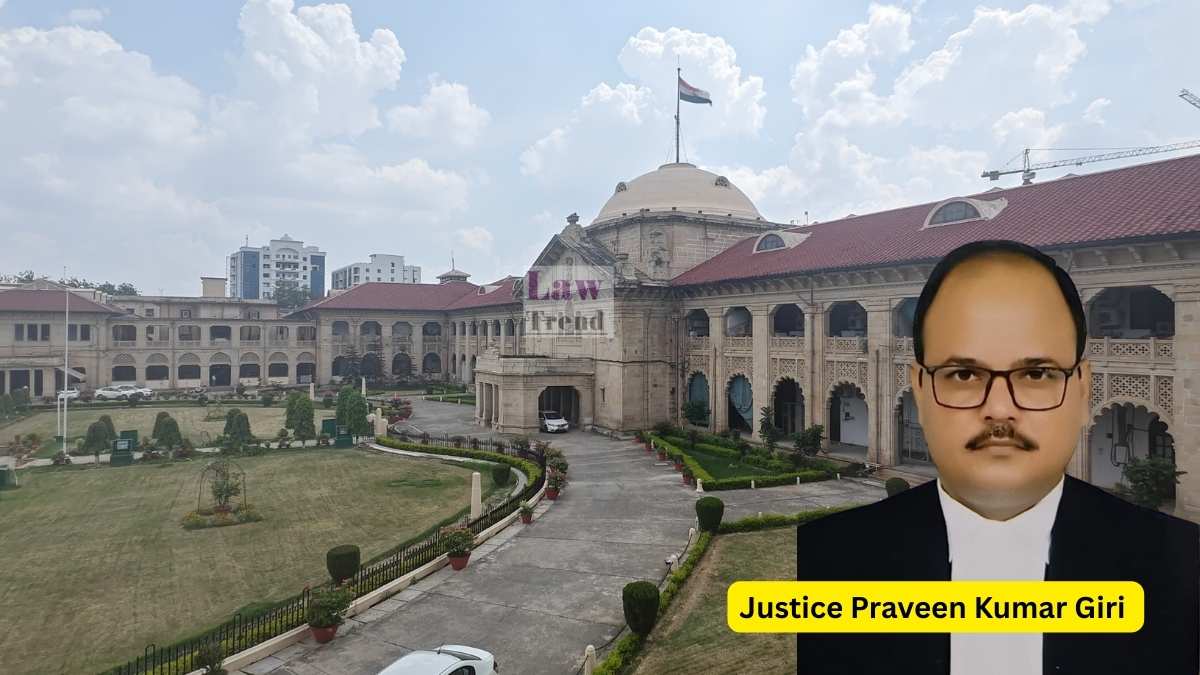
In a significant ruling addressing rampant encroachments on public utility land, the High Court of Judicature at Allahabad held that village functionaries and revenue officials failing to report unauthorized occupation of Gram Panchayat properties will face disciplinary action for misconduct and prosecution for criminal breach of trust, abetment, and conspiracy. Presiding over the matter, Justice Praveen Kumar Giri directed the Tahsildar, Chunar to conclude pending eviction proceedings within the statutory 90-day timeline and issued sweeping statewide directions to ensure the actual removal of encroachments and the restoration of public lands to their original condition.
Background of the Case
The ruling was delivered on a Public Interest Litigation (PIL) petition filed by Manoj Kumar Singh. The petitioner approached the High Court seeking a writ of mandamus to command authorities to remove unauthorized encroachments made by private respondents over public utility land recorded as a pond (babali) in the revenue records of Village Chauka, Pargana Bhuieli, Tehsil Chunar, District Mirzapur. The land parcels involved were Gata No. 48 (area 0.177 hectare), Gata No. 51 (area 0.101 hectare), and Gata No. 53 (area 0.114 hectare). The petitioner further prayed for directions to decide a pending representation dated July 22, 2024.
Submissions of the Parties
Counsel appearing for the petitioner submitted that the pond (babali) had been encroached upon by certain villagers, yet no proceedings had been taken under Section 67 of the Uttar Pradesh Revenue Code, 2006 for eviction. The petitioner contended that although the authorities—including the Tahsildar, Revenue Inspector, the Village Pradhan (as Chairman of the Bhumi Prabandhak Samiti), and the Lekhpal (as Secretary of the Samiti)—had been duly informed, they neglected their duties as statutory custodians of Gram Panchayat property. It was pointed out that proceedings under Section 67 of the Revenue Code were initiated only on August 7, 2025, and September 8, 2025, after the present PIL was filed.
Opposing the contention of continued administrative inaction, learned Additional Chief Standing Counsel Sri Girjesh Kumar Tripathi produced written instructions from the Tahsildar, Chunar, confirming that statutory proceedings for the removal of encroachment under Section 67 had already commenced against the alleged encroachers. The instructions were taken on record.
Legal Provisions and Court’s Analysis
Examining the statutory framework governing public utility lands, Justice Praveen Kumar Giri analyzed the obligations of the Bhumi Prabandhak Samiti under Sections 28-A, 28-B, and 34 of the Uttar Pradesh Panchayat Raj Act, 1947, alongside Sections 59, 60, 61, and 67 of the Uttar Pradesh Revenue Code, 2006, read with Rules 56, 66, and 67 of the Uttar Pradesh Revenue Code Rules, 2016. The Court noted that Section 28 of the Panchayat Raj Act deems every member or servant of a Gram Panchayat or its committees to be a public servant within the meaning of Section 21 of the Indian Penal Code (now Section 2(28) of the Bharatiya Nyaya Sanhita, 2023).
The Court observed that under Rule 66 of the Rules of 2016, the Chairman (Village Pradhan) and Secretary (Lekhpal) of the Bhumi Prabandhak Samiti are legally bound to submit information in R.C. Form-19 to the Assistant Collector or Tahsildar regarding any wrongful occupation or damage to entrusted public land. Criticizing bureaucratic laxity, the Bench observed that village authorities were ignoring encroached public utility lands, which amounts to conspiracy and abetment:
“The land recorded as ‘pond (babali)’ in the Revenue record is entrusted to the Bhumi Prabandhak Samiti (hereinafter referred to as ‘Samiti’) comprising Village Pradhan as Chairman of the Samiti and Lekhpal of the area as Secretary of the Samiti, however, they are not paying any heed to initiate proceedings for removal of the encroachment though they are the custodian of the public utility land and it appears that they are ignoring the encroachment of the land belonging to the Samiti/Gram Sabha by other persons which amount to conspiracy as well as abetment on the part of the Chairman, Secretary and other members of the Samiti.”
The Court held that such omission by statutory custodians attracts serious penal and service consequences:
“The property of Gram Sabha is entrusted to the Bhumi Prabandhak Samiti, therefore, the Bhumi Prabandhak Samiti is the custodian of the said property, and if the said property is encroached by any unauthorized person, the Chairman and the Secretary are under obligation to inform the Tahsildar under Rule 66 of the U.P Revenue Code Rules, 2016 and if they do not inform the Tahsildar about such encroachment and thereby fail to protect and preserve such property and such inaction on the part of the Members of the Samiti, including its Chairman i.e. Village Pradhan and Secretary i.e. Lekhpal, shall amount to criminal breach of trust under Section 316 of the Bharatiya Nyay Sanhita, 2023 along with Criminal Conspiracy and Abetment.”
Highlighting the scope of a completed proceeding, the Bench ruled:
“It is hereby clarified that the completion of proceedings shall not be construed to mean merely passing of an order under Section 67 of the Uttar Pradesh Revenue Code, 2006. The proceedings shall be deemed to have been culminated and completed only upon the execution and enforcement of the said order at the site, ensuring actual removal of the encroachment and restoration of possession of the public land by the competent authority within 90 days as provided under Rule 67 (6) of the Rules, 2016.”
The Court also referred to Order XLI Rule 5 of the Code of Civil Procedure, 1908, clarifying that the mere pendency of an appeal against an order passed under Section 67 does not operate as an automatic stay; unless a specific interim stay is granted in favor of the encroacher, the eviction order can be executed on the spot after 30 days.
Addressing the environmental impact of occupying water reservoirs, the Court invoked Article 21, Article 14, Article 48A, and Article 51A(g) of the Constitution of India, observing:
“In a short term it is said, “JAL HI JIVAN HAI” i.e. “Water is life”, thus without water there is no existence of life of any creature on Earth so it must be saved at any cast. Thus, no encroachment is permissible on water reservoir and it must be removed as early as possible with heavy penalty, cost and punishment.”
The Court extensively discussed prior precedents, including the Division Bench ruling of the Allahabad High Court in Dayaram Yadav and 2 Others vs State of Uttar Pradesh and 6 Others, which reiterated that non-enforcement of eviction orders amounts to dereliction of duty, and the Supreme Court rulings in Hinch Lal Tiwari vs Kamla Devi and Ors. and Jitendra Singh Vs. Ministry of Environment and others, which established that village commons and water bodies are essential safeguards to protect the fundamental right to life. Reliance was also placed on State of Haryana and others Vs. Satpal and others and Babu Ram vs. State of Himachal Pradesh and Anr., which held that citizens have no right to encroach upon public land.
Expressing regret over the sheer volume of such litigation, the Court remarked:
“In view of the above facts and circumstances, this Court feels sorrow that this Court is flooded with the umpteen number of PILS pertaining to the encroachment of public utility land in respect of proceedings of Section 67 of the Revenue Code, 2006.”
Statewide Directives and Decision
Disposing of the petition without costs, the High Court directed the Tahsildar, Chunar to decide the pending Section 67 proceedings within the statutory period under Rule 67(6). In addition, Justice Praveen Kumar Giri issued a comprehensive set of directives:
- Action Against Lekhpals: All District Magistrates and Sub-Divisional Magistrates across Uttar Pradesh were directed to initiate departmental proceedings for misconduct under Rule 195 of the Rules of 2016 read with Section 233(2)(ix) of the Revenue Code, as well as criminal proceedings for criminal breach of trust under Section 316 of the Bharatiya Nyaya Sanhita, 2023 (with abetment and conspiracy), against any Lekhpal who fails to submit information in R.C. Form-19 to the Tahsildar within 60 days of this order.
- Action Against Village Pradhans: Similar disciplinary and criminal proceedings, along with proceedings for removal under Section 95(1)(g)(iii) of the Uttar Pradesh Panchayat Raj Act, 1947 for abuse of position and persistent failure of duty, must be initiated against any Village Pradhan who fails to report encroachments in R.C. Form-19 within 60 days.
- Accountability of Tahsildars: If a Tahsildar or Tahsildar (Judicial) fails to conclude Section 67 eviction proceedings within 90 days from the date of the show cause notice without recording sufficient reasons for the delay, departmental proceedings under the Uttar Pradesh Government Servant (Discipline and Appeal) Rules, 1999 must be initiated for misconduct.
- Enforcement and Restoration: The process of removal of encroachment and action against erring officers must be completed within 90 days after affording an opportunity of hearing to affected parties. Public utility lands must be restored to their original nature as recorded in revenue records.
- Police Assistance: Police authorities are directed to provide all necessary cooperation and assistance to revenue officials to carry out evictions peacefully and maintain public order.
- Contempt Warning: The Court warned that if encroachments persist and functionaries fail to report them, civil contempt proceedings may be initiated by any person before the High Court.
- Government Compliance: Additional Chief Secretaries and Principal Secretaries of concerned departments were directed to examine continuing encroachments and ensure preservation and restoration. District Magistrates and Commissioners were instructed to intimate the Additional Chief Secretaries/Principal Secretaries every year regarding action taken against encroachers and erring officials.
Case Title: Manoj Kumar Singh Versus State of U.P. and 12 others
Case No.: Public Interest Litigation (PIL) No. – 2923 of 2025
Bench: Justice Praveen Kumar Giri
Date: October 6, 2025




