

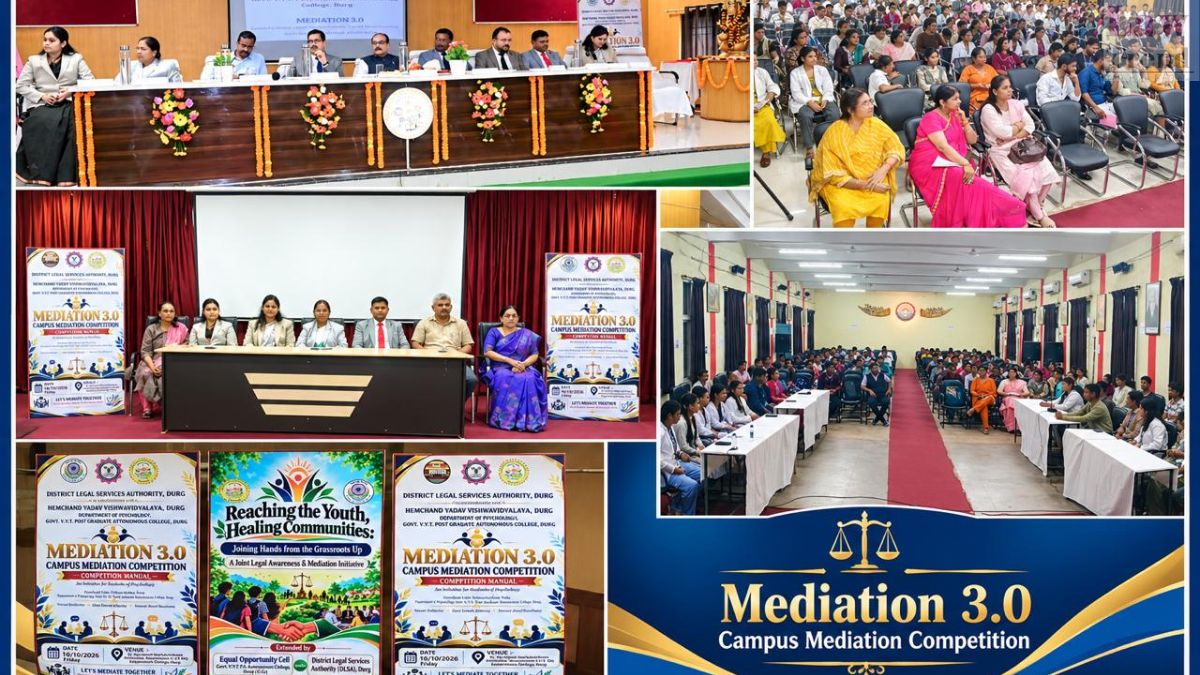
Disputes can be resolved not only through confrontation, but also through dialogue, mutual understanding and consent. With the aim of conveying this idea to the younger generation and providing an opportunity to understand mediation in practice, the Campus Mediation Competition was organised under Mediation 3.0. This initiative gave students an opportunity to understand how mediation can serve as an effective means of resolving disputes amicably.
More than 100 students registered for the competition, reflecting the growing interest among young people in mediation and alternative dispute resolution. Under the guidance of Shri K. Vinod Kujur, Principal District and Sessions Judge, the Campus Mediation Competition – Mediation 3.0 was organised for students by the Principal District and Sessions Court, Durg, and the District Legal Services Authority, Durg, in collaboration with the Department of Psychology of Hemchand Yadav Vishwavidyalaya, Durg, and Government Vishwanath Yadav Tamaskar Postgraduate Autonomous College (Science College), Durg.
The Equal Opportunity Cell of Government Vishwanath Yadav Tamaskar Postgraduate Autonomous College (Science College), Durg, also participated in the programme. This joint initiative provided a meaningful platform for coordination among the judiciary, legal services institutions and the academic community. The event was organised under the nationwide Mediation 3.0 campaign, conducted from 1 August to 31 December 2026 under the guidance of the Supreme Court’s Mediation and Conciliation Project Committee.
The objective of this initiative was to familiarise students with the mediation process and highlight the importance of dialogue, mutual understanding and voluntary consent in resolving disputes. Through the competition, students had an opportunity to understand how mediation can serve as an effective means of resolving disputes amicably.
The programme was graced by the presence of Shri K. Vinod Kujur, Principal District and Sessions Judge, Durg and Chairman, District Legal Services Authority, Durg; Prof. Dr. Sanjay Tiwari, Vice-Chancellor, Hemchand Yadav Vishwavidyalaya, Durg; Dr. Ajay Singh, Principal; Dr. Anil Kumar Pandey, Registrar; Shri Anish Dubey, District and Additional Sessions Judge, Durg; Smt. Sushma Lakra, Chairperson, Permanent Lok Adalat, Durg; Shri Bhupesh Kumar Basant, Chief Judicial Magistrate, Durg; Shri Umesh Kumar Bhagwatkar, Secretary, District Legal Services Authority, Durg; Smt. Kamini Jaiswal, Civil Judge, Senior Division, Durg; and Smt. Aishwarya Diwan, Civil Judge, Junior Division, Durg.
In his address, Shri K. Vinod Kujur, Principal District and Sessions Judge, Durg and Chairman, District Legal Services Authority, Durg, shared experiences from his student life and emphasised the need to develop awareness of mediation among young people. He said that mediation has been an integral part of our social traditions and that the present generation can play an important role in carrying this tradition forward. He encouraged students to adopt a culture of dialogue, mutual understanding and peaceful resolution of differences.
Prof. Dr. Sanjay Tiwari, Vice-Chancellor, Hemchand Yadav Vishwavidyalaya, Durg, also expressed his views on the importance of mediation and alternative dispute resolution. He highlighted the importance of student participation in such academic initiatives and coordination between universities and judicial institutions.
From “Date after Date” to Consent-Based Justice
Shri Anish Dubey, District and Additional Sessions Judge, Durg, began his address with the famous film dialogue “Date after Date”, drawing attention to delays in the judicial process. He highlighted the challenges arising from the large number of pending cases in courts and limited judicial resources.
He explained that National and State-level Lok Adalats play an important role in the disposal of pending cases, and that Mediation 3.0 is also an important effort towards encouraging the amicable resolution of disputes.
Psychology and Mediation: Understanding the Human Aspects Behind Disputes
The role of psychology in the mediation process was also highlighted during the programme. Understanding human behaviour, emotions, dialogue and interpersonal relationships helps identify the root causes of disputes and promote constructive conversations. The mediation experience provided students with an opportunity to develop important skills such as active listening, empathy, effective communication, the ability to reach settlements, logical thinking and dispute management. These skills can prove useful not only in their future professional lives but also in their personal and social relationships.
Enthusiastic Performance by Students in the Competition
Students demonstrated their abilities in dialogue, negotiation and consensus-building through group and individual competitions. The results were as follows:
Group Competition
• First Prize — Group 8: Yamini Baghel, Neeta Sahu, Aditya Ku. Chandrapakshi and Mrinal Dap.
• Second Prize — Group 5: Kanchana Kosha, Karuna Jain, Sandhya Thakur and Anjali Verma.
• Third Prize — Group 2: Shreya Sahu, Garima Sahu, Omkumari and Dhyasant Sahu.
Undergraduate (UG) Level Individual Competition
• First Prize: Mrinal Dap.
• Second Prize: Toshi.
• Third Prize: Shlok.
Postgraduate (PG) Level Individual Competition
• First Prize: Asha.
• Second Prize: Anjali.
• Third Prize: Neetu.
A Joint Initiative of the Judiciary and Academic Institutions
The Campus Mediation Competition organised under Mediation 3.0 highlighted the importance of increasing awareness of mediation among the younger generation and promoting a culture of dispute resolution through dialogue, mutual understanding and voluntary consent.
The participation of the District Judiciary, District Legal Services Authority, Hemchand Yadav Vishwavidyalaya, Durg, and the Equal Opportunity Cell of Government Vishwanath Yadav Tamaskar Postgraduate Autonomous College, Durg, demonstrated that judicial and academic institutions can together play an important role in developing a culture of peaceful dispute resolution.
On this occasion, faculty members of the university and college, teachers of the Department of Psychology, students, officers and staff of the District Legal Services Authority, and Para Legal Volunteers were present.




