

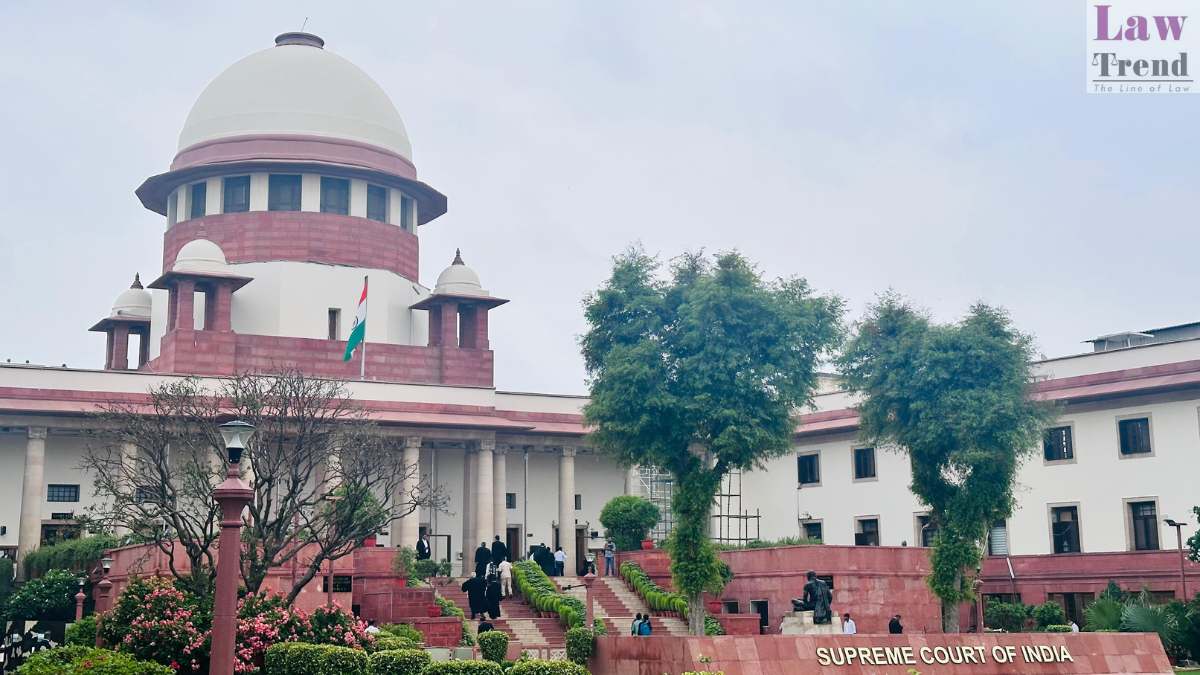
In a ruling clarifying the appellate remedies available against interlocutory contempt orders, a Supreme Court bench comprising Justice Dipankar Datta and Justice Sheel Nagu held that an intra-court appeal lies against an order passed by a Single Judge in a contempt application if it traverses the merits of the dispute or determines substantive rights. The Court ruled that civil contempt proceedings are of a sui generis character and cannot be equated with the exercise of criminal jurisdiction so as to attract statutory bars against intra-court appeals.
The Bench further questioned the correctness of the three-judge bench precedent in Ram Kishan Fauji v. State of Haryana (2017), which barred intra-court appeals in writ proceedings arising from criminal substratums, observing that it creates an unwarranted asymmetry and impairs access to justice. Consequently, the Court referred the Ram Kishan Fauji decision to a larger bench for reconsideration while granting the appellant liberty to file a Special Appeal before the Division Bench of the High Court.
Background of the Case
The proceedings originated from a service dispute concerning recruitment to the posts of Assistant Prosecution Officers. A Single Judge of the High Court of Judicature at Allahabad, Lucknow Bench, in a writ petition, quashed an Office Memorandum dated July 28, 2020, along with a consequential communique dated August 14, 2020, and directed authorities to consider the candidature of the respondents.
In purported compliance with that direction, the competent authority—the appellant—passed an order on September 2, 2026, rejecting the candidature of the respondents and placed it on record before the High Court through a compliance affidavit.
However, during contempt proceedings initiated by the respondents, the Single Judge passed an interim order on September 3, 2026, rejecting the compliance affidavit. The Single Judge observed that the State remained under an obligation to appoint the respondents, listed the contempt petition for September 17, 2026, and directed that if the writ court’s order was not complied with, the Additional Chief Secretary (Department of Home) must appear in person for further proceedings, including the framing of charges. Aggrieved by this interim direction, the appellant approached the Supreme Court under Article 136 of the Constitution.
Arguments of the Parties
Appearing for the appellant, Additional Solicitor General Mr. Nataraj contended that once an order had been passed in compliance with the writ court’s directive, such an order could not have been judicially reviewed in the exercise of contempt jurisdiction. Citing J.S. Parihar v. Ganpat Duggar and Lalith Mathur v. L. Maheswara Rao, he argued that whether a compliance order is right or wrong cannot be examined in contempt proceedings, and the only proper course for an aggrieved party is to file a fresh writ petition. He also submitted, citing Niaz Mohd. v. State of Haryana, Kapildeo Prasad Sah v. State of Bihar, and Ashok Paper Kamgar Union v. Dharam Godha, that civil contempt requires deliberate and wilful disobedience, whereas the Single Judge’s order sought to grant substantive relief not even awarded by the writ court.
When queried by the Bench regarding whether a Special Appeal under the Allahabad High Court Rules, 1952 lay against the interim order, Mr. Nataraj argued in the negative. He contended that the order was not one imposing punishment, rendering Section 19 of the Contempt of Courts Act, 1971 inapplicable. Furthermore, he argued that Rule 5 of Chapter VIII of the Allahabad High Court Rules excludes appeals arising from the exercise of criminal jurisdiction, and because contempt proceedings are quasi-criminal, no Special Appeal would lie before a Division Bench. Relying on Midnapore Peoples’ Coop. Bank Ltd. v. Chunilal Nanda, Ajay Kumar Bhalla v. Prakash Kumar Dixit, and Subhash Chandra v. Srikant Goswami, he submitted that approaching the Supreme Court under Article 136 was the sole remedy available.
Because the Supreme Court decided not to enter into the factual merits of the Single Judge’s order and confined its determination to the availability of an intra-court appeal, counsel for the respondents was not called upon to answer.
The Court’s Analysis
The Supreme Court examined the constitutional and statutory framework governing contempt powers, drawing upon Article 215 of the Constitution and the precedents in S.A.L. Narayan Row v. Ishwarlal Bhagwandas and P. Mohanraj v. Shah Bros. Ispat (P) Ltd. The Court noted that civil contempt jurisdiction is sui generis and functions in the nature of a special civil jurisdiction aimed at enforcing compliance, rather than executing criminal prosecutions under penal statutes.
Addressing the argument that the quasi-criminal nature of contempt invokes the criminal jurisdiction exclusion under Rule 5 of Chapter VIII of the Allahabad High Court Rules, the Bench clarified:
“In light of the above meaning, contempt being quasi-criminal in nature means that it resembles criminal law in its consequences of conviction and punishment, but is not actually criminal prosecution. The trial is neither for an offence punishable under the Indian Penal Code, 1860/Bharatiya Nyaya Sanhita, 2023/other penal laws nor is the guilt determined in terms of the procedure spelt out in the Code of Criminal Procedure, 1973/Bharatiya Nagarik Suraksha Sanhita, 2023/other procedural laws.”
Applying the tests laid down in Midnapore Peoples’ Coop. Bank Ltd. v. Chunilal Nanda, the Court catalogued specific instances where an intra-court appeal is maintainable against a Single Judge’s order passed during contempt proceedings:
- An order issuing directions to a party not bound by the parent order or not originally party to the writ proceedings (unless stepping into the shoes of the original respondent);
- An order requiring compliance once again upon examining the correctness of a purported compliance order and rejecting it;
- An order travelling beyond the parent order to grant relief not previously awarded; and
- An order determining disputed questions of law or fact that effectively decide substantive rights.
Turning to the bar on intra-court appeals rooted in Ram Kishan Fauji v. State of Haryana, the Bench expressed deep reservations regarding its premise that Article 226 contains bifurcated civil and criminal jurisdictions based solely on the underlying subject matter of the dispute. Distinguishing criminal matters, proceedings, and jurisdictions, the Court observed:
“Article 226, in plain terms, confers a single, original, special, and extraordinary constitutional jurisdiction. Such jurisdiction is also neither civil nor criminal, but sui generis. It is also instructive that the very description or allocation of writ petitions before a High Court or this Court as ‘civil’ or ‘criminal’ does not, per se, furnish a principled basis for ascertaining the nature of the jurisdiction exercised under Article 226.”
Highlighting the adverse impact of restricting intra-court appeals on citizens seeking protection of personal liberty under Article 21, the Bench held that shutting the appellate door within the High Court forces litigants to seek discretionary remedies under Article 136 in New Delhi at significant expense, thus compromising access to justice under Articles 14 and 21 as recognized in Anita Kushwaha v. Pushap Sudan.
Decision of the Court
The Supreme Court declined to adjudicate the validity of the Single Judge’s interim order on merits and remitted the appellant to the remedy of an intra-court appeal. The appellant was granted two weeks to present a Special Appeal before the Division Bench of the High Court, which was directed to hear the matter on its merits in accordance with law.
To enable this recourse, the Supreme Court stayed the contempt proceedings pending before the Single Judge for a period of two months.
Simultaneously, the Bench formally referred the legal questions concerning the correctness of Ram Kishan Fauji to the Chief Justice of India for constitution of an appropriate larger bench. The framed reference questions include:
“Does the decision in Ram Kishan Fauji v. State of Haryana, (2017) 5 SCC 533 correctly interpret the Letters Patent governing the various high courts on maintainability of intra-court appeals in the light of the nature of jurisdiction conferred by Article 226 of the Constitution, adverted to above? Does the ratio not, effectively, negate proper access to justice at the intra-court appellate level, apart from creating a division in Article 226 not contemplated by the framers of the Letters Patent or the Constitution? Should the decision in Ram Kishan Fauji (supra) be revisited in view of the discussions in paragraphs 49 to 51 of this opinion?”
Case Title: Sanjay Prasad v. Madhusudan Dwivedi & Ors.
Case No.: Civil Appeal No. ___ of 2026 (Arising out of SLP (C) No. 33319 of 2026)
Bench: Justice Dipankar Datta and Justice Sheel Nagu
Date: October 14, 2026




