

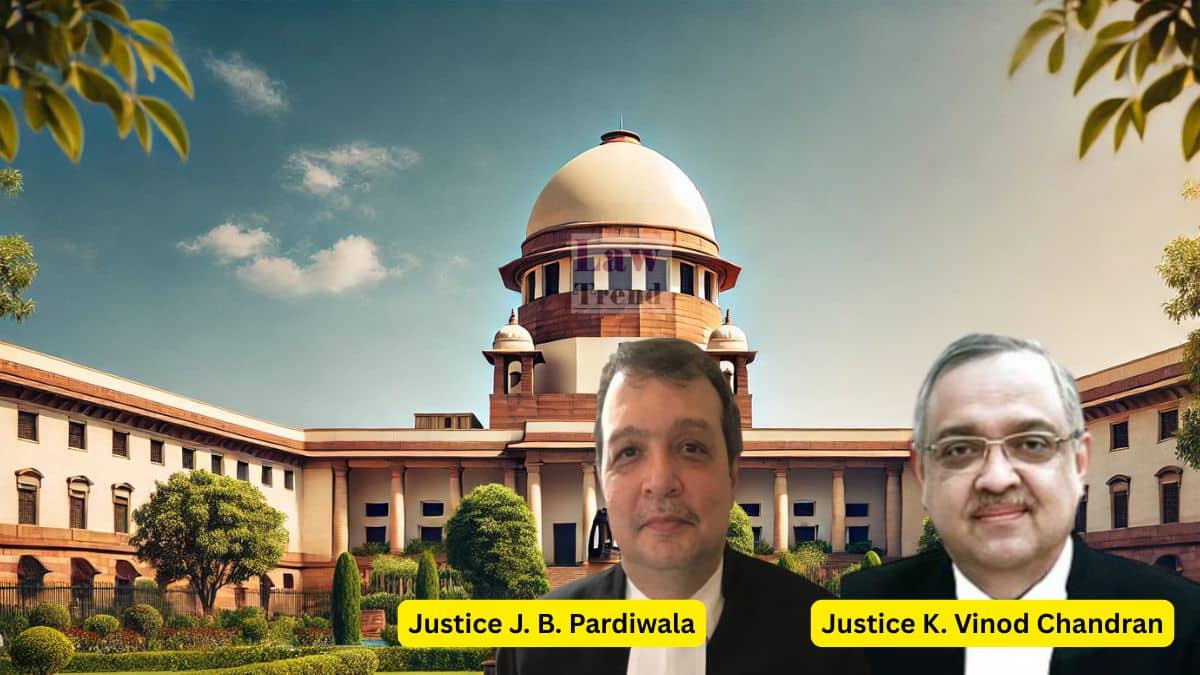
The Supreme Court of India, comprising a Bench of Justice J. B. Pardiwala and Justice K. Vinod Chandran, has held that non-signatories to a partnership agreement can be joined as “veritable parties” to arbitration proceedings at the referral stage if the resolution of the dispute directly affects their underlying rights to the subject asset. Partially modifying an order of the High Court passed under Section 11 of the Arbitration and Conciliation Act, 1996, the Bench ruled that although respondents 3 and 4 were not signatories to the 1985 partnership deed containing the arbitration clause, they are prima facie veritable parties because their claim to the disputed commercial property hinges directly on the validity of an allegedly forged retirement deed. The Court clarified that this finding remains prima facie and leaves the final determination on their inclusion, limitation, and estoppel open for adjudication by the Arbitral Tribunal.
Background of the Dispute
The controversy centres on an immovable property designated as Unit No. 2, measuring 3,500 square feet on the ground floor of Manish Commercial Centre, Worli, Mumbai (referred to as the “subject asset”). The asset was originally acquired on October 3, 1977, by a partnership firm named M/s Prospective Traders, which was initially constituted on April 2, 1977, between three family trusts of V. U. Shah, N. U. Shah, and C. U. Shah.
On December 9, 1985, the firm was reconstituted by inducting the appellants—Hemant D. Shah HUF and the wife of Hemant D. Shah—along with the first and second respondents—Chittaranjan D. Shah HUF and the daughter-in-law of C. D. Shah. A subsequent reconstitution deed dated December 30, 1987, saw the retirement of the original trust partners, an arrangement disputed by the appellants but not contested by the original partners.
A major fracture occurred around a retirement deed dated July 3, 1995, under which the appellants purportedly retired from the firm. The appellants have consistently assailed this document as forged. Following this, the second respondent retired on July 1, 2005, converting the firm into a sole proprietorship under the first respondent with the firm’s assets vested in him. On September 30, 2009, the first respondent inducted the third and fourth respondents as partners. After the first respondent retired on November 4, 2009, the third and fourth respondents continued as partners in control of the firm and the subject asset.
An earlier arbitral award secured at the instance of the appellants was previously set aside under Section 34 of the Act. When the appellants approached the High Court under Section 11 of the Act seeking the appointment of an arbitrator and the inclusion of the respondents, the High Court answered the issue of limitation in favour of the appellants against respondents 1 and 2. However, the High Court declined the prayer to join respondents 3 and 4, finding that they were not signatories to the arbitration agreement and did not fall within recognized exceptions such as persons claiming through or under a signatory or under the Group of Companies doctrine.
Arguments of the Parties
Before the Supreme Court, learned Counsel for the appellants, Sri Ashim Sood, pressed for the inclusion of the third and fourth respondents in the arbitral reference. The appellants asserted that they never retired from the firm, that the 1995 retirement deed was a forged instrument, and that the original partnership and its ownership over the subject asset continue to subsist.
Opposing this, learned Counsel for the first and second respondents, Sri Sanjay Sarin, maintained that the partnership stood dissolved upon the retirement of the second respondent subsequent to the appellants’ retirement. Learned Senior Counsel for the third and fourth respondents, Sri Ritin Rai, argued that his clients distanced themselves from the partnership agreement of December 9, 1985, which contained the arbitration clause, contending that they were non-signatories who joined subsequent arrangements.
The Court’s Analysis and Precedents
Delivering the judgment, Justice K. Vinod Chandran observed at the outset that “‘Veritable Party’ in a constituted arbitration is a vexing question that props up oftener than ever, which question has to be determined more on the facts; the multiple aspects arising therefrom, which cannot be put down in a strait jacket formula.”
The Bench examined the principles governing non-signatories laid down in Cox & Kings Limited v. SAP India Private Limited and Another (2024) and Hindustan Petroleum Corporation Limited v. BCL Secure Premises Private Limited (2026).
The Court noted that while the Group of Companies doctrine elaborated in Cox & Kings Limited did not directly apply to the present proceedings, the underlying principles assisted in resolving the dispute. The judgment cited paragraph 100 of Cox & Kings Limited, emphasizing that courts and tribunals cannot adopt a rigid approach to exclude non-signatories whose conduct and relationship with signatories demonstrate an intention to be bound by the contract containing the arbitration clause. The Bench highlighted paragraph 132 of Cox & Kings Limited:
“‘Looking at the factors holistically, it could be inferred that the non-signatories, by virtue of their relationship with the signatory parties and active involvement in the performance of commercial obligations which are intricately linked to the subject-matter, are not actually strangers to the dispute between the signatory parties.'”
The Court further referenced the conclusions in Cox & Kings Limited, reiterating that the requirement of a written agreement under Section 7 does not exclude binding non-signatories, that referral courts should leave it to the tribunal to decide whether a non-signatory is bound, and that doctrines beyond the Group of Companies doctrine remain applicable.
Examining Hindustan Petroleum Corporation Limited, the Bench observed that while the referral court under Section 11 must arrive at a prima facie satisfaction regarding the existence of an arbitration agreement and whether a non-signatory is a veritable party, the arbitral tribunal’s jurisdiction to decide the issue on evidence and legal doctrine remains intact.
Applying these principles to the facts, the Bench observed that the dispute squarely revolves around the ownership of the subject asset. The Court reasoned that if the retirement deed of July 3, 1995, is ultimately found to be invalid or forged, the parties necessarily revert to the reconstituted partnership deed of December 9, 1985:
“In which event, it would affect the rights of the 3rd and 4th respondents, who were inducted by the 1st respondent, as partners who obtained rights over the ‘subject asset’ by that partnership deed, in which neither the appellants nor the 1st and 2nd respondents are partners. The dispute raised for arbitration revolves around the ownership of the ‘subject asset’; whether it be by virtue of the deed of 09.12.1985 or by the deed of 04.11.2009.”
Decision of the Court
The Supreme Court concluded that respondents 3 and 4 are veritable parties to the dispute, as their asserted rights over the subject asset under the deed of 2009 depend entirely upon the validity of the appellants’ disputed retirement.
Accordingly, the Court modified the High Court’s order to the extent of finding the third and fourth respondents to be veritable parties to the arbitration despite not being signatories to the December 9, 1985 deed.
The Bench added a word of caution, emphasizing: “[O]ur findings on 3rd and 4th respondents being veritable parties, is a prima facie finding, which would not govern the adjudication of the said issue or the issue of limitation or the ground raised of an estoppel against the appellants by 3rd and 4th respondents, which would be alive; left to be considered by the Arbitral Tribunal.”
With these observations and modifications, the appeal was disposed of.
Case Details:
Case Title: Hemant D. Shah HUF & Anr. Versus Chittaranjan D. Shah HUF & Ors.
Case No.: SLP (C) No. 26474 of 2026
Bench: Justice J. B. Pardiwala and Justice K. Vinod Chandran
Date: October 12, 2026




