

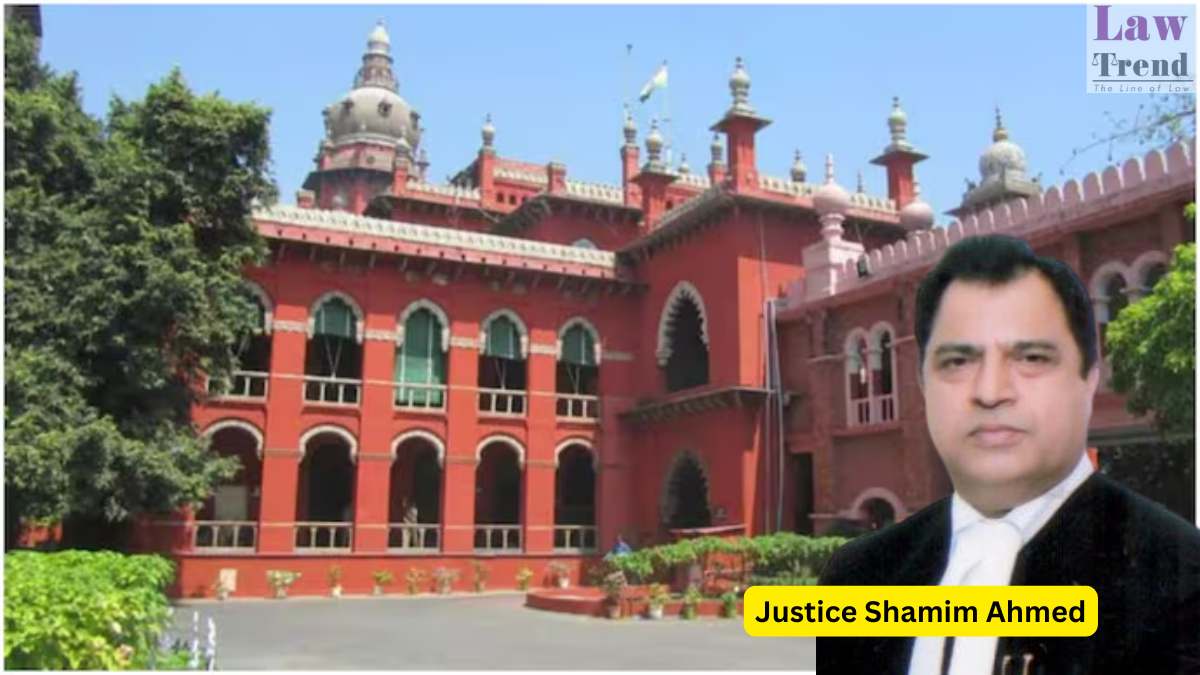
The Madras High Court, presided over by Justice Shamim Ahmed, has ruled that the statutory right of residence guaranteed to an aggrieved woman under the Protection of Women from Domestic Violence Act, 2005 cannot be substituted with a monetary allowance for alternative accommodation when her security and dignity are at stake. Setting aside an interim stay granted by a Sessions Court that had replaced a 73-year-old widow’s residence order with a monthly rent payment of Rs 15,000, the Court ordered her immediate restoration to the shared household and directed the Puducherry administration and police to institute daily monitoring to safeguard her physical well-being, food, and medical necessities.
Background of the Case
The petitioner, an aged widow of 73 years, had resided in the residential premises in Puducherry for several decades. Having no biological children, she and her late husband adopted the first respondent as their son, educated him, and supported him until he secured permanent employment in a government enterprise, subsequently arranging his marriage with the second respondent. During his lifetime, the petitioner’s late husband executed a Will concerning the residential property in favour of the first respondent, while explicitly protecting the petitioner’s life interest and right of residence for her lifetime.
Following her husband’s demise on June 9, 2023, disputes arose within the family. On December 30, 2024, an alleged altercation and assault occurred, leading to the registration of a criminal complaint in Crime No. 7 of 2025. Dispossessed from the house and deprived of her gold jewellery, the petitioner was forced to take shelter at a relative’s house. She subsequently initiated proceedings in D.V.C. No. 8 of 2026 before the Judicial Magistrate (Mahila Court), Puducherry.
The Magistrate found a prima facie domestic relationship and shared household, granting a Residence Order and Protection Order under Sections 17 and 19 of the Domestic Violence Act, while directing the police to provide necessary implementation assistance. However, on an appeal preferred by the respondents, the III Additional Sessions Judge, Puducherry, vide an interim order dated July 13, 2026, stayed the Magistrate’s residence order on the condition that the first respondent pay Rs 15,000 per month towards alternative accommodation. Aggrieved by this substitution, the petitioner approached the High Court in revision.
Arguments of the Parties
Appearing for the petitioner, counsel argued that the petitioner is an elderly widow with no independent support system who had resided in the house for decades. It was contended that directing her to find alternative accommodation at this stage of life causes severe hardship and effectively defeats the statutory protections under the Domestic Violence Act. Counsel further submitted that the first respondent, having been brought up and supported by the petitioner and her late husband, bears an inescapable legal and moral duty to ensure her shelter, food, clothing, and medical care.
Conversely, counsel for the respondents argued that serious disputes concerning the title and possession of the property are actively pending adjudication before a competent civil court, alongside proceedings before the Maintenance and Welfare of Parents and Senior Citizens Tribunal. On this basis, the respondents contended that proceedings under the Domestic Violence Act should not be utilised to indirectly resolve questions of property ownership and title.
The Court’s Analysis and Precedents
Addressing the rival contentions, the High Court clarified that proceedings under the Protection of Women from Domestic Violence Act, 2005 are enacted to provide immediate and effective protection, and cannot be curtailed due to pending civil litigation over title:
“The statutory scheme therefore makes it clear that the immediate protection of residence and safety is distinct from the ultimate adjudication of proprietary rights. Consequently, the pendency of civil proceedings or competing claims of title cannot, at the interim stage, by itself obliterate the protection which the learned Magistrate has found necessary to grant to the Revision Petitioner.”
Highlighting the emotional and humanitarian reality of the case, the Court observed:
“A house may be a subject matter of litigation, but for an aged woman who has spent several decades of her life therein, it also represents her sense of security, dignity and belonging. Equally, for a person who was brought up as a son by the Revision Petitioner, the responsibilities arising from such a relationship cannot be viewed merely through the prism of competing claims over property.”
The Court reviewed relevant jurisprudence concerning the protection of elderly persons and parents:
- In Kamalakant Mishra v. Additional Collector and Others (2025), the Supreme Court affirmed that welfare enactments for senior citizens must be construed liberally to advance care and protection, holding that tribunals possess full authority to evict relatives who breach maintenance obligations.
- In Smt. Sumantra Bai Mehra v. Smt. Parvati Mehra @ Rinki Mehra (2024), the Madhya Pradesh High Court, relying on the Supreme Court’s ruling in S. Vanitha v. Deputy Commissioner, Bengaluru Urban District, held that maintenance includes food, clothing, residence, and medical care, affirming that an aged person cannot simply be ejected from their home.
- In Vijaya Manohar Arbat v. Kashirao Rajaram Sawai (1987), the Supreme Court laid down that society casts an unyielding obligation on children to maintain and care for their aged and infirm parents.
- In S. Rajan v. R. Srinivasan and Others (2025), the Madras High Court underlined that welfare statutes demand more than mere monetary arrangements, recognizing basic physical necessities, love, and care within the statutory spirit.
Applying these principles, Justice Shamim Ahmed emphasized that financial allowances cannot replace actual residential security:
“The direction for payment of Rs.15,000/- per month cannot be treated as an exhaustive discharge of the responsibilities towards an aged woman who requires not only financial assistance but also food, clothing, security, medical care, emotional support and a dignified place to reside.”
“protective legislation concerning senior citizens cannot be reduced to a mere monetary arrangement when the very residence and physical security of an aged person are in issue. The relief granted must be meaningful and capable of protecting the person whom the legislation seeks to protect.”
Decision of the Court
The High Court stayed the operation of the Sessions Court’s order dated July 13, 2026, and restored the Judicial Magistrate’s residence order forthwith, issuing a comprehensive series of interim directions:
- The District Magistrate and the Senior Superintendent of Police (SSP), Puducherry, must immediately facilitate the safe and unhindered restoration of the petitioner to the residential premises.
- The jurisdictional police must provide necessary support during entry and ensure no breach of peace occurs.
- The respondents are strictly restrained from creating any hindrance or disturbance to her peaceful residence or denying her access to the living quarters.
- The first respondent must continue to pay Rs 15,000 per month towards the petitioner’s maintenance on or before the 15th of each succeeding month, commencing from October 2026.
- The respondents must guarantee her safety and refrain from any physical, verbal, emotional, or economic abuse.
- The respondents must ensure she receives adequate food three times a day, appropriate clothing, and daily living necessities.
- The respondents must attend to all her essential medical requirements, condition-specific treatment, and medicines.
- The respondents must not dispossess her or interfere with her residence in any manner.
- The jurisdictional police must depute one Police Constable, preferably accompanied by a Woman Police Constable, to conduct daily home visits to verify her safety, comfort, food, and medical care.
- Daily compliance reports must be submitted to superior officers, and a consolidated report must be submitted to the High Court by the SSP, Puducherry, by the next date of hearing.
- The police must take immediate action upon any complaint regarding obstruction, neglect, threat, or abuse.
The Court clarified that these directions are strictly interim protective measures and do not determine proprietary titles or the validity of documents, which remain open for determination before the competent civil court. The matter has been listed for further hearing on October 29, 2026.
Case Details:
Case Title: Mahalakshmi v. Moorthy and Another
Case No.: CRL RC No. 2328 of 2026 and MP No. 19203 of 2026
Bench: Justice Shamim Ahmed
Date: 09.10.2026




