

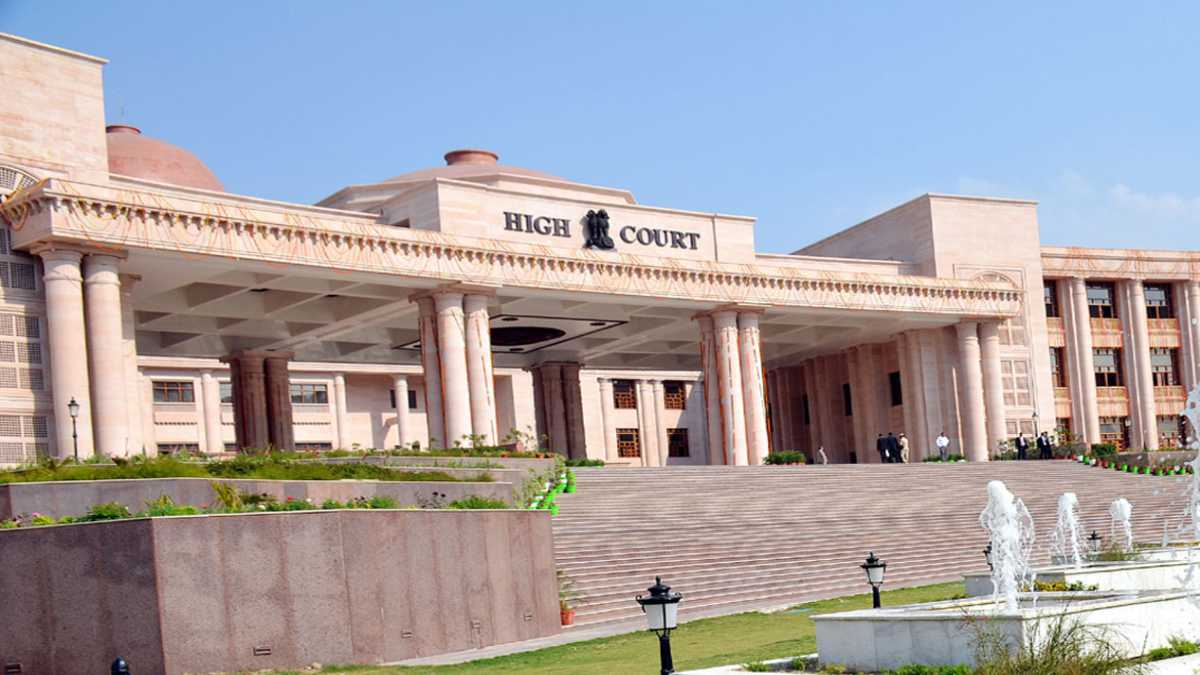
The Allahabad High Court, through a division bench comprising Justice Shekhar B. Saraf and Justice Abdhesh Kumar Chaudhary at the Lucknow Bench, has ruled that a writ petition setting out specific and particularised violations of the principles of natural justice cannot be summarily dismissed at the threshold as not maintainable merely due to the existence of an alternative statutory remedy. Setting aside an order of a Single Judge in a seniority and appointment dispute concerning the Principal of Sri Jai Narayan Mishra Post Graduate College, Lucknow, the court held that maintainability and entertainability are distinct legal concepts, and that the rule of exhaustion of statutory remedies is a rule of judicial discretion rather than an absolute constitutional bar.
Background of the Case
The appellant, Vinod Chandra, was appointed as a Lecturer on August 28, 1991, pursuant to the recommendations of the Uttar Pradesh Higher Education Services Commission, Allahabad, and was subsequently elevated to the post of Principal at Sri Jai Narayan Mishra Post Graduate College, Lucknow. During his tenure, Chandra availed leave with pay under the Commonwealth Academic Staff Scholarship Scheme for a total of 3 years and 335 days across 1995–1998 and 1998–1999, as well as leave without pay spanning 3 years and 338 days across 1999–2000, 2004–2006, and 2014. According to Chandra, all leaves had been duly sanctioned by the competent authority.
On June 10, 2020, the Principal published a seniority list of college teachers after inviting objections. In that list, Chandra was placed at Serial No. 6, while the contesting private respondent (Respondent No. 4), whose substantive appointment as Lecturer dated to June 21, 1990 and regularization to June 14, 1992, was placed at Serial No. 15. Neither Respondent No. 4 nor any other party appealed against that list within the statutory period prescribed under the First Statutes of the University of Lucknow read with the Uttar Pradesh State Universities Act, 1973.
Nearly three years later, on March 14, 2023, Respondent No. 4 submitted a representation before the Principal alleging that the leave availed by Chandra was unauthorized and constituted a break in service. However, a subsequent seniority list issued on June 30, 2023 reaffirmed Chandra’s seniority at Serial No. 4 and placed Respondent No. 4 at Serial No. 8. Being the senior-most teacher, Chandra was appointed Principal on July 1, 2023.
Aggrieved by the appointment, Respondent No. 4 filed an appeal before the Vice Chancellor of the University of Lucknow challenging Chandra’s continuity of service and seniority. The Vice Chancellor constituted a committee to examine the dispute, which was subsequently dissolved and reconstituted. The reconstituted committee submitted a report on November 3, 2025, concluding that Chandra’s service was shorter than that of Respondent No. 4 by 40 days. Accepting this report, the Vice Chancellor passed an order on November 14, 2025 declaring Respondent No. 4 senior. Following this, the college management amended the seniority list and resolved on November 30, 2025 to hand over charge of the office of Principal to Respondent No. 4.
Chandra challenged these decisions before a Single Judge under Article 226 of the Constitution. However, by an order dated December 17, 2025, the Single Judge dismissed the writ petition at the threshold as not maintainable without calling for a counter-affidavit, holding that an efficacious alternative statutory remedy was available under Section 68 of the Uttar Pradesh State Universities Act, 1973. Chandra then preferred this special appeal.
Arguments of the Parties and Representation of Counsels
The appellant was represented by counsel Anupam Mehrotra, assisted by counsel Desh Deepak Singh, along with counsel Rajat Srivastava. Mehrotra submitted that the order of the Single Judge was legally unsustainable because the Vice Chancellor’s determination was vitiated by mala fides and passed in gross violation of natural justice. It was argued that the original inquiry committee had been reconstituted without notice to Chandra, no proper opportunity of hearing was afforded by the reconstituted committee, and the Vice Chancellor lacked jurisdiction to treat duly sanctioned leaves as a break in service. Mehrotra further contended that Respondent No. 4 had never challenged the 2020 seniority list within the mandatory 60-day period under Statute 18.14. In support of his submissions, counsel cited the Supreme Court rulings in Dr. Bal Krishna Agarwal v. State of U.P., Managing Director, ECIL, Hyderabad v. B. Karunakar, State of Uttar Pradesh v. Ram Prakash Singh, and Union of India v. Mohd. Ramzan Khan.
Opposing the appeal on behalf of Respondent No. 4, Senior Advocate Gaurav Mehrotra, assisted by counsels Akber Ahmad, Gyanesh Bajpai, Atul Dixit, and Ms. Manjari, contended that an intra-court appeal could not be entertained merely because another view was possible once discretion had been exercised by the writ court, citing Bihar Industrial Area Development Authority v. SCOPE Sales Limited. He submitted that the committee’s report was merely recommendatory, that Chandra had participated in the proceedings, and that adequate opportunity had been provided, placing reliance on SBI v. Amit Iron (P) Ltd. Counsel asserted that the appellant had an equally efficacious alternative remedy under Section 68 of the 1973 Act, relying on Leelavathi N. v. State of Karnataka. He added, however, that Respondent No. 4 was willing to have the dispute adjudicated on merits before the Single Judge and sought ten days to file a counter-affidavit.
Respondent No. 2 was represented by counsel Savitra Vardhan Singh (with counsel Anurag Kumar Singh also on record), Respondent No. 3 was represented by counsel Avdhesh Shukla, and the State was represented by the Chief Standing Counsel (C.S.C.).
The Court’s Analysis
The division bench rejected the contention that the Single Judge’s threshold dismissal was immune from appellate interference under the principle in SCOPE Sales, observing that the rule presupposes the writ court weighed rival contentions on a complete record. The court observed that “an intra-court appeal against that determination is not a request for a second opinion on a settled controversy. In our view, it is a challenge to a threshold finding reached without evidence from the other side.”
Re-examining the doctrine of alternative remedy, the bench noted that the jurisdiction under Article 226 is “plenary in nature and is not limited by any other provision of the Constitution,” and that the restriction is entirely “self-imposed.” The bench referenced the Supreme Court’s decisions in Whirlpool Corporation v. Registrar of Trade Marks, Mumbai, Radha Krishan Industries v. State of Himachal Pradesh, and the three-judge bench ruling in Assistant Commissioner of State Tax v. Commercial Steel Ltd., which identify four clear exceptions to the exhaustion rule: enforcement of fundamental rights, violation of natural justice, excess of jurisdiction, and challenge to the vires of an enactment.
The High Court held that the Single Judge had inverted the prescribed legal sequence by ruling that Chandra’s case fell outside these exceptions without testing the facts against a counter-affidavit. The bench emphasized:
“a disputed plea of breach of principles of natural justice cannot be resolved by assuming it away, as has been sought to be done in the impugned order.”
The court pointed out that Chandra had pleaded concrete, specific violations: the committee was dissolved and reconstituted behind his back, his length of service was recomputed without considering the State Government’s approval dated March 13, 2012 regarding his leaves, and the Vice Chancellor acted on the report without giving him an opportunity to address its altered premise.
Because determining whether natural justice has been violated is itself a question of fact, the division bench ruled that the Single Judge could not have returned such a finding on the strength of the petition alone. The bench laid down the proper procedure:
“call for counter affidavits, then test the plea on the rival versions and then determine whether the exception is attracted and lastly decide whether discretion should be exercised in favour of relegating the petitioner to the alternative remedy.”
Relying on the Supreme Court’s decision in M/s Godrej Sara Lee Ltd. v. The Excise And Taxation Officer-Cum-Assessing Authority, the court reiterated that “entertainability” and “maintainability” of a writ petition are distinct concepts. The fine but real distinction between the two ought not to be lost sight of. Citing Godrej Sara Lee, the bench noted that “dismissal of a writ petition by a High Court on the ground that the petitioner has not availed the alternative remedy without, however, examining whether an exceptional case has been made out for such entertainment would not be proper.”
Decision of the Court
The division bench quashed and set aside the Single Judge’s order dated December 17, 2025, restoring Writ-A No. 14662 of 2025 to its original number.
The matter was remitted to the Single Judge for fresh consideration on merits, with a direction to hear the matter expeditiously, preferably within six weeks, taking into account that the appellant has only one year remaining in service. The respondents were directed to file their counter-affidavits within ten days, with liberty to the appellant to file a rejoinder within three days thereafter. The court clarified that all contentions on merits, including the plea of natural justice violation, remain open for determination by the Single Judge.
Case Title: Vinod Chandra Versus State Of U.P. Thru. Prin. Secy. Deptt. Higher Education Govt. Lko. And 4 Others
Case No.: Special Appeal No. 10 of 2026
Bench: Justice Shekhar B. Saraf and Justice Abdhesh Kumar Chaudhary
Date: October 05, 2026




