

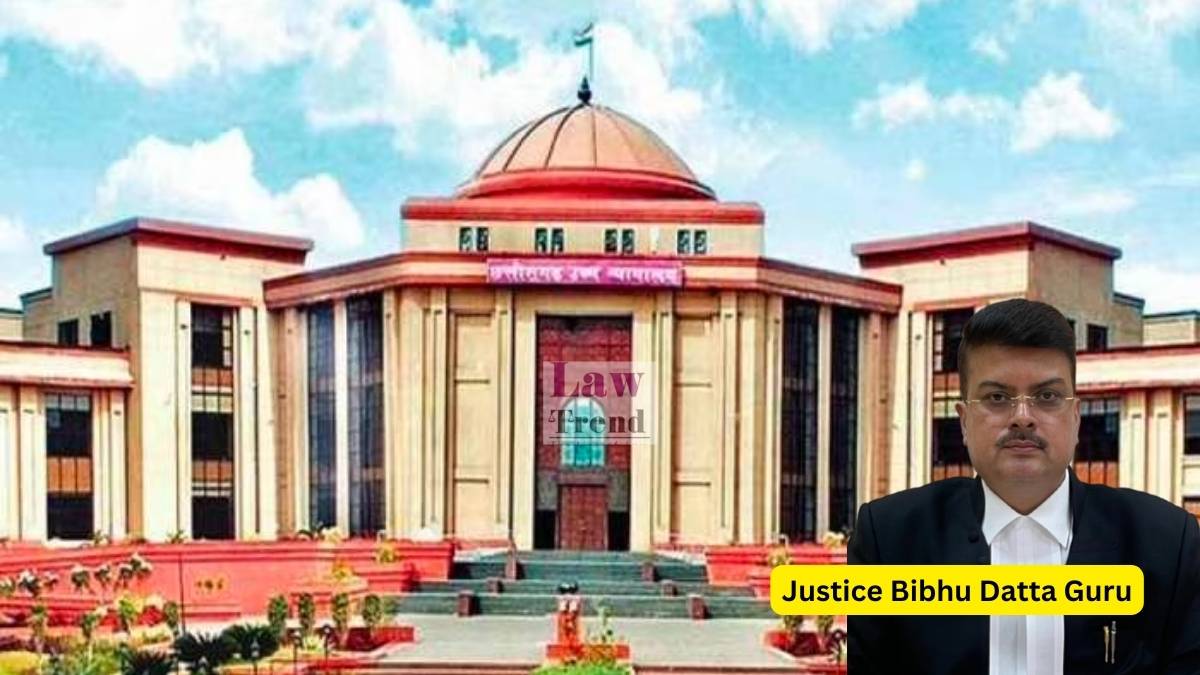
The High Court of Chhattisgarh has ruled that the extraordinary and discretionary jurisdiction under Article 226 of the Constitution of India is not designed to assist litigants who sleep over their rights for decades and later attempt to revive stale claims. Dismissing a writ petition in limine on grounds of delay and laches, a single-judge bench of Justice Bibhu Datta Guru held that although no statutory period of limitation is prescribed for invoking writ jurisdiction, petitions must be presented within a reasonable time.
Background of the Case
The petitioner, Rajendra Kumar Mahant, approached the High Court claiming to be the son of Late Ramlal Mahant. According to the pleadings in the writ petition, his father was appointed as an Assistant Teacher and retired from service on April 30, 2002. The petitioner admitted that all retiral dues payable to his father had been duly settled and that his father subsequently passed away in the year 2015.
Through the writ petition, the petitioner sought a direction commanding the respondent authorities—South Eastern Coalfields Ltd. (SECL) and its senior management—to decide an alleged representation purportedly submitted by his father on January 2, 1996, claiming the payment of arrears for the period spanning 1989 to 1994.
Submissions of the Parties
Appearing on behalf of the petitioner, Advocate Vinod Kumar Dewangan pressed for a direction to consider the pending representation. In paragraph 7 of the petition, the petitioner asserted that there was no delay in approaching the Court.
Opposing the petition, Advocate Rahul Mishra, appearing for SECL, pointed out significant contradictions in the petitioner’s pleadings. He highlighted that while the petitioner claimed his father was an Assistant Teacher, the alleged representation itself stated that the deceased was appointed as a Peon (Category-II). The respondents contended that the petitioner was attempting to adjudicate a stale claim concerning the 1989–1994 period after his father had retired in 2002 and passed away in 2015.
Analysis of the Court
Upon examining the record, Justice Bibhu Datta Guru observed that the claim pertained to arrears from 1989 to 1994, brought before the Court after an unexplained delay of more than three decades. The Court noted that there was no acknowledgment or receipt on record to show that the representation dated January 2, 1996, was ever actually submitted to the competent authority, nor was any exceptional circumstance shown to justify the delay.
Emphasizing the foundational principles governing the writ court’s discretionary power under Article 226, the bench observed:
“It is well settled that a person invoking the extraordinary and discretionary jurisdiction of this Court under Article 226 of the Constitution of India must approach the Court with due diligence and within a reasonable period of time. The writ jurisdiction is not intended to provide relief to a litigant who has remained inactive for an unduly long period and thereafter seeks to revive a stale claim.”
The Court further held that condoning such an enormous delay without cogent explanation could prejudice third-party rights and unsettle matters that had attained finality:
“The principles underlying the doctrine of delay and laches are founded upon the considerations of repose, certainty and finality. A litigant who sleeps over his alleged rights for an inordinate period cannot, as a matter of right, invoke the discretionary writ jurisdiction of this Court at a belated stage.”
Addressing the inaction of the petitioner and his predecessor, the bench remarked:
“In the case at hand, the petitioner filed the instant writ petition after three decades claiming the dues of his late father for which the deceased employee submitted a representation during his life time in the year 1996. Thereafter, the deceased employee retired in 2002 and subsequently died in 2015 and during this period he has not made any effort with regard to his pending representation. The petitioner (son of the deceased employee) chose to sleep and got up at his own leisure, for some reason which is fathomable to him only. But such fathoming of reasons by oneself is not countenanced in law. Any one who sleeps over his right is bound to suffer.”
Decision
Finding no plausible or satisfactory explanation for the prolonged inaction of more than thirty years, the High Court declined to exercise its extraordinary writ jurisdiction and dismissed the petition in limine on the ground of delay and laches.
Case Title: Rajendra Kumar Mahant v. South Eastern Coalfields Ltd. and Others
Case No.: WPS No. 7294 of 2026
Bench: Justice Bibhu Datta Guru
Date: 06/10/2026




