

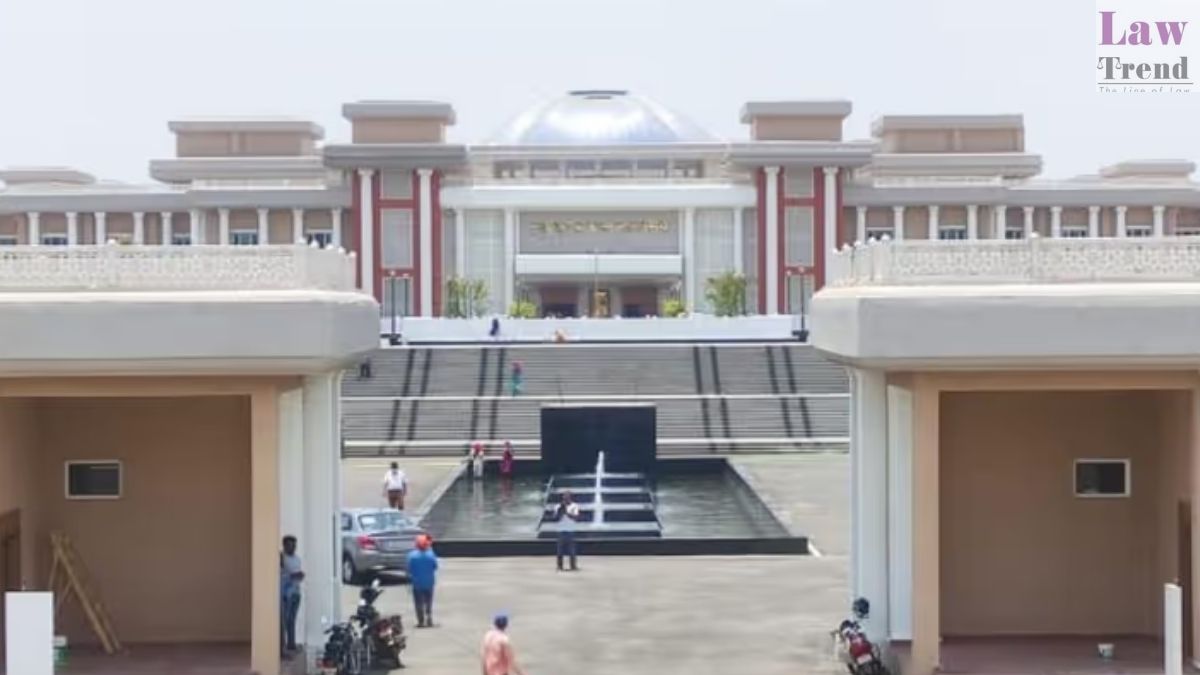
In a significant verdict reaffirming urban rights, a Division Bench of the High Court of Jharkhand comprising Chief Justice M. S. Sonak and Justice Rajesh Shankar held that the right to a clean, dignified, and reasonably safe urban life is an essential component of the right to life under Article 21, alongside the freedom of movement under Article 19(1)(d) of the Constitution. Disposing of a public interest litigation (PIL) concerning severe traffic congestion, encroachment, and commuter safety issues in Hazaribagh, the Court issued a series of binding, time-bound directives to civic and police authorities while ruling that administrative inconvenience or lack of funds cannot justify an abdication of statutory and constitutional obligations.
Background of the Case
The writ petition was instituted in 2021 by petitioner Achyut Swaroop Mishra, who appeared in person. Mishra highlighted the chaotic traffic conditions across Hazaribagh, citing the complete absence of traffic-light monitoring systems, non-functional CCTV surveillance, lack of organized parking spaces, and extensive encroachments upon public footpaths. The petitioner brought to light specific fatal collisions at crowded intersections such as Barkagaon More and Kargil Chowk, alongside recurring vehicular accidents causing pedestrian injuries.
When the authorities initially adopted a denial posture regarding the civic breakdown, the Court, via an order dated July 11, 2024, appointed Advocate Commissioner Prashant Pallav to inspect the city. His comprehensive report confirmed widespread haphazard parking, lack of automatic signals, an acute shortage of traffic personnel, defunct CCTV units, and lax enforcement of helmet and seat-belt regulations. Subsequent responses by the State Administration and the Municipal Corporation led to institutional blame-shifting, wherein the police pointed to municipal failures over parking while the Corporation complained of inadequate police assistance.
Arguments of the Parties
The petitioner submitted that despite various stakeholder meetings, inter-departmental orders, and formal task forces constituted under judicial scrutiny, there remained deep laxity on the ground and conditions had not substantially improved. Mishra contended that sustained municipal and police inaction directly infringed upon citizens’ fundamental rights.
On behalf of the State Administration and the Hazaribagh Municipal Corporation, counsel highlighted steps taken under continuous judicial monitoring. The police demonstrated that ground personnel had been increased from an initial 35 to 212, with 20 additional personnel placed at critical junctions, alongside the operationalization of a dedicated Traffic Police Station at District Chowk and a post at Panch Mandir Chowk. Authorities noted that fines totaling Rs. 42,26,200 were levied for unauthorized parking, alongside a cumulative realization of Rs. 10,87,22,661 for offences including helmet and seat-belt violations, tinted glass, and reckless driving.
The Municipal Corporation submitted that an earlier disproportionate traffic-monitoring proposal of approximately Rs. 38.64 Crores was dropped, and a fresh agreement worth Rs. 2.68 Crores was executed on August 19, 2026, with M/s Keyhole Design Private Limited for the automated traffic light system. The Corporation further cited anti-encroachment drives conducted by a task force formed in January 2026, the survey of street vending zones under the Street Vendors Act, 2014, and plans to relocate the Old Bus Stand outside city limits along the Bypass Road.
The Court’s Analysis and Precedents
Analyzing the statutory framework under the Motor Vehicles Act, 1988, the Jharkhand Municipal Act, 2012, the Noise Pollution (Regulation and Control) Rules, 2000, and the Street Vendors (Protection of Livelihood and Regulation of Street Vending) Act, 2014, the Court underscored that the civic administration cannot evade statutory duties by citing financial constraints or lack of inter-agency coordination.
The Bench observed:
“Ultimately, the respondents must remain aware that the right to a clean, dignified and reasonably safe urban life is an integral facet of the right to life guaranteed under Article 21 of the Constitution. Further, Article 19(1)(d) and other rights enshrined in Article 19 protect the freedom of movement of every citizen, whether navigating the city as a pedestrian, motorist or commuter.”
Addressing municipal accountability, the Bench cited Municipal Council, Ratlam v. Vardhichand (AIR 1980 SC 1622), noting that the Supreme Court had explicitly rejected pleas of financial stringency in discharging duties relating to public safety and civic sanitation. Regarding public pathways, the Court relied on Ahmedabad Municipal Corporation v. Nawab Khan Gulab Khan ((1997) 11 SCC 121), Sudhir Madan v. Municipal Corporation of Delhi ((2009) 17 SCC 597), M.C. Mehta v. Union of India ((2019) 10 SCC 614), and Maniyar Iliyaz @ Shaik Riyaz v. P. Ayyappan (2026 INSC 647), reaffirming that pavements are vital public infrastructure meant for pedestrian safety, parking on footpaths is strictly barred, and pedestrians enjoy a fundamental right to walk on unencroached pathways.
Observing street vending rights, the Court held:
“The statutory regime, as well as the decisions on the subject, no longer favours the complete ouster of street vendors. The objective should be to allow street vending to harmoniously coexist with motorable carriageways and walkable footpaths.”
Highlighting the need for concrete results, the Court firmly remarked:
“The respondents must remember that merely giving paper assurances is not sufficient. Such assurances have to translate into action, and that action must be sustained.”
The Decision and Binding Directions
Disposing of the writ petition, the High Court directed the Deputy Commissioner, Superintendent of Police, and Municipal Commissioner to work in tandem and held them personally responsible for strict compliance under a 17-point directive:
- Traffic Light Management System: The Municipal Commissioner must ensure that installation, testing, and trial runs under the August 19, 2026 agreement with M/s Keyhole Design Private Limited are completed and the system put to operational trial within four months across at least 20 designated major junctions, complete with zebra markings and statutory signage.
- Maintenance & Monitoring Team: A three-member team (an Assistant Engineer of the Corporation, a Traffic Police Inspector, and a contractor representative) must be constituted within three weeks to maintain daily downtime logs. Signals dark or stuck beyond 48 hours must be restored within the subsequent 48 hours.
- CCTV Integration: A joint inventory of all CCTV cameras installed since 2017 must be filed within two months by the Deputy Commissioner and Superintendent of Police. Non-functional cameras must be repaired or replaced within four months, and new junction and ANPR cameras under the 2026 contract must integrate with the Police Control Room.
- Personnel and Enforcement: The Superintendent of Police must submit a peak-hour deployment chart naming officers responsible for each junction, and all traffic personnel must undergo a training programme of not less than three days within three months in coordination with the District Legal Services Authority (DLSA).
- No-Entry for Heavy Vehicles: Commercial and heavy goods vehicles remain barred from entering notified municipal limits between 8:00 AM and 8:00 PM as a unified rule, with unsanctioned municipal entry levies prohibited and defaulting collection officials subject to departmental action.
- Parking, Encroachments, and Street Vendors: Authenticated maps of designated parking areas must be submitted within three months, and off-street parking notices issued to non-compliant commercial establishments along the PTC Chowk–Korrah Chowk stretch. Footpaths and carriageways must be cleared, with re-encroachment prosecuted under Section 606 of the Jharkhand Municipal Act, 2012. Vending and non-vending zones under the Street Vendors Act, 2014, must be surveyed and notified within four months.
- Silence Zones & Bus Terminal: 100-metre silence zones must be notified within two months around hospitals, courts, and schools, with monthly enforcement against pressure horns and unauthorized amplification under the Noise Pollution Rules, 2000. Land status on the bypass for a new bus terminal and e-rickshaw routing plans must be placed on record within four months.
- Personal Accountability: The Deputy Commissioner, Superintendent of Police, and Municipal Commissioner must each personally swear and file a compliance affidavit within four months, without delegating to subordinate officers.
Case Title: Achyut Swaroop Mishra v. The State of Jharkhand & Others
Case No.: W.P. (PIL) No. 4534 of 2021
Bench: Chief Justice M. S. Sonak and Justice Rajesh Shankar
Date: September 29, 2026




