

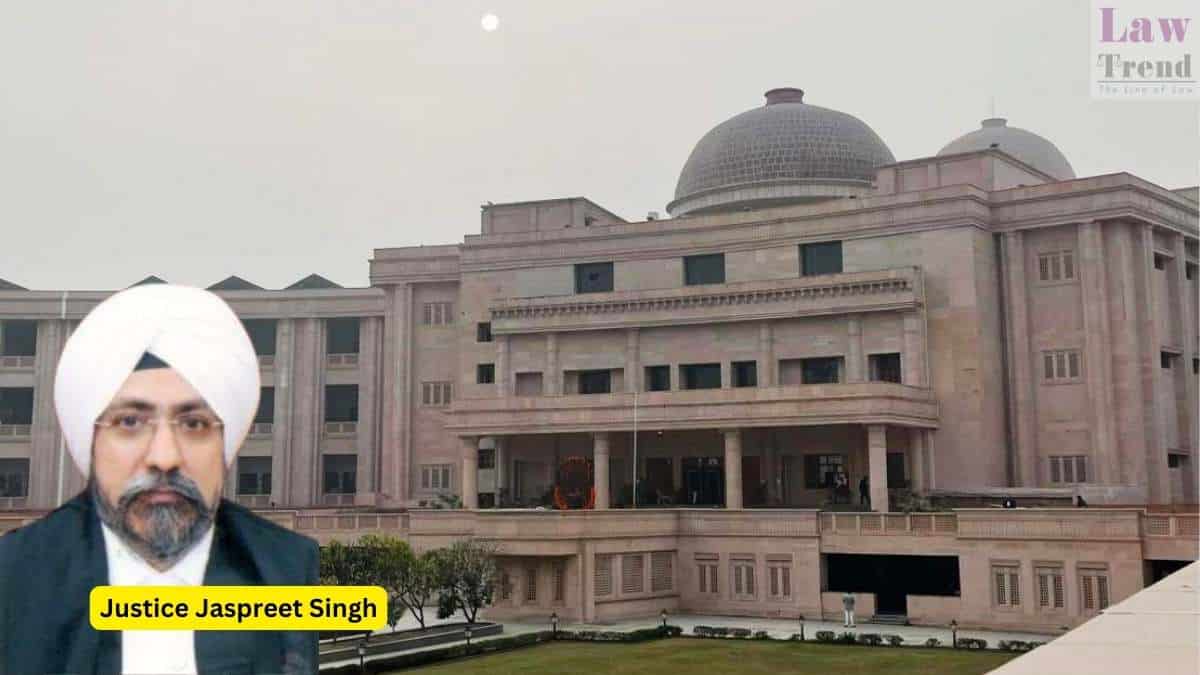
In a landmark ruling resolving a significant question of public importance, the Lucknow Bench of the High Court of Judicature at Allahabad, presided over by Justice Jaspreet Singh, held that the Land Acquisition, Rehabilitation and Resettlement Authority (LARRA) constituted under the Right to Fair Compensation and Transparency in Land Acquisition, Rehabilitation and Resettlement Act, 2013 (the Act of 2013) does not possess the power, authority, or jurisdiction to execute its own awards. Answering the reference in a batch of 45 petitions, the Court ruled that an award rendered by LARRA attains the statutory status of a “deemed decree” under Section 70(2) of the Act and is executable solely before the Principal Court of Original Civil Jurisdiction—namely the District Court. However, the Court clarified that the executing District Court serves strictly as an executory arm and cannot entertain objections on merits, apply Section 47 of the Code of Civil Procedure, 1908 (CPC), or go behind the award.
Background of the Case
The legal controversy arose out of 45 bunched petitions. The requiring bodies—comprising 33 petitions filed by the 4th Battalion of Sashastra Seema Bal (SSB), 8 petitions filed by the Uttar Pradesh Expressways Industrial Development Authority (UPEIDA), and one petition filed by the Lucknow Development Authority (LDA)—challenged the jurisdiction of LARRA to enforce and execute its own reference awards. Simultaneously, three petitions were filed by land owners seeking directions for expeditious disposal of their execution cases pending before LARRA.
In the SSB matters, 14.988 hectares of land in Villages Bendowa and Jagroli, Tehsil Mohanlalganj, Lucknow, had been acquired for establishing SSB’s Frontier Headquarters. Following a 2015 award by the Additional District Magistrate, land owners sought enhancement under Section 64 of the Act of 2013. In one such reference (Misc. Case No. 9/2022, Bishambhar v. State), LARRA enhanced the compensation with interest and 100% solatium. After SSB’s delayed appeal was dismissed by the High Court, the land owner instituted Execution Case No. 16/2024 before LARRA itself. In those execution proceedings, LARRA passed coercive orders directing recovery of the amount as arrears of land revenue, issued show-cause notices for civil imprisonment to SSB officials, and directed the disclosure of bank accounts for attachment.
In the UPEIDA batch, land acquired in Village Shivlar, Lucknow, for the Purvanchal Expressway resulted in enhanced awards by LARRA in April 2024, followed by execution proceedings where LARRA similarly directed deposit and disclosure of bank accounts for attachment. In the LDA petition (LDA v. Ramrati), concerning acquisition in Village Bargawan, Lucknow, LARRA enhanced the compensation rate to Rs. 10,000 per sq. meter. LDA filed an objection challenging LARRA’s jurisdiction to entertain execution proceedings (Execution Case No. 13/2024), which LARRA rejected on December 19, 2025.
Submissions of the Parties and Representation
The petitioners and respondents were represented by a battery of counsel across the batch of matters:
- For the Requiring Bodies:
- Appearing for the 4th Battalion of Sashastra Seema Bal (SSB), learned counsel Shri Paavan Awasthi, alongside the Additional Solicitor General of India (ASGI), led the arguments.
- Appearing for the Uttar Pradesh Expressways Industrial Development Authority (UPEIDA), submissions were advanced by learned counsel Shri Abhineet Jaiswal.
- Appearing for the Lucknow Development Authority (LDA), learned Senior Counsel Shri Mukund Tiwari argued alongside learned counsel Shri Bhanu Bajpai.
- In the three connected petitions preferred by the land owners seeking expedition (Writ Petition Nos. 2354, 2381, and 2399 of 2026), learned counsel Shri Vijay Kumar Srivastava represented the petitioners.
- For the Land Owners and Respondents:
- Arguments on behalf of the land owners and private respondents were led by Shri Vijay Kumar Srivastava and Shri Mustafa Ahmad Khan, supported by Shri Amit Jaiswal, Ms. Rani Singh, Shri Harsh Vardhan Singh, Ms. Amrita Yadav, Shri Kshemendra Shukla, Shri Ankit Verma, Shri Prabhat Kumar, and Shri Ram Dheeraj.
- For the State of Uttar Pradesh:
- The State respondents were represented by the learned Additional Advocate General assisted by the Chief Standing Counsel (CSC).
Arguments by Requiring Bodies (SSB, UPEIDA, and LDA)
Counsel for the requiring bodies contended that LARRA is an “Authority” established under Section 51, and not a Court. They emphasized that under Section 53, even an advocate with seven years of practice can be appointed as Presiding Officer.
Counsel argued that Section 60(1) of the Act of 2013 adopts only specific, limited provisions of the CPC (such as summoning witnesses, discovery, and review), and consciously omits inherent powers and execution provisions (Sections 36 to 74 and Order XXI of the CPC). They contrasted this with Section 53 of the repealed Land Acquisition Act, 1894, which applied the entire CPC to the Reference Court. Relying on Umesh Goel v. H.P. Cooperative Group Housing Society Limited and Bhagyodaya Co-operative Bank Limited v. Ravindra Balkrishna Patel, they submitted that the deeming fiction under Section 70(2) merely elevates the award to a decree for finality and civil court execution, rather than empowering the Authority to execute it. Furthermore, they asserted that the bar of civil court jurisdiction under Section 63 is restricted to adjudication of land acquisition disputes and does not bar the civil court from executing decrees.
Arguments by the Land Owners
Conversely, learned counsel for the land owners maintained that the 2013 Act is a self-contained, beneficial code intended to ensure speedy disposal. They argued that Section 60(3) empowers LARRA to regulate its own procedure guided by natural justice, and that the power to adjudicate inherently embraces the power to enforce orders. They submitted that relegating land owners—who have suffered compulsory acquisition—to civil courts would cause severe hardship and run counter to the statement of objects and reasons. They also relied on a State Notification dated August 4, 2022, a Government Letter dated February 21, 2024, and a High Court circular dated May 17, 2024, as noticed by a Division Bench in Chandrabhan Yadav v. State of U.P., contending that execution jurisdiction had been conferred upon LARRA Presiding Officers.
Stance of the State of Uttar Pradesh
The learned Additional Advocate General for the State of U.P. submitted written instructions supporting LARRA’s jurisdiction based squarely on the Notification dated August 4, 2022, and the decision in Chandrabhan Yadav.
The Court’s Analysis
Examining the legislative architecture, the Court distinguished between “legislation by reference” and “legislation by incorporation,” drawing upon the Supreme Court rulings in U.P. Avas Evam Vikas Parishad v. Jainul Islam and Girnar Traders v. State of Maharashtra. The Court held that while the 1894 Act made the CPC applicable as a whole by reference, Section 60(1) of the 2013 Act incorporated only specific, selective provisions of the CPC. The entire body of execution provisions under Order XXI was omitted by the Legislature.
The Court noted that although Section 60(1)(g) read with Section 109(2)(q) provides a window for the Appropriate Government to frame rules conferring additional powers on LARRA, no such rules providing execution powers have been framed under the Uttar Pradesh Rules, 2016.
Addressing the claim of inherent powers and Section 60(3), the Court cited the Full Bench decision in Kaushal Kishore v. DDC and observed that inherent powers reside in classic courts of law, not statutory authorities, unless explicitly conferred. The Court observed that procedural regulation under Section 60(3) cannot serve as a “Trojan horse, to secretly galvanize power of execution for LARRA.”
Analyzing the effect of the legal fiction under Section 70(2), the Court cited State of Punjab v. Davinder Singh and observed that creating a deemed decree imparts finality and the principle of res judicata, but does not spontaneously bestow powers of execution upon an Authority that lacks them. Reviewing several enactments—including the Railway Claims Tribunal Act, 1987, the U.P. Public Services (Tribunal) Act, 1976, the Real Estate (Regulation and Development) Act, 2016, and the Arbitration and Conciliation Act, 1996—the Court observed that whenever the Legislature intends a tribunal or an authority to enforce its orders or have them executed through civil courts, it enacts an express statutory provision.
Addressing the State Notification dated August 4, 2022, the Court pointed out that it was issued under Section 3(d) of the repealed 1894 Act to appoint LARRA Presiding Officers as Special Judicial Officers for pending cases under the Old Act, and does not confer execution powers under the 2013 Act.
Resolving the mode of enforcement, the Court held:
“After having made a threadbare analysis of the statutory provisions and comprehensive discussions as noted above, it unveils that the power of execution has not been conferred nor any Rules for it have been framed under the Rule making power, hence, the power of execution cannot be read into a statute and so also for LARRA. Having said so, it does not imply that a person is left remediless, rather in law, it is clearly inferable that an award passed by LARRA attains the status of a deemed decree and the said deemed decree becomes executable and for the said purpose execution will have to be done by the Court of Competent jurisdiction i.e. the District Court which has all the judicial and legal wherewithal and logistics including coercive powers to get the decree executed.”
The Court, however, strictly restricted the role of the District Court, ruling that:
“merely because the award attains the status of a decree which may be presented before the District Court for its execution, if so required, but the Court which executes the decree is merely the executory arm and it confines itself to execution only and does not adopt the adjudicatory powers and role of an Executing Court envisaged under the CPC.”
The Court added that:
“under the Act of 2013, once the award attains the status of a deemed decree and is presented before the District Court for its enforcement, then it is only the enforcement part which is to be carried out by the District Court and it does not include the power to adjudicate.”
It explicitly ruled out the applicability of Section 47 CPC, explaining that entertaining substantive challenges to the award during execution would violate the jurisdictional bar under Section 63 of the Act.
The Court also highlighted that once an award achieves finality, the compensation becomes a crystallized right protected under Article 300-A of the Constitution. If the State or its instrumentalities delay payment arbitrarily, aggrieved land owners can invoke writ jurisdiction under Article 226/227 of the Constitution for enforcement, as supported by decisions including Unitech Limited v. TSIIC and Surya Construction v. State of U.P..
The Court further recommended legislative action:
“To avoid much inconvenience to the holders of awards and noticing the concept of ‘Welfare State’ viz-a-viz its citizens, it would augur well for the State to consider using its rule making power to clear the air, usher certainity and provide power and jurisdiction for execution of the award with the Authority itself for integrated, robust mechanism for smooth enforcement of awards and it would also avoid undue harassment to the holders of awards by moving to different forums across jurisdictions for adjudication first and then for its execution.”
Decision of the Court
Summing up its findings, the Court concluded:
“(a) Under the Act of 2013, LARRA does not have the power to execute its own award as no specific power has been conferred upon LARRA nor any Rules conferring such power of execution have been framed by the State/Appropriate Government in this regard.”
“(b) The notification of the State dated 04.08.2022, which has been relied upon by the State, does not confer power on LARRA to execute its award under the Act of 2013.”
“(c) LARRA is an Authority constituted for the purposes of adjudication of matters referable to it in terms of Sections 51 and 64 of the Act of 2013 and such powers to adjudicate do not include the power to execute nor such powers can be exercised by the Authority under Section 60(3) of the Act nor in the guise of inherent powers.”
“(d) The award of LARRA attains a status of a decree, it can be executed as a decree by the District Court, who would act as an executory arm and the District Court while executing the LARRA award would not be entitled to adjudicate matters on merits directly or indirectly impacting the award or by going behind the award. The provisions of Section 47 CPC will not be applicable during execution of LARRA award, as explained and clarified in this judgment.”
“(e) The bar of jurisdiction of the Civil Court contained in Section 63 of the Act of 2013 is limited and operates only in context with such matters which are exclusively cognizable by LARRA in terms of Section 51 and Section 64 of the Act of 2013 and this bar does not operate upon the District Court for the purposes of execution of an award passed by LARRA.”
Accordingly, the petitions filed by the requiring bodies (SSB, UPEIDA, and LDA) were allowed, and all orders passed by LARRA in exercise of executory powers were quashed as without jurisdiction. The three petitions filed by land owners seeking expedition were disposed of as they did not survive.
Case Details
Case Title: Lucknow Development Authority v. Ramrati (and connected petitions)
Case No.: Matter Under Article 227 No. 143 of 2026 (along with 44 connected petitions)
Bench: Justice Jaspreet Singh
Date: September 28, 2026




