

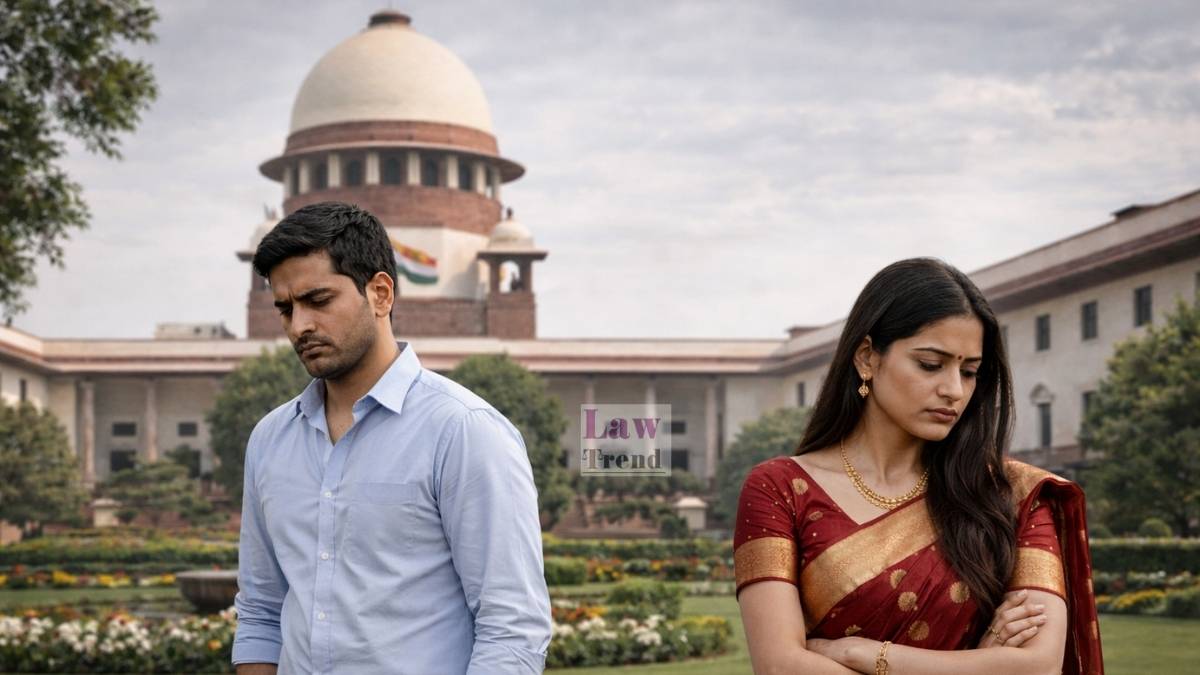
The Supreme Court of India, through a Bench comprising Justice B.V. Nagarathna and Justice R. Mahadevan, has invoked its plenary powers under Article 142 of the Constitution of India to grant a decree of divorce by mutual consent and quash 18 civil and criminal proceedings pending between an estranged couple and their family members. The order was passed after the respondent-husband paid Rs 35,00,000 towards permanent alimony in full and final settlement of all claims, bringing a conclusive end to multi-forum matrimonial litigation.
Background of the Case
The matter originated from two transfer petitions instituted by the petitioner-wife. In the criminal transfer petition, she sought the transfer of Charge Sheet No. 251/2024 arising from FIR No. 148/2022 (registered under Sections 294, 323, 341, and 506 of the Indian Penal Code) from the Court of Judicial Magistrate First Class-3, Cuttack, Odisha, to the Court of Additional Chief Judicial Magistrate, Girgaon, Mumbai. In the connected civil transfer petition, the wife and her family members sought the transfer of a complaint filed by the mother-in-law under the Protection of Women from Domestic Violence Act, 2005, from Cuttack to Girgaon, Mumbai. The apex court had previously issued notice and stayed proceedings in both matters.
The parties solemnized their marriage on December 4, 2016, at Cuttack, Odisha, and had been living separately since 2022 due to irreconcilable differences. While mediation before the Supreme Court Mediation Centre had previously failed, the respondent-husband moved an interlocutory application under Article 142 of the Constitution of India seeking dissolution of the marriage on the ground of irretrievable breakdown and the quashing of all civil and criminal proceedings pending between the parties and their family members.
Submissions of the Parties
Learned counsel for the petitioner-wife submitted on instructions that the wife was willing to consent to a decree of divorce, subject to an appropriate quantum of permanent alimony. Counsel placed substantial emphasis on the wife’s adverse medical condition and ongoing treatment expenses, noting that she was dependent on her father and that the husband possessed sufficient financial resources to provide a dignified settlement. Although counsel noted that the wife had issued a legal notice requesting her not to represent her, the Court declined to discharge counsel, observing that she had assisted both the litigant and the Court most effectively.
Counsel for the respondent-husband submitted that the wife had initially claimed Rs 30,00,000, while the husband had offered Rs 15,00,000. Acting on suggestions made by the Court, the husband agreed to enhance the permanent alimony to Rs 35,00,000 as a full and final settlement of all claims, despite having to borrow funds.
Following interim directions issued on August 5, 2026, the husband paid an initial tranche of Rs 2,00,000 and subsequently produced two Demand Drafts totaling the remaining Rs 33,00,000 before the Bench. The wife, appearing in person, acknowledged receipt of the demand drafts and furnished a list of pending litigations, requesting that all proceedings inter se be quashed. Counsel for the husband likewise filed a compliance affidavit and a list of pending proceedings seeking closure.
The Court’s Analysis
Addressing the scope of its extraordinary jurisdiction, the Supreme Court referred to the Constitution Bench judgment in Shilpa Sailesh vs. Varun Sreenivasan, (2023) 14 SCC 231, reiterating:
“Exercise of jurisdiction under Article 142(1) of the Constitution of India by this Court in such cases is clearly permissible to do ‘complete justice’ to a ’cause or matter’. We should accept that this Court can pass an order or decree which a Family Court, trial court or High Court can pass.”
The Bench highlighted that where parties have endured long-standing separation and reached an uncoerced settlement that resolves maintenance and financial claims, relegating them to trial courts or insisting on the statutory waiting period under Section 13-B of the Hindu Marriage Act would merely perpetuate litigation.
The Court also relied on Rinku Baheti vs. Sandesh Sharda, (2025) 3 SCC 686, which affirmed that dissolution under Article 142 on the ground of irretrievable breakdown of marriage is a discretionary remedy:
“It is only when this Court is satisfied and convinced that there is a deadlock in the marriage which cannot be saved and the only solution for the parties is to move on independently by putting an end to their marital ties that the decree for divorce on the ground of irretrievable breakdown of marriage can be granted.”
Applying these principles to the facts, the Bench observed:
“We therefore find force in the submission of learned counsel for the respondent No.3/husband that since the marriage between the parties in the present case has come to a dead end and there is no possibility of reconciliation, real justice will be achieved by allowing the application filed by respondent No.3/husband under Article 142 of the Constitution and consequently granting the prayers for a decree of divorce by mutual consent and quashing of pending cases between the parties.”
Decision of the Court
The Supreme Court allowed the respondent-husband’s interlocutory application under Article 142 of the Constitution of India, ordering the formal dissolution of the marriage solemnized on December 4, 2016.
To give complete quietus to the matrimonial dispute, the Court quashed all 18 pending litigations between the spouses and their families across various forums, including:
- Criminal proceedings under Section 498A and Sections 294, 323, 341, and 506 of the IPC;
- Complaints and appeals under the Protection of Women from Domestic Violence Act, 2005;
- Maintenance and domestic proceedings under the Senior Citizens Act;
- A writ petition before the Delhi High Court arising out of Central Information Commission proceedings; and
- Related perjury applications under Section 340 of the CrPC.
The Bench further quashed any other pending civil or criminal matters between the parties and directed both sides not to file fresh proceedings against each other. The transfer petitions were disposed of, with directions to the Registry to draw up a decree.
Case Details:
Case Title: Shikha w/o Varun Surekha @ Shikha d/o Sharadkumar Raniwala v. State of Odisha & Others
Case No.: Transfer Petition (Criminal) No. 493 of 2025 with Transfer Petition (Civil) No. 2564 of 2025
Bench: Justice B.V. Nagarathna and Justice R. Mahadevan
Date: September 28, 2026




