

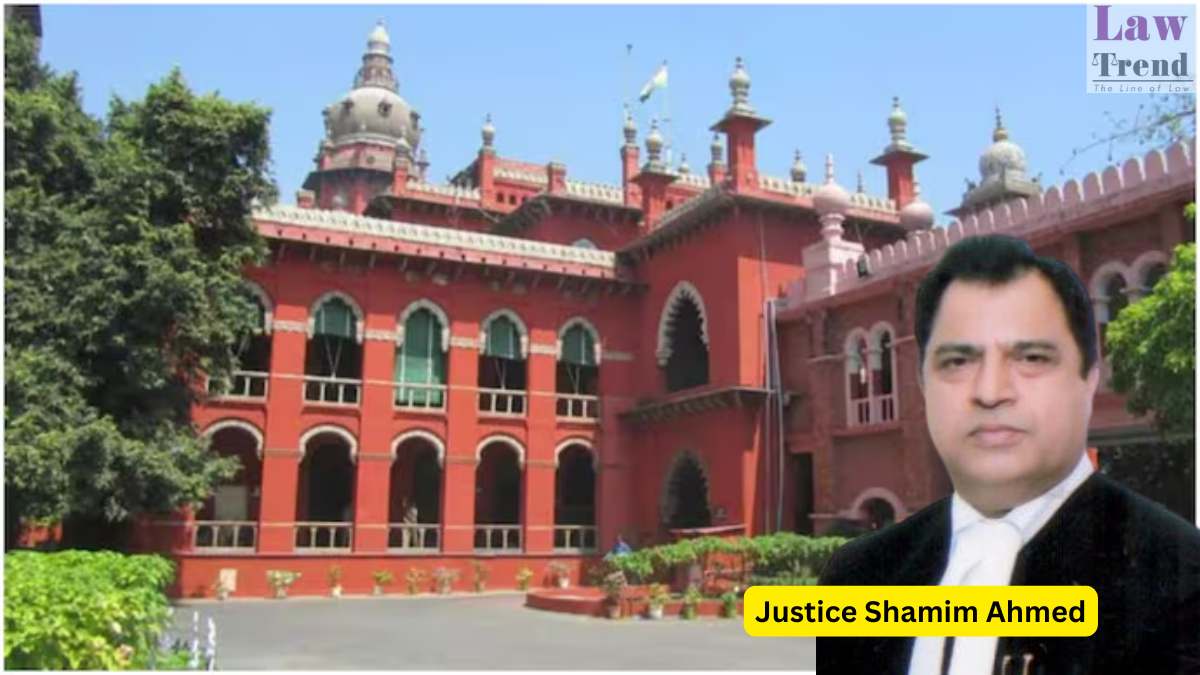
The Madras High Court, presided over by Justice Shamim Ahmed, has held that the pendency of civil or rent control proceedings between a landlord and a tenant does not bar criminal investigation where the complaint independently discloses the commission of cognizable penal offences. Dismissing a criminal revision case filed by property owners, the Court affirmed the order of the XVIII Metropolitan Magistrate, Saidapet, Chennai, which had directed the jurisdictional police under Section 156(3) of the Code of Criminal Procedure (Cr.P.C.) to register a First Information Report (FIR) and investigate allegations of criminal trespass, vandalism, theft, and intimidation.
Background of the Case
The dispute centers on a commercial premises situated at No. 78/103, Dr. Radhakrishnan Salai, Mylapore, Chennai, owned by the second petitioner, Banumathi Vezhavendan. The property had originally been leased to one M. Azan Feroz under a rental agreement dated March 1, 2016. The second respondent, M. Kamaraj, entered into occupation of a portion of the premises through a partnership firm named “Brunch Chat & Juices,” established in October 2016 to run a chat and beverage business.
Following the arrest of the original tenant in February 2019, disputes arose regarding tenancy and rental arrears. Apprehending forcible dispossession, Kamaraj instituted a civil suit (O.S. No. 1482 of 2019) before the VII Assistant City Civil Court, Chennai, obtaining a permanent injunction restraining interference with his possession except by due process of law. Subsequently, the landlady initiated eviction proceedings (RLTOP No. 58 of 2020), wherein the Rent Court granted an eviction order on July 11, 2023, while rejecting the claim for arrears. Cross-appeals (R.L.T.A. No. 216 of 2023 and R.L.T.A. No. 39 of 2024) were filed and remained pending before the appellate authority.
According to Kamaraj, during November and December 2024, the petitioners—V. Vetri Vendan, Banumathi Vezhavendan, and Ezhil Vendhan—accompanied by several unidentified individuals, forcibly trespassed into the premises, broke open locks, vandalized interiors, removed freezers, furniture, and commercial equipment valued at approximately Rs. 15,00,000, and issued criminal threats to compel him to vacate. Kamaraj lodged complaints with the E-2 Royapettah Police Station and representations to superior police officers. With the police declining to register an FIR on the grounds that the matter was a civil dispute, Kamaraj moved the XVIII Metropolitan Magistrate, Saidapet, under Section 156(3) Cr.P.C. On November 1, 2025, the Magistrate directed the registration of an FIR, prompting the petitioners to approach the High Court in revision.
Arguments of the Parties
Counsel for the revision petitioners contended that the dispute was purely civil in nature, arising out of a landlord-tenant relationship already undergoing adjudication before the Rent Court and Appellate Authority. The petitioners argued that the complaint was an engineered counterblast to the eviction order obtained by the landlady and constituted an abuse of the judicial process. They further submitted that the Magistrate acted mechanically without judicial scrutiny, that Kamaraj had suppressed earlier proceedings and police complaints, that the mandatory prerequisites under Section 154 Cr.P.C. were unfulfilled, and that the CCTV footage relied upon had neither been properly produced nor substantiated.
Opposing the petition, counsel for the second respondent submitted that the revision was fundamentally misconceived as an order under Section 156(3) Cr.P.C. merely sets the criminal investigation into motion without determining guilt or civil rights. It was argued that the complaint disclosed distinct, serious penal offences that occurred despite a subsisting civil injunction protecting Kamaraj’s possession. Counsel maintained that statutory remedies before the police had been fully exhausted, that the CCTV footage alongside a certificate under Section 65B of the Indian Evidence Act had indeed been placed on record, and that disputed questions of fact and defense could not be adjudicated at the pre-investigation stage.
The Government Advocate (Criminal Side) representing the police supported the respondent, submitting that the Magistrate’s order was a well-reasoned speaking order warranting no revisional interference.
The Court’s Analysis
Examining the statutory framework of Chapter XII of the Cr.P.C., Justice Shamim Ahmed highlighted the clear distinction between the pre-cognizance investigative stage under Section 156(3) and an inquiry under Section 200 Cr.P.C. The Court observed:
“The statutory function discharged by the Magistrate is confined to examining whether the complaint, read as a whole, discloses the commission of cognizable offences requiring police investigation.”
The Court rejected the petitioners’ contention that the existence of rent control litigation precluded criminal prosecution, emphasizing:
“The true test is not whether civil proceedings exist, but whether the ingredients of penal offences are prima facie made out. If the allegations disclose criminal trespass, theft, mischief, criminal intimidation or any other cognizable offence, the investigating agency is under a statutory obligation to investigate irrespective of the pendency of civil litigation. Civil liability and criminal liability operate in distinct fields. The existence of one does not necessarily exclude the other.”
To reinforce this principle, the High Court cited multiple Supreme Court precedents:
- Rocky vs State of Telangana & Anr. [2025 INSC 1384], reiterating that “civil and criminal proceedings may validly coexist if the factual matrix supports both.”
- C.S. Prasad vs C.Satyakumar & Anr. [2026 INSC 39] (discussing Kathyayini vs. Sidharth P.S. Reddy and Others), affirming that adjudication in civil matters cannot be treated as determinative of criminal culpability and that “criminal liability must be examined independently.”
- Nazibul Rahim Khan & Ors. Vs State of Uttar Pradesh & Anr. [2026 INSC 619], which noted the settled position from S N Vijayalakshmi v State of Karnataka that both civil and criminal proceedings can be maintained upon the same cause of action.
- Accama Sam Jacob vs State of Karnataka & Anr. [2026 SCC OnLine 585], where the apex court held that quashing proceedings merely because a dispute appeared civil in nature effectively stifles the investigative process at its inception.
- State of Bihar v. A.C. Saldanna [(1980) 1 SCC 554], regarding the independent nature of the Magistrate’s powers under Section 156(3).
Rejecting the argument that tenancy disputes confer immunity from criminal prosecution, the Court remarked:
“It is an unacceptable broad proposition advanced by the petitioners that every dispute arising between a landlord and tenant is necessarily immune from criminal investigation. Acceptance of such an argument would amount to conferring an unwarranted immunity upon parties to civil litigation and would permit criminal acts committed during the pendency of such litigation to escape investigation merely because a civil remedy also exists. Such a consequence would be contrary to both principle and public policy.”
Addressing Section 156(3) Cr.P.C. as a mechanism against executive inaction, the Court observed:
“The provision acts as a judicial safeguard against arbitrary police inaction. Where the police refuse to investigate cognizable offences on untenable grounds, the Magistrate is empowered to require them to perform their statutory duty.”
On the controversy regarding the electronic evidence and CCTV footage, the Court noted from the judicial record that the pen drive and Section 65B certificate were placed before the Magistrate. More fundamentally, the Court ruled that detailed evidentiary appraisal, forensic authenticity, and rival factual assertions are matters strictly reserved for investigation and trial, not revisional scrutiny.
Final Decision
Finding no perversity, illegality, or jurisdictional error in the order of the XVIII Metropolitan Magistrate, the High Court dismissed the Criminal Revision Case. The Court affirmed the order dated November 1, 2025, and directed the Inspector of Police, E-2 Royapettah Police Station, to register an FIR on the complaint dated November 22, 2024, and proceed with the investigation strictly in accordance with law. Connected miscellaneous petitions were closed with no orders as to costs.
Case Details:
Case Title: V. Vetri Vendan and Others v. The Inspector of Police, E-2 Royapettah Police Station and Another
Case No.: CRL RC No. 2579 of 2025 and CRL MP Nos. 22724 & 2738 of 2025
Bench: Justice Shamim Ahmed
Date: September 25, 2026




