

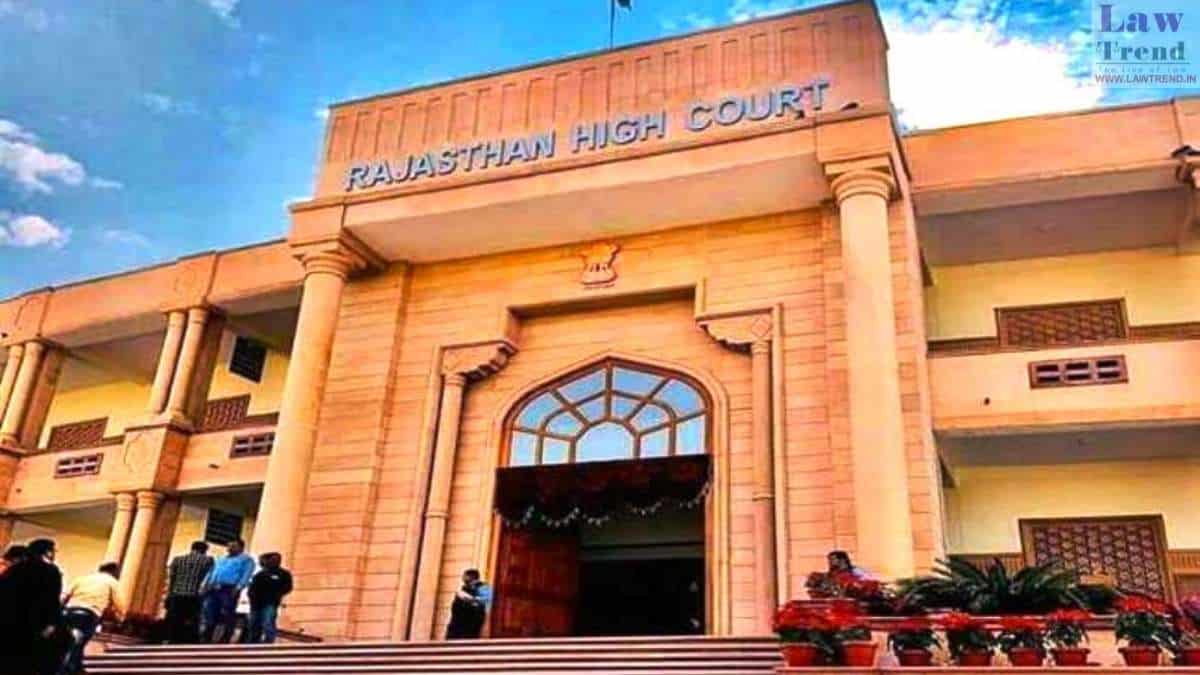
The Rajasthan High Court, presided over by Justice Sunil Beniwal, has held that allowing a complainant to introduce and exhibit an authenticated bank return memo bearing the bank’s official seal and signature—after an unsealed computer-generated slip had previously been marked—amounts to rectifying an inadvertent error rather than filling an impermissible lacuna in the prosecution case. Dismissing a criminal miscellaneous petition filed under Section 528 of the Bharatiya Nagarik Suraksha Sanhita (BNSS), 2023, the Court ruled that the mere marking of a document as an exhibit is intended solely for identification and does not dispense with the legal requirement of proof or make the document automatically admissible.
Background of the Case
The matter originated from a complaint filed by respondent No. 1, Gopal Traders, through its proprietor Beni Gopal Lohati, against the petitioner, Gulam Mohd., under Section 138 of the Negotiable Instruments Act, 1881. The complainant alleged that the petitioner borrowed Rs. 3,90,000/- and issued a cheque towards repayment. Upon presentation, the cheque was dishonoured with the remark “Insufficient Funds” vide a return memo dated April 6, 2018. Following the petitioner’s non-payment despite receipt of a statutory demand notice, the complaint was instituted.
During trial proceedings before the Special Judicial Magistrate (N.I. Act cases) No. 1, Pali, the complainant was examined as CW-01 on March 4, 2020, and produced an online-generated bank return memo that was marked as Exhibit-2. This document did not bear the seal or signature of any authorised bank officer. When the complainant was confronted during cross-examination regarding the absence of authentication, he subsequently produced a fresh return memo bearing the bank’s seal and the signature of an authorised signatory. This subsequent memo was permitted to be marked as Exhibit-9 on February 9, 2026.
The petitioner objected to the marking of the subsequent memo as Exhibit-9, arguing that the document pertaining to the same transaction had already been exhibited as Exhibit-2. The trial court rejected this objection on February 10, 2026. Aggrieved, the petitioner preferred a revision petition before the Sessions Judge, Pali, which was dismissed on March 24, 2026. The petitioner then approached the High Court seeking to quash both lower court orders and de-exhibit Exhibit-9.
Arguments of the Parties
Counsel for the petitioner submitted that the complainant could not be allowed to introduce another bank return memo for the same transaction once Exhibit-2 had already been taken on record. It was contended that the subsequent document was produced solely to fill a lacuna that surfaced during the cross-examination of CW-01. Furthermore, counsel argued that the document was introduced along with a ‘Talbana’ without filing any formal application to take it on record. The petitioner contended that providing an opportunity to cross-examine does not justify curing evidentiary defects at a belated stage.
Conversely, the Public Prosecutor vehemently opposed the petition, submitting that both the trial court and the revisional court had passed well-reasoned orders. He argued that no prejudice would be caused to the petitioner because the trial remains at the stage of the complainant’s evidence, leaving the petitioner entirely free to raise all valid objections and test the document’s veracity during cross-examination.
The High Court’s Analysis
Justice Sunil Beniwal identified the primary issue as whether a bank return memo previously marked as Exhibit-2 could be permitted to be exhibited again with additional bank endorsements as Exhibit-9.
Addressing the contention regarding “filling a lacuna,” the Court observed that judicial determination must consider whether a document is tendered to cure an inherent weakness or to support an existing case previously advanced. Referring to the Supreme Court’s ruling in Rajendra Prasad v. Narcotic Cell through its Officer in Charge, Delhi, the Court highlighted the distinction between an irreparable lacuna and an oversight:
“A lacuna in prosecution is not to be equated with the fallout of an oversight committed by a public prosecutor during trial, either in producing relevant materials or in eliciting relevant answers from witnesses. The adage ‘to err is human’ is the recognition of the possibility of making mistakes to which humans are proved. A corollary of any such latches or mistakes during the conducting of a case cannot be understood as the lacuna which a court cannot fill up.”
“Lacuna in the prosecution must be understood as the inherent weakness or a latent wedge in the matrix of the prosecution case. The advantage of it should normally go to the accused in the trial of the case, but an over sight in the management of the prosecution cannot be treated as irreparable lacuna. No party in a trial can before-closed from correcting errors. If proper evidence was not adduced or a relevant material was not brought on record due to any inadvertence, the court should be magnanimous in permitting such mistakes to be rectified. After all, function of the criminal Court is administration of criminal justice and not to count errors committed by the parties or to find out and declare who among the parties performed better.”
The Court also drew support from P. Chhaganlal Daga v. M. Sanjay Shaw, which referenced Mohanlal Shamji Soni v. Union of India and Ram Chander v. State of Haryana, reiterating that under Section 311 of the Code of Criminal Procedure (CrPC), the court possesses wide powers to receive essential material for a just decision. Additionally, the Court cited U.T. of Dadra & Nagar Haveli v. Fatehsinh Mohansinh Chauhan, reaffirming that calling evidence to ascertain the truth does not amount to filling a lacuna unless serious prejudice resulting in a miscarriage of justice is established.
Applying these principles, the High Court held that the return memo had been placed on record at the initial stage as a computer-generated slip. When its admissibility was challenged, the complainant merely produced a version bearing the bank’s endorsement. This act, the Court concluded, was not an attempt to fill a lacuna, but the correction of an inadvertent error.
Marking of Exhibits vs. Admissibility and Proof
The Court further clarified that there is a distinct legal difference between a document being marked as an exhibit and being admitted or proved. Citing the Supreme Court in LIC of India v. Ram Pal Singh Bisen:
“We are of the firm opinion that mere admission of document in evidence does not amount to its proof. In other words, mere marking of exhibit on a document does not dispense with its proof, which is required to be done in accordance with law.”
The Bench noted that this principle was reaffirmed in S. Sangeetha & Ors. v. Tmt. P. Ponni, which cited the three-Judge Bench decision in Bipin Shantilal Panchal v. State of Gujarat. In that decision, the Supreme Court discouraged halting trials over admissibility objections, directing instead that objected documents be marked tentatively, with admissibility determined at the final judgment stage. Consequently, Justice Sunil Beniwal noted that marking Exhibit-9 does not serve as conclusive proof of its execution or contents, and its evidentiary value remains subject to proof under the Bharatiya Sakshya Adhiniyam.
Turning to procedural objections, the Court held that the absence of a formal application under Section 311 CrPC does not vitiate the proceeding. Relying on the Constitution Bench judgment in Willie (William) Slaney v. State of Madhya Pradesh, the Court observed:
“The Code is a code of procedure and, like all procedural laws, is designed to further the ends of justice and not to frustrate them by the introduction of endless technicalities… mere mistakes in procedure, mere inconsequential errors and omissions in the trial are regarded as venal by the Code and the trial is not vitiated unless the accused can show substantial prejudice.”
The High Court reasoned that because the petitioner retains a full opportunity to cross-examine the complainant on the newly marked document, no substantial prejudice or failure of justice was occasioned.
Decision of the Court
Finding the petition devoid of merit, the High Court dismissed the criminal miscellaneous petition. The Court directed the trial court to permit the petitioner full opportunity to cross-examine the complainant regarding Exhibit-9 to test its genuineness and raise all legally available objections concerning its admissibility.
Case Details
Case Title: Gulam Mohd. v. Gopal Traders and State of Rajasthan
Case No.: S.B. Criminal Miscellaneous (Petition) No. 4345/2026
Bench: Justice Sunil Beniwal
Date: September 18, 2026




