

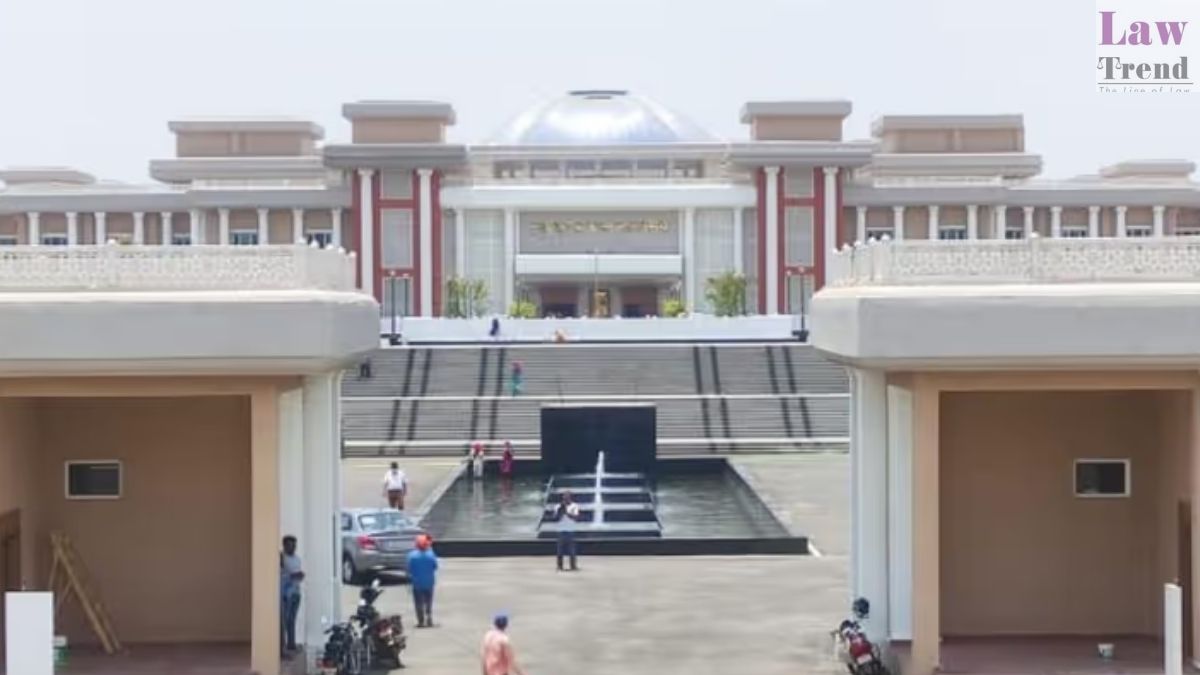
In an appeal addressing the denial of land acquisition compensation under the Coal Bearing Areas (Acquisition and Development) Act, 1957, the High Court of Jharkhand, presided over by Justice Sanjay Kumar Dwivedi, has set aside an order of the Reference Tribunal that dismissed a claimant’s plea merely for failing to file a Form-‘K’ return. Allowing the substitution of the deceased claimant’s legal heirs and accepting essential land records as additional evidence under Order XLI Rule 27 of the Code of Civil Procedure (CPC), the High Court remanded the matter back to the Additional Judicial Commissioner 1st Cum Tribunal, Ranchi for fresh adjudication on merits.
Background of the Dispute
The appeal arose out of Reference Case No. 07 of 1998, which had been dismissed on September 29, 2018, by the Additional Judicial Commissioner 1st Cum Tribunal, Ranchi. The original claimant, late Tikendra Choudhary—succeeded upon his demise by his legal heirs including his wife Bhuneshwari Devi and children—claimed raiyati interest over 18.19 acres of land in Mouza-Sewai, Ramgarh district (formerly Hazaribagh). The land comprised Plot No. 656 (9.00 acres), Plot No. 1134 (7.19 acres), and Plot No. 1216 (2.00 acres) under Khata No. 83.
The claimant derived title on the basis of a Hukumnama Purcha, Zamindari receipts, and Government receipts, with his name entered in Register II and the Bujharat Register. Additionally, the District Land Acquisition Officer, Hazaribagh, had recognized the land with “Raiyati Manyata” on April 3, 1989. The property originally stood in the name of the claimant’s mother, Bilasho Devi, who passed away in November 1990.
The land was acquired by the Central Government through a notification issued on December 29, 1962, under Section 4 of the Coal Bearing Areas (Acquisition and Development) Act, 1957, for the Rajrappa Project under the National Coal Development Corporation (NCDC), which subsequently merged into Central Coalfields Limited (CCL). In accordance with the applicable land acquisition rehabilitation policy, CCL had provided Category-I (Mazdoor Class) employment to the original claimant. However, despite repeated representations submitted in 1989, 1990, and 1995, compensation for the acquired land was never disbursed.
Consequently, in March 1988, the claimant filed an application under Section 17(2) of the Act of 1957 before the Tribunal at Ranchi, seeking a declaration of right, title, and possession, along with compensation at Rs. 15,000 per decimal, 30 percent solatium, 15 percent interest, and additional statutory benefits. The Tribunal, however, dismissed the reference in September 2018 solely on the technical ground that the claimant failed to submit the return in Form-‘K’.
Arguments Before the High Court
Appearing for the substituted appellants, Advocate Mrs. Ritu Kumar submitted that the original claimant was an ordinary villager employed as a Category-I laborer who lacked legal knowledge regarding procedural formalities and the critical importance of producing the Purcha before the Tribunal.
She drew attention to interlocutory application I.A. No. 9843 of 2024, filed under Order XLI Rule 27 CPC, seeking the admission of additional evidence. The counsel pointed out that the same Tribunal, on the very same date (September 29, 2018), had allowed the compensation claims of other similarly situated raiyats in Reference Case Nos. 94 and 95 of 1993 for Khata No. 83 based on Exhibit 8/d (the Ex-landlord’s return). The newly obtained Purcha specifically contained the name of Bilasho Devi at Serial No. 76. Mrs. Kumar stressed that CCL had already recognized the acquisition by employing the original claimant, making the denial of land compensation contradictory.
Opposing the plea, Advocate Mr. Amit Kumar Sinha, appearing for CCL, initially contended that the relevant documents were not placed before the Tribunal during the original proceedings and that the appellants had failed to show due diligence to warrant the acceptance of additional evidence at the appellate stage. However, upon court queries, Mr. Sinha conceded that CCL had indeed acquired the land, that compensation had already been released to another set of claimants under Reference Case Nos. 94 and 95 of 1993, and that the State was also raising claims over the land asserting it to be Gairmazuruwa.
The Court’s Analysis and Observations
Justice Sanjay Kumar Dwivedi evaluated the scope of Order XLI Rule 27 CPC concerning the production of additional evidence at the appellate stage, articulating the governing legal principle:
“From careful examination of the Order XLI Rule 27 of the C.P.C, it transpires that the parties to the appeal are not entitled to produce additional evidence (oral or documentary) in the Appellate Court except on the principles enumerated in clause (a), (aa) and (b) of the Code where the appellate court requires a document to be produced or any witness to be examined to enable it to pronounce the judgment, or for any other substantial cause. The expression “to enable it to pronounce judgment” has been interpreted so as to mean that when the appellate court finds itself unable to pronounce judgment owing to be a lacuna or defect in evidence as it stands, it may admit additional evidence. But that does not mean that the clause should be resorted to patch up the weakness of the evidence of the unsuccessful party before the trial court, though, if the court itself requires the evidence to do justice between the parties, it may accept the same.”
The Court noted that the Tribunal rejected the claim solely for non-production of the document (Exhibit 8/d), whereas claims of other raiyats concerning the identical khata and plot numbers had been allowed based on that very document. Emphasizing the significance of the claimant’s employment with CCL, the Court observed:
“The original claimant/appellant has already been provided employment by the respondent CCL which further fortify the claim of the claimants/appellants that the land in question was acquired and that is why the respondent CCL has provided employment to the original claimant/ appellant.”
Finding that the requirements of Order XLI Rule 27 CPC were satisfied in the interest of justice, the High Court allowed the interlocutory application and took the documents on record as additional evidence.
Decision of the Court
The High Court set aside the judgment dated September 29, 2018, passed by the Additional Judicial Commissioner 1st Cum Tribunal, Ranchi, and restored Reference Case No. 07 of 1998 to its original file. The Tribunal has been directed to decide the reference afresh, duly taking into account the two documents admitted as additional evidence.
Highlighting that the dispute is decades old, the Court instructed both the claimants and CCL to appear before the Tribunal on September 29, 2026, at 10:30 AM, directing both sides to make every endeavor for early disposal without seeking unnecessary adjournments.
Case Details:
- Case Title: Bhuneshwari Devi & Ors. v. Union of India through CMD, Central Coalfields Limited & Ors.
- Case No.: M.A. No. 664 of 2018
- Bench: Justice Sanjay Kumar Dwivedi
- Date of Judgment: September 17, 2026




