

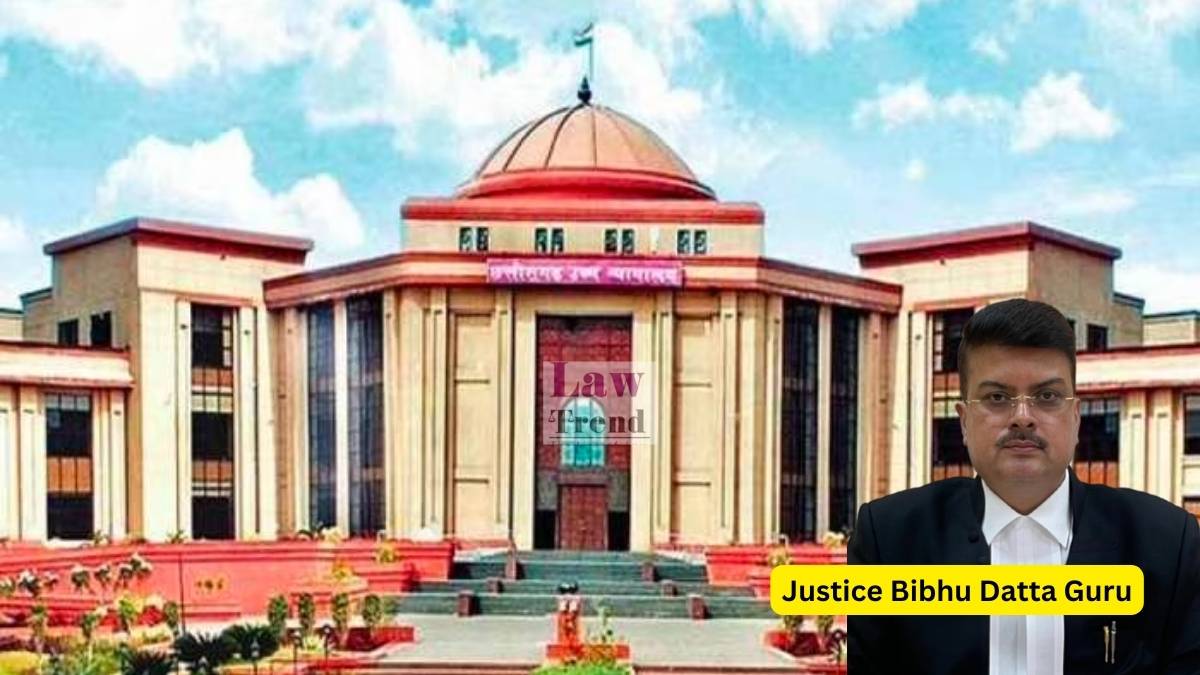
In a significant ruling affirming procedural fairness in departmental actions, the High Court of Chhattisgarh, presided over by Justice Bibhu Datta Guru, held that the statutory requirement of issuing a prior written proposal and affording a reasonable opportunity of hearing to an employee is mandatory before inflicting even a minor penalty. Setting aside a punishment order passed against an Assistant Draftsman, the Court clarified that considering an employee’s representation after the penalty has already been imposed cannot cure the initial denial of natural justice.
Background of the Case
The petitioner, Prabhawati Patel, serving as an Assistant Draftsman at the Rural Engineering Services, Division Korba, challenged an order dated June 11, 2026, passed by the Chief Executive Officer of the Zila Panchayat, Korba (Respondent No. 6). By the said order, a minor penalty of withholding one annual increment without cumulative effect was inflicted upon her.
The disciplinary action stemmed from a review meeting conducted on June 10, 2026, regarding the progress of certain construction works. The petitioner had compiled and placed progress information before the authorities during the meeting based on materials provided by field officials. Just within 24 hours of the meeting, on June 11, 2026, the competent authority passed the punishment order alleging discrepancies in the information presented. The petitioner subsequently submitted a representation on June 15, 2026.
Arguments Before the Court
Advocate Zainab Mustafa Vanak, appearing for the petitioner, contended that the impugned order was passed in gross violation of Rule 16(1)(a) of the Chhattisgarh Civil Services (Classification, Control and Appeal) Rules, 1966. She submitted that no written proposal containing the imputations of misconduct was ever served upon the petitioner, nor was any opportunity granted to her to explain the circumstances before imposing the penalty.
Relying on the decision of the Supreme Court in O.K. Bhardwaj v. Union of India (UOI) & Ors. (Civil Appeal No. 12774/1996), counsel urged that even in matters involving minor penalties, an employee must be afforded an opportunity to file an explanation regarding the charges, as this forms the minimum requirement of the principles of natural justice that cannot be dispensed with.
Opposing the petition, State counsel Shaleen Singh Baghel and Rahul Sahu, appearing for Respondent No. 6, argued that the petitioner bore the responsibility for presenting information before the competent authority, which was found to be incorrect. They submitted that such a lapse amounted to negligence in the discharge of official duties. The respondents asserted that in view of the nature of the lapse, the minor penalty did not warrant interference, especially since the petitioner’s subsequent representation was duly considered by the competent authority.
The Court’s Analysis
Addressing the core legal issue of whether a minor penalty could be imposed without adhering to the procedure under Rule 16 of the 1966 Rules, the Court underscored that the provision mandates informing the civil servant in writing of the proposal and imputations, followed by a reasonable opportunity to make a representation.
Highlighting the mandatory nature of this safeguard, the Court observed:
“The safeguard contained in Rule 16(1)(a) is not a mere procedural formality. The provision embodies the fundamental requirement of fairness that, before a penalty is imposed upon a Government servant, the employee must have an effective opportunity to meet the allegations and place his/her explanation before the disciplinary authority.”
The Court noted that the respondents failed to offer any explanation as to why no notice or hearing was provided prior to issuing the penalty within 24 hours of the review meeting. Rejecting the respondents’ contention that the petitioner’s post-penalty representation satisfied due process, the Court held:
“Such subsequent representation cannot be treated as compliance with Rule 16(1)(a). The statutory requirement is of an opportunity being afforded before the proposed penalty is imposed, so that the explanation furnished by the employee may be considered by the disciplinary authority while deciding whether any penalty is warranted and, if so, what penalty ought to be imposed.”
The Court further held that the minor nature of the penalty does not dilute statutory mandates:
“The fact that the penalty imposed is a minor penalty does not dispense with the mandatory requirement of Rule 16. Likewise, the contention that the alleged lapse was apparent from the proceedings of the review meeting cannot, by itself, substitute the statutory opportunity contemplated under Rule 16(1)(a).”
Emphasizing that the petitioner had disputed the factual basis of the allegations by stating the data was received from field officials, the Court noted that these contested aspects required consideration only after giving the employee an effective opportunity to present her stand.
Concluding that the failure to afford prior opportunity vitiated the entire proceedings, the Court held:
“The petitioner was neither informed in writing of the proposal to take disciplinary action against her along with the imputations of misconduct nor afforded a reasonable opportunity to submit her representation before the penalty was imposed. The subsequent representation submitted by the petitioner after passing of the impugned order cannot cure the aforesaid fundamental procedural infirmity.”
Decision
Finding the order unsustainable in law, the High Court allowed the writ petition and quashed the penalty order dated June 11, 2026, directing that consequential relief follow. The Court, however, granted liberty to the competent disciplinary authority to proceed afresh against the petitioner strictly in accordance with the 1966 Rules, if permissible in law.
Case Title: Prabhawati Patel v. State Of Chhattisgarh & Others
Case No.: WPS No. 6103 of 2026
Bench: Justice Bibhu Datta Guru
Date: September 23, 2026




